The search phrase Cheryl Hines daughter scars points to a dramatic story: Catherine Rose Young allegedly survived a serious accident that left visible scars. Yet the most important fact is also the least sensational. No credible, publicly available reporting confirms that Cheryl Hines’ daughter suffered the severe accident or scarring described by low-quality websites.
That does not prove Catherine has never experienced an injury, nor does the public have a right to every private medical detail. It means the viral narrative cannot currently be treated as fact. Reputable profiles document her family background, education, early screen appearances, business partnership with her mother, and public activities—but not the supposed life-changing crash repeated across questionable pages.
Cheryl Hines Daughter Scars: Key Takeaways
- Catherine Rose Young is Cheryl Hines’ only biological daughter, born in March 2004.
- Multiple websites describe an accident, but their timelines and details conflict.
- Some versions place the event in early childhood; others cite 2007, 2008, or 2019.
- Reliable profiles do not document a major crash that caused severe facial or bodily scars.
- Photographs cannot establish someone’s medical history, and appearance-based speculation should not replace sourced reporting.
- The responsible conclusion is that the widely circulated story remains unverified and likely fabricated. That distinction is the core of any accurate Cheryl Hines daughter scars article.
The phrase Cheryl Hines daughter scars therefore deserves a fact-check, not another rewritten rumor. Readers searching for a clear answer should distinguish between what has been published repeatedly and what has actually been verified.
Who Is the Person Behind the Cheryl Hines Daughter Scars Query?
Cheryl Hines’ daughter is Catherine Rose Young, often called Cat. She is the daughter of Hines and producer-manager Paul Young, who married in 2002 and later divorced. Catherine was born on March 8, 2004, and Hines has spoken publicly about their close relationship.
Catherine appeared in small roles when she was young, including projects connected to her mother’s career. She later graduated from high school, entered college, and became her mother’s business partner in the self-care company Hines + Young, launched in 2023.
More recent reporting has linked Catherine and Hines professionally through the short film Prowl. Those documented activities create a consistent, sourceable public timeline—quite different from the vague and contradictory accident stories attached to Cheryl Hines daughter scars.
Catherine Rose Young’s Verified Public Profile
The most reliable public information focuses on ordinary milestones rather than tragedy:
- She grew up with connections to the entertainment industry.
- She occasionally accompanied her mother to premieres and public events.
- She appeared in RV and The Grand as a child.
- She entered college after graduating from high school in 2022.
- She co-founded Hines + Young with Cheryl Hines.
- She later worked with her mother on Prowl.
These facts are documented in established profiles and entertainment coverage. None supports the claim that a widely reported catastrophic accident permanently scarred her. More importantly, major biographical coverage does not contain the detailed accident narrative that content-farm pages present as established history.
Where Did the Cheryl Hines Daughter Scars Story Come From?
The exact origin is difficult to identify because the rumor appears across a network of low-authority pages, copied summaries, social posts, and search snippets. An older social-media result promoted an article titled as though there were a known “story behind her scars,” but it did not provide the primary documentation expected for such a serious claim.
The rumor became more visible when websites began publishing articles targeting variations such as Cheryl Hines daughter accident, Catherine Rose Young accident, and Cheryl Hines daughter scars. Repetition then created an illusion of confirmation. Ten pages repeating one unsupported claim are not ten independent sources.
A 2025 fact-check found that different pages offered incompatible versions of the event. One claimed an accident when Catherine was two; others suggested a car crash in 2007, an incident involving a drunk driver in 2008, or an event in 2019. Those dates cannot all represent the same documented tragedy.
Contradictory Details Are a Major Warning Sign
When a real accident receives meaningful press attention, its basic facts normally become relatively stable:
- When did it happen?
- Where did it occur?
- Who confirmed it?
- Was there a police, hospital, family, or representative statement?
- Which reputable outlet reported it first?
The Cheryl Hines daughter scars rumor fails this test. The date changes. The cause changes. The injuries change. Some articles use emotionally charged language but provide no named source, direct quotation, official record, or traceable original report.
That pattern frequently appears in fabricated celebrity content. A page begins with a search-friendly claim, adds generic passages about trauma, courage, and resilience, and finishes without producing evidence that proves its central story.
One particularly revealing page published in 2026 contained unresolved placeholders such as “[specific date]” and “[age]” while describing the alleged accident as fact. Such placeholders strongly suggest that the article was produced from an unfinished template rather than verified reporting.
Is There Evidence Behind Cheryl Hines Daughter Scars?
There is no reliable public evidence confirming the specific severe scars described by rumor-driven articles. That is the precise answer. It is stronger and more responsible than declaring private medical facts that Catherine herself has not publicly established.
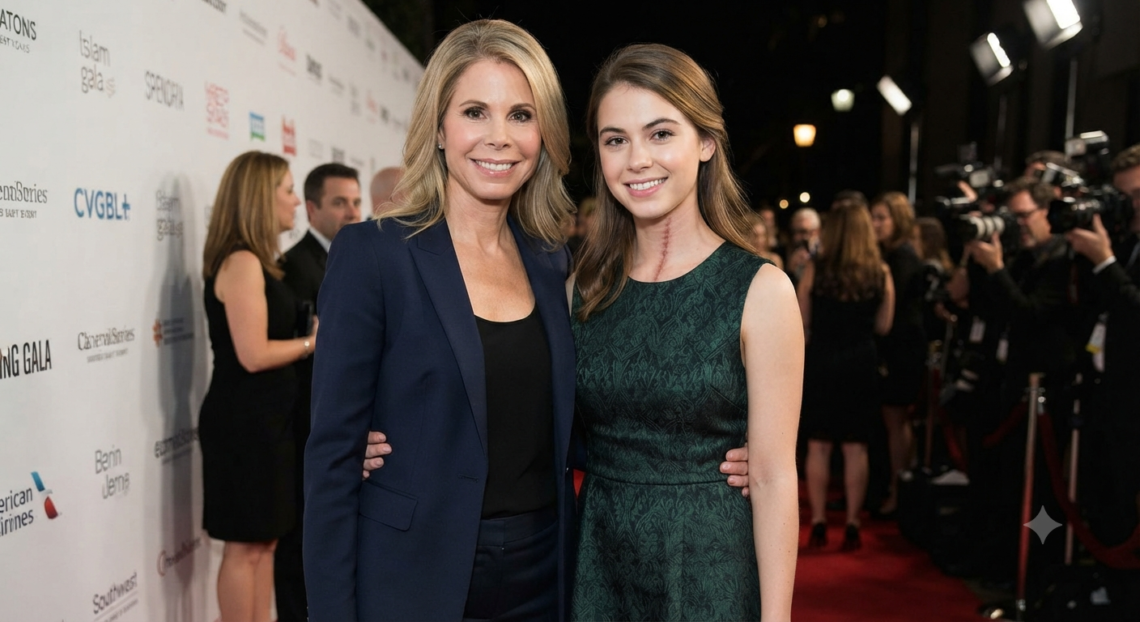
It is also important not to “investigate” a person’s body through red-carpet photographs. Lighting, makeup, camera resolution, image editing, clothing, and angles all influence what viewers think they see. A photograph is not a medical record, and the absence or presence of a visible mark does not prove the circumstances of an alleged accident.
For that reason, a credible article about Cheryl Hines daughter scars should not zoom into pictures, label natural skin features, or speculate about surgery. It should examine sourcing. On that standard, the Cheryl Hines daughter scars story lacks support.
No Public Confirmation Is Not the Same as Invading Privacy
There are two separate points:
- The viral accident story is not credibly verified.
- Catherine is not obligated to disclose private health information.
Both can be true at once. Responsible reporting does not demand that a public figure’s adult daughter release medical records to disprove internet gossip. The burden of proof belongs to the websites making the dramatic claim.
It would also be inaccurate to state categorically that Catherine has never had an accident or scar of any kind. Almost everyone experiences injuries at some point. The narrower, evidence-based finding is that there is no reliable confirmation of the severe, widely publicized accident described by online rumor pages.
Why Cheryl Hines Daughter Scars Keeps Ranking in Search Results
Search engines use numerous systems and signals to locate and rank relevant pages. When many publishers create pages around the same long-tail query, an unsupported claim can become highly visible even when the underlying evidence remains weak. Google itself emphasizes helpful, reliable, people-first material rather than pages created primarily to attract search traffic.
The Cheryl Hines daughter scars query is especially attractive to content farms because it contains a celebrity name, a family relationship, and a medical or appearance-related hook. That combination creates curiosity and emotional urgency.
The Search-Demand Loop
The process may unfold like this:
- A vague or fabricated page introduces a claim.
- Users encounter the phrase and search it again.
- Keyword tools register increased interest.
- More publishers target the same wording.
- Search results become crowded with derivative articles.
- Readers assume that volume equals verification.
This is a search-demand loop, not proof. The growth of the keyword Cheryl Hines daughter scars may demonstrate curiosity about the rumor, but it does not validate the underlying story.
A publisher may even find the keyword in an SEO tool without knowing where it originated. The publisher then commissions an article, the writer relies on existing search results, and the finished page repeats claims drawn from equally unverified competitors.
AI-Generated Content Can Multiply Unsupported Claims
Some misleading pages display common signs of automated or poorly supervised production: placeholder text, inconsistent dates, generic safety advice, invented-sounding quotations, and conclusions that contradict their introductions.
One page may initially state that an accident definitely happened, then later acknowledge that no credible evidence supports it. Another may switch between a car crash, childhood injury, and unspecified “incident” without explaining the inconsistency.
Generative tools can reproduce a false premise confidently when prompted to write everything “known” about it. Once the output is published, it may become apparent source material for another page. Google warns that generating many pages without adding meaningful value can violate its policies against scaled content abuse.
The resulting citation chain can look extensive while tracing back to no reliable original source.
What Reputable Sources Say About Cheryl Hines Daughter Scars
A detailed profile published by People identifies Catherine as Hines’ daughter with Paul Young and describes her upbringing, her closeness with her mother, her childhood interest in performing, her education, and the creation of Hines + Young. It does not report the supposed severe accident behind Cheryl Hines daughter scars.
The profile explains why Hines wanted to start a company with Catherine. Her daughter was leaving for college, and the project offered a way to remain connected while empowering Catherine as a young woman.
That account is specific and attributed. It includes dates, direct comments, documented family milestones, and identifiable activities rather than an anonymous claim about an unspecified tragedy.
Later reporting has continued to describe Catherine as a college student, business partner, and emerging performer. A 2025 profile in The Wall Street Journal noted that Hines and her daughter had shot the short film Prowl. Again, this documented timeline contains no corroboration for the viral crash narrative.
The omission alone cannot prove that no private incident ever occurred. It does, however, undermine websites claiming that a catastrophic accident “captured public attention” or became a defining, widely reported chapter in the family’s life.
What the Cheryl Hines Daughter Scars Search Gets Wrong
The search query assumes its own conclusion. It does not ask whether Catherine has scars or whether an accident occurred. It treats both points as established and asks users to discover the backstory.
This is called a false-premise query. Other examples include questions that assume a celebrity has died, divorced, committed a crime, undergone surgery, or received a diagnosis when none of those claims has been verified.
A responsible writer should not accept the premise merely because a keyword has search volume. The article must first test whether the underlying event occurred.
For Cheryl Hines daughter scars, the evidentiary sequence should be:
- Establish Catherine’s identity.
- Locate the earliest accident report.
- Identify direct confirmation.
- Compare dates and descriptions.
- Search reputable archives and profiles.
- State clearly when the evidence is insufficient.
The rumor fails before the final step because no trustworthy original accident report has surfaced.
How to Fact-Check Celebrity Accident and Scar Stories
The safest approach is not to trust the first page that matches the keyword. Use a repeatable verification method.
1. Find the Earliest Traceable Report
Look for the first publication that provided a date, location, source, and circumstances. If every article cites another vague article—or cites nothing—the claim is structurally weak.
Check publication dates carefully. A page written years after the alleged event should explain how it obtained its information and why no contemporary coverage is available.
2. Prioritize Primary or Near-Primary Sources
Strong evidence could include:
- A statement from the person involved
- A family or representative’s confirmation
- A verified social-media account
- A police or public-agency record
- A court filing
- A reputable publication with named reporting
Anonymous biography blogs do not become reliable simply because they appear prominently in search results.
3. Compare the Timeline
For Cheryl Hines daughter scars, the alleged date changes across articles. Timeline conflict is not a minor typo when the central claim concerns a major accident.
A credible publisher would investigate the discrepancy and explain it. A content farm is more likely to select whichever date appears in the page it is currently rewriting.
4. Check Whether Reputable Biographies Mention It
A life-altering event said to have “captured public attention” would normally appear in at least some serious profiles, interviews, archives, or contemporary entertainment coverage.
Its absence does not mathematically disprove the event. It strongly weakens claims that the incident was famous, extensively reported, or publicly discussed by the family.
5. Separate Evidence From Emotional Language
Words such as tragic, heartbreaking, brave, inspiring, and miraculous create emotional momentum. They do not answer who confirmed the event.
Remove the adjectives and examine what remains. In many rumor-driven articles, almost nothing verifiable survives.
6. Do Not Use Photographs as Medical Evidence
A person may have a scar that is not visible in a particular picture. A mark visible in one image may have numerous explanations unrelated to a dramatic accident.
Unless the person has publicly discussed the mark, responsible writers should not diagnose, identify, or invent its cause.
Why Ethical SEO Matters for This Topic
Celebrity SEO can produce traffic without producing truth. A publisher may be tempted to turn Cheryl Hines daughter scars into an emotional recovery story because that angle promises clicks. Doing so without evidence risks spreading misinformation about a real person’s body and medical history.
E-E-A-T is not achieved by adding a biography table, a long introduction, or several generic external links. For a sensitive topic, genuine trustworthiness requires transparent sourcing, careful wording, and clear limits on what is known.
Google’s own guidance says trust is the most important component within E-E-A-T and encourages publishers to make the who, how, and why of their content clear. The “why” should be helping readers—not merely attracting visits from a trending query.
A high-quality page should therefore:
- State the verified answer early.
- Identify conflicting claims without sensationalizing them.
- Link claims to reputable coverage.
- Avoid diagnosing scars from photographs.
- Correct misinformation rather than decorating it.
- Include an author and editorial review process.
- Update the page if credible direct evidence emerges.
This approach offers substantially more value than competitors that merely rewrite the rumor. It also satisfies the actual search intent: readers want to know what happened, and the evidence-based answer is that the commonly circulated account has not been substantiated.
Cheryl Hines and Catherine Rose Young’s Relationship
The public record portrays Hines and Catherine as close. Hines has discussed balancing motherhood with work, while profiles have documented Catherine accompanying her to sets, premieres, family activities, and later business projects.
Their company, Hines + Young, turned that relationship into a formal partnership. Hines said the idea developed as Catherine prepared to leave home for college, giving them a meaningful project to share while Catherine built an independent adult life.
That real mother-daughter story is more specific—and ultimately more interesting—than the unsupported Cheryl Hines daughter scars narrative. It includes parenting, education, entrepreneurship, entertainment-industry exposure, and collaborative filmmaking.
Frequently Asked Questions
Did Cheryl Hines’ daughter have a serious accident?
No credible public report confirms the major accident described by rumor-focused websites. The stories provide conflicting years and causes, while reputable profiles of Catherine do not document such an event.
The most accurate wording is that the alleged accident remains unverified. It should not be presented as established fact.
What caused Cheryl Hines’ daughter’s scars?
There is no reliable public evidence establishing that Catherine Rose Young has the severe scars alleged online, so no verified cause can be given.
Articles assigning the supposed injuries to a car crash, drunk driver, childhood incident, or later accident without traceable sourcing should not be treated as factual.
Who is Cheryl Hines’ biological daughter?
Her biological daughter is Catherine Rose Young, born in 2004 to Cheryl Hines and her former husband, Paul Young.
Catherine has appeared at public events, acted in small childhood roles, attended college, co-founded Hines + Young, and worked with her mother on Prowl.
Why are there so many articles about Cheryl Hines daughter scars?
The query appears to have spread through repetition, search demand, content-farm publishing, and automated rewriting. Multiple pages can make a claim appear established even when they recycle the same unsupported premise.
Conflicting timelines, missing primary sources, placeholder language, and vague descriptions are among the clearest warning signs.
Is it possible the family kept an accident private?
Yes. Any family may keep personal events and medical information private.
However, that possibility cannot be used as proof that a specific online story is true. Publishers claiming a severe, publicly discussed accident must provide evidence; readers should not be asked to accept speculation merely because an undisclosed private event is theoretically possible.
Conclusion: Treat the Story as Unverified, Not Established Fact
The available evidence does not support presenting Cheryl Hines daughter scars as a confirmed accident-and-recovery story. Credible profiles identify Catherine Rose Young and document her education, public appearances, business partnership with her mother, and acting work, but they do not corroborate the dramatic claims circulated by low-quality pages.
The next step is simple: check the original source before publishing or sharing the rumor. Look for a named reporter, a consistent date, direct confirmation, contemporaneous reporting, and independent coverage from reputable outlets.
Until such evidence exists, describe the claim accurately—as an unverified internet story, not a fact about Catherine Rose Young’s life, health, or body.