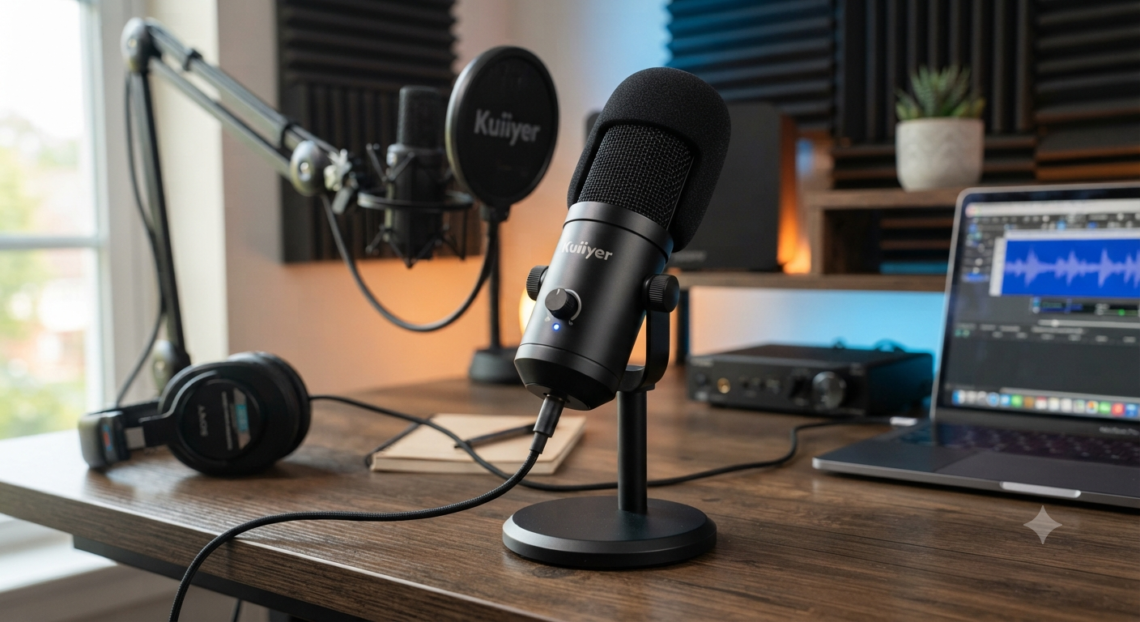
The Kuiiyer microphone is attracting attention as an affordable wireless audio system for teachers, presenters, interviewers, fitness instructors, churches, small events, and beginner content creators. The name, however, does not refer to one universally documented product. Current marketplace listings most consistently point to the Kuiiyer E328, a dual-channel UHF system supplied with two bodypack transmitters, headset microphones, lavalier microphones, and a compact receiver.
That distinction matters. Some online pages use “Kuiiyer microphone” for the E328, others show the E317B, and still others refer to handheld karaoke products. A useful review must therefore separate verified listing information from assumptions, explain how this type of wireless system works, and show buyers what to check before ordering.
Quick Verdict: Is the Kuiiyer Microphone Worth Considering?
For speech, instruction, interviews, presentations, worship services, demonstrations, and entry-level video work, the Kuiiyer microphone can be a practical budget option. Its strongest selling point is flexibility: one kit may support two speakers and let each person choose between a discreet lapel mic and a more stable headset.
It is not automatically the best choice for professional filmmaking, broadcast production, touring musicians, or buyers who require published RF specifications, extensive support, and proven long-term reliability. The limited official documentation and inconsistent marketplace data mean the safest approach is to buy from a seller with clear photos, a complete specifications page, and a strong return policy.
Key takeaways:
- The Kuiiyer microphone is best suited to spoken-word applications and small sound systems.
- The E328 is commonly listed as a dual-channel UHF wireless kit.
- Marketplace descriptions claim compatibility with PA speakers, mixers, amplifiers, computers, tablets, and phones through suitable connections or adapters.
- Real-world performance will depend heavily on microphone placement, gain settings, local radio-frequency conditions, and the quality of the connected speaker or recording device.
- Buyers should verify the exact model, operating frequencies, included adapters, battery type, connector format, and local spectrum rules before purchase.
What Is the Kuiiyer Microphone?
The most visible version is the Kuiiyer E328, described by marketplace sellers as a two-person wireless microphone system. Listings show a compact receiver, two bodypack transmitters, two headset microphones, and two lavalier microphones. The receiver is designed to connect to sound equipment through a quarter-inch-style microphone input, while some listings say an included adapter can support recording with phones, tablets, and computers.
Another listing identifies the E317B as a related wireless headset and lavalier model with a 6.3 mm output and Micro-USB connectivity. Yet that page also displays technically questionable frequency fields, which is a reminder that marketplace specification tables can contain translation or data-entry errors.
The phrase Kuiiyer microphone should therefore be treated as a product-family search term, not a guarantee that every listing includes the same hardware. Always match the model number and package contents rather than relying only on the title.
Kuiiyer E328 Specifications at a Glance
The following overview combines the most consistent information found across current E328 listings. Seller claims can change, so treat this as a pre-purchase checklist rather than an official engineering datasheet.
| Feature | Commonly listed detail | What it means in practice |
|---|---|---|
| Wireless format | Digital UHF | Designed to avoid dependence on crowded 2.4 GHz Wi-Fi channels |
| Channels | Dual channel | Two people can speak through one receiver |
| Microphone options | Two lavaliers and two headsets | Each user can choose visibility or stability |
| Transmitters | Two bodypacks | Worn on a belt, waistband, or pocket |
| Receiver output | Universal 1/4-inch connection | Intended mainly for mixers, PA speakers, amplifiers, and karaoke systems |
| Claimed range | Up to 60 metres | Best-case seller claim; walls, people, metal, and interference can reduce it |
| Suggested uses | Teaching, speeches, conferences, interviews, recording, vlogging, churches | Strongest for voice rather than critical studio recording |
| Power | Rechargeable lithium-ion is listed for the E328 | Confirm the exact charging method and runtime with the seller |
Marketplace descriptions promote a transmission distance of up to 60 metres and state that UHF operation reduces the chance of interference from Bluetooth or Wi-Fi. Those are seller claims rather than independent laboratory results, so buyers should expect shorter range in difficult rooms or crowded RF environments.
How the Kuiiyer Microphone System Works
A wireless system has three essential stages: the microphone capsule captures the voice, the bodypack transmitter converts and sends the signal, and the receiver delivers that audio to a speaker, mixer, amplifier, camera interface, or recording device. With the Kuiiyer microphone, two transmitters can feed one dual-channel receiver, allowing two users to speak without sharing a handheld mic.
The lavalier option clips to clothing and keeps the speaker’s hands free. The headset sits closer to the mouth, which usually creates a more consistent level when the user turns their head, walks, teaches, exercises, or demonstrates a product.
UHF does not mean “interference-proof.” Professional wireless guidance recommends keeping a clear line of sight between transmitters and receiver antennas and avoiding walls, metal objects, and dense groups of people where possible. Maximum usable distance varies with transmitter power, receiver sensitivity, obstacles, reflections, and nearby RF activity.
Sound Quality: What Should You Realistically Expect?
The Kuiiyer microphone is better evaluated as a speech and utility system than as a studio vocal microphone. For lectures, classes, interviews, sermons, livestreams, and basic videos, the main goal is intelligibility: the voice should be louder, closer, and easier to understand than audio captured from a distant phone or laptop microphone.
Do not expect the same noise floor, frequency accuracy, dynamic range, RF coordination, construction quality, or post-production flexibility offered by established professional wireless systems. No independent technical test data or official frequency-response graph was found for the E328 during research, so claims such as “crystal-clear sound” should be read as marketing language rather than measured proof.
The connected equipment also shapes the result. A clean mixer preamp and well-positioned PA speaker can make a modest wireless mic sound useful, while a noisy amplifier, overloaded phone adapter, incorrect input type, or excessive gain can make even a good microphone sound harsh.
Lavalier Versus Headset Audio
Use the lavalier when appearance matters and the speaker will remain relatively still. Place it near the upper chest, typically around sternum or breast-pocket level, while keeping it away from necklaces, loose fabric, zippers, and hair that can scrape the capsule. Shure’s presenter guidance similarly recommends chest-level placement and warns that mounting too high can sound muffled while mounting too low reduces voice level.
Use the headset when consistent loudness matters more than invisibility. It is usually the better choice for fitness instruction, energetic teaching, stage movement, cooking demonstrations, public speaking, and worship leaders because the mic-to-mouth distance stays more stable.
Device Compatibility: Check the Input Before Buying
A common mistake is assuming that a wireless receiver will connect directly to every phone, laptop, camera, Bluetooth speaker, or television. The Kuiiyer microphone E328 is primarily advertised for devices with a quarter-inch microphone input, including PA systems, mixers, amplifiers, and karaoke equipment. One listing also says phone and computer recording is possible with an included adapter.
That does not guarantee plug-and-play operation with every device. A 6.35 mm plug, 3.5 mm TRS socket, 3.5 mm TRRS phone port, USB-C port, Lightning port, and camera microphone input are electrically and physically different.
Before ordering, confirm:
- Connector size: Is the receiver 6.35 mm, 3.5 mm, USB-C, or another format?
- Input type: Does your device have a true microphone input, or only an auxiliary line input?
- Phone adapter: Does it support microphone input, not just headphone output?
- USB-C or Lightning interface: Is an active digital audio adapter required?
- Mono or stereo behavior: Will both wireless channels be combined into one mono signal?
- Monitoring: Can you hear the live signal through headphones without delay?
- Power: Can the receiver operate while charging if the session runs long?
When a seller says “compatible with smartphones,” ask for a photo or diagram showing the exact cable chain. This simple step prevents many return-worthy problems with a Kuiiyer microphone.
How to Set Up the Kuiiyer Microphone Correctly
The setup process should be straightforward, but proper gain staging matters more than most buyers realize.
- Charge every component fully. Confirm that both bodypacks and the receiver show normal battery status.
- Turn down the speaker or mixer channel. Starting at low volume protects the audience and equipment from sudden pops or feedback.
- Connect the receiver to a microphone-level input. Use the correct adapter only when necessary.
- Attach one microphone to each bodypack. Seat the plugs firmly so movement does not create crackling or dropouts.
- Power on the receiver and transmitters. Confirm that each channel is paired and passing audio.
- Position the microphones. Keep a lavalier near the upper chest or place the headset capsule near the corner of the mouth without touching the skin.
- Raise input gain gradually. Speak at the loudest expected level and stop before clipping or distortion.
- Set speaker volume after the input level is stable. Do not compensate for poor mic placement by pushing excessive gain.
- Walk-test the room. Check for dropouts at the stage edges, behind furniture, and near metal structures.
- Record a short sample. Listen through headphones for hum, clothing noise, digital artifacts, and uneven levels.
Before an important event, repeat the test with the Kuiiyer microphone in the actual room. This process gives the Kuiiyer microphone a fair chance to perform. Most “bad microphone” complaints begin with incorrect inputs, weak batteries, loose connectors, poor placement, or excessive gain.
Reducing Feedback, Noise, and Wireless Dropouts
Feedback occurs when amplified sound from the speaker re-enters the microphone and loops through the system. The quickest fixes are to move the microphone closer to the voice, move the loudspeaker farther from the microphone, lower unnecessary gain, and mute unused channels. These are standard live-sound practices recommended by Shure.
For cleaner operation:
- Keep the receiver visible to the bodypacks when possible.
- Avoid placing the receiver directly beside large metal surfaces, routers, power supplies, or tangled cable bundles.
- Keep loudspeakers in front of the presenters, not behind them.
- Use the headset for soft-spoken or highly mobile users.
- Mute the unused transmitter rather than leaving two open microphones active.
- Keep lavalier capsules away from clothing friction.
- Replace or recharge batteries before important sessions.
- Perform a test in the actual venue, not only at home.
The Kuiiyer microphone may work well in a quiet classroom yet struggle in an exhibition hall full of wireless equipment. Venue testing is more meaningful than a range number printed on a listing.
Best Uses for the Kuiiyer Microphone
Teaching and Training
A dual-user kit suits co-teaching, workshops, demonstrations, and question-and-answer sessions. The headset option is especially useful when the instructor writes on a board, handles equipment, or moves around the room.
Churches and Small Events
For sermons, announcements, readings, and interviews, the Kuiiyer microphone offers hands-free operation without the cost of two separate receiver systems. It should be tested carefully near stage monitors and large PA speakers.
Fitness and Movement-Based Instruction
A headset generally outperforms a clothing-mounted lavalier when the user turns, bends, or exercises. Secure the bodypack against sweat and impact, and verify that the microphone and connectors are not advertised as water-resistant unless the seller explicitly documents it.
Interviews, Podcasts, and Video
Two lavaliers can simplify seated interviews and beginner video production. For serious production, however, record a backup source because budget wireless systems may not offer onboard recording, safety tracks, timecode, or recoverable audio when RF dropouts occur.
Karaoke and Casual Performance
The E328 format can support speech and light vocal use through a compatible amplifier, but singers who need strong stage rejection, rugged handheld construction, and predictable frequency response may be better served by a purpose-built handheld wireless system.
Limitations and Buying Risks
The largest concern is not a single negative specification. It is documentation uncertainty. Search results show multiple Kuiiyer models and inconsistent marketplace fields, while no comprehensive official E328 manual or manufacturer specification page was clearly identifiable during research.
Consider these risks before buying:
- Model numbers and included accessories may vary between sellers.
- Claimed range may reflect ideal conditions.
- Frequency information may be incomplete or incorrectly entered.
- Phone compatibility may depend on adapters not shown clearly.
- Warranty and replacement support may depend entirely on the marketplace seller.
- Battery runtime may differ by revision or package.
- The operating band may not be legal or interference-free in every country.
Wireless microphone rules are location-specific. In the United States, for example, the FCC restricts or prohibits operation in certain bands and advises users to understand which frequencies are permitted. Buyers elsewhere should check the relevant national spectrum regulator rather than assuming that any UHF product is universally legal.
Kuiiyer Microphone Versus Common Alternatives
Choose a basic USB microphone when one seated person records at a computer and maximum simplicity matters. It will usually provide more predictable digital connectivity but no wireless movement.
Choose a 2.4 GHz phone lavalier kit when the main destination is USB-C or Lightning video recording. These systems are often easier for mobile creators, although 2.4 GHz shares spectrum with Wi-Fi and can be more challenging in crowded environments.
Choose the Kuiiyer microphone when two people need affordable, hands-free wireless audio into a PA, mixer, amplifier, or compatible recording chain. Its combination of two bodypacks, headset options, and lavaliers is the central value proposition.
Choose a professional UHF or digital wireless platform when reliability, frequency coordination, replaceable components, detailed specifications, service support, onboard recording, or mission-critical operation justifies the higher price.
How to Buy the Right Kuiiyer Microphone Listing
Do not choose solely by the lowest price. Compare the evidence shown on each product page.
Look for:
- A visible model number, preferably E328 if that is the system you intend to buy.
- Clear package photos showing two bodypacks, two lavaliers, two headsets, the receiver, charging cables, and adapters.
- Exact operating frequencies or tuning range.
- Battery capacity, expected runtime, and charging time.
- Receiver output type and phone or computer adapter details.
- A seller-supported return window.
- Recent customer photos and reviews that match the listed hardware.
- Written confirmation that both channels work simultaneously.
- Local plug, charging, and frequency compatibility.
A trustworthy listing should answer technical questions directly. If the seller cannot confirm the operating frequency or connector path, the risk is not worth a small discount.
Final Verdict
The Kuiiyer microphone, particularly the E328 dual-channel UHF package, appears designed for buyers who need two-person, hands-free wireless speech at a modest cost. Its mix of lavalier and headset microphones makes it versatile for classrooms, churches, training sessions, interviews, fitness instruction, presentations, and casual content creation.
Its weakness is uncertainty. Specifications vary across listings, independent test data is scarce, and compatibility depends on the exact receiver, adapters, and destination device. The smartest next step is to identify your required input, request the operating-frequency details from the seller, verify every included accessory, and buy only from a listing with a reliable return policy.
Frequently Asked Questions
Is the Kuiiyer microphone good for YouTube videos?
The Kuiiyer microphone can be useful for beginner YouTube interviews, tutorials, demonstrations, and talking-head videos, especially when two speakers need separate wearable microphones. Confirm that your camera or phone can accept the receiver output, record a test before filming, and keep a backup audio source for important shoots.
Does the Kuiiyer E328 work with smartphones?
Some E328 listings claim smartphone, tablet, and computer compatibility through an included adapter, but this does not guarantee support for every USB-C, Lightning, or 3.5 mm device. Verify the exact adapter, microphone-input standard, and recording app before purchasing.
How far can the Kuiiyer microphone transmit?
Marketplace descriptions claim up to 60 metres for the E328 under favorable conditions. Real range can be shorter because of walls, metal, crowds, antenna placement, interference, and receiver location, so test the system in the intended venue rather than relying on the maximum figure.
Is a headset or lavalier better with this system?
A lavalier is more discreet and works well for seated interviews or calm presentations. A headset usually provides more consistent volume for instructors, performers, fitness coaches, and speakers who move frequently because the capsule remains close to the mouth.
Can the Kuiiyer microphone be used professionally?
It may be adequate for low-risk paid work, small events, internal corporate videos, and basic presentations after thorough testing. For weddings, broadcasts, live productions, or any event where lost audio cannot be repeated, a professional wireless system with documented frequencies, stronger support, and backup recording is a safer investment.