Dita Sandico is one of the most distinctive figures in Philippine fashion, known for transforming indigenous fibers, traditional weaving techniques, and Filipino cultural references into contemporary clothing with international appeal. Today, she officially presents her name and fashion label as Ditta Sandico, while the spelling “Dita Sandico” has also appeared in earlier articles and continues to be widely searched online.
Her significance goes far beyond designing beautiful clothes. Over a career spanning roughly four decades, Sandico has connected fashion with sustainability, indigenous craftsmanship, Filipino identity, social enterprise, and material innovation—long before responsible fashion became a mainstream industry conversation.
That combination explains why her work deserves attention today. She did not simply borrow traditional textiles for visual effect. She built long-term relationships with weaving communities, experimented with difficult natural fibers, developed new applications for Philippine materials, and helped move indigenous fabrics from provincial looms onto runways and international platforms.
Who Is Dita Sandico?
Dita Sandico, professionally known today as Ditta Sandico, is a Filipina fashion designer, entrepreneur, textile innovator, visual artist, and advocate for indigenous craftsmanship. Government sources identify her by her fuller name, Maria Fernandina “Ditta” R. Sandico, and recognize her for creating fashion using Philippine materials such as abaca, cotton, and piña.
Her fashion philosophy is rooted in a simple but unusually durable idea: clothing should carry more than aesthetic value. Sandico views fashion as a way to preserve cultural knowledge, support the people who create textiles, encourage responsible consumption, and reinterpret heritage for contemporary life. Her official biography explicitly describes her mission as creating timeless pieces from organic indigenous fabrics while promoting local natural resources and supporting producing communities.
That philosophy has given her a recognizable niche in modern Filipiniana fashion. Instead of treating Filipino dress as something reserved exclusively for ceremonies, she has explored ways to make indigenous materials adaptable, sculptural, portable, and relevant to modern wardrobes.
The Early Influences Behind Dita Sandico
The foundations of Dita Sandico’s career appeared well before she became a professional designer. Fashion entered her life through her mother, who worked in merchandising at Manila COD, while her father introduced her to indigenous communities and traditional textiles.
Sandico has recalled visiting Mangyan communities in Mindoro from around the age of 11. There, she observed women working with fibers and weaving fabric by hand—an experience that helped shape her fascination with textiles and the people behind them.
This distinction matters. Her relationship with indigenous weaving did not begin as a late-career sustainability strategy.
It grew from years of direct exposure.
Sandico later studied fashion merchandising at the Tobe-Coburn School in New York and began her professional retail career through the family-owned COD department store. By the mid-1980s, she was increasingly looking toward Philippine regions and traditional weaving practices for design inspiration.
How Dita Sandico Built a Career Around Philippine Textiles
The trajectory of Dita Sandico can be understood as a continuous process of material experimentation. Rather than choosing one traditional textile and repeating it indefinitely, she worked with different weaving communities and explored how regional fabrics could function in modern clothing.
One early chapter involved abel Iloko, the handwoven textile tradition associated with northern Luzon. She worked with Ilocano weaving and eventually developed relationships with artisans maintaining patterns and techniques passed through generations.
She also explored piñalino, which combines piña with linen, working with weavers associated with Elisa Reyes in Bulacan. These experiments expanded the range of indigenous and natural materials she could translate into dresses, formal garments, and barong-inspired designs.
Then came the material that would become closely associated with her name.
Abaca.
Dita Sandico and the Creation of Banaca
The defining material in the Dita Sandico story is banaca, the name Sandico gave to a textile associated with banana and abaca fibers. Her own account explains the terminology through abaca’s botanical relationship with the banana family: abaca is Musa textilis, a plant belonging to the Musaceae family.
The breakthrough did not begin with a luxurious fabric. Sandico encountered rough abaca samples from Virgilio Apanti of Catanduanes and saw potential where others might have seen stiffness and limitations. Working with artisans in Baras, Catanduanes, the material was developed to become more pliable, colorful, and suitable for fashion applications.
Vogue Philippines notes that by 2000 she was pioneering the use of banana-abaca fabric from Catanduanes in her multifunctional wraps. Those wraps became an important part of her commercial and visual identity.
This is where Sandico’s contribution becomes especially interesting from a design perspective. She was not merely decorating conventional garments with ethnic motifs.
She was changing what the material itself could do.
Why Banaca Became Her Signature
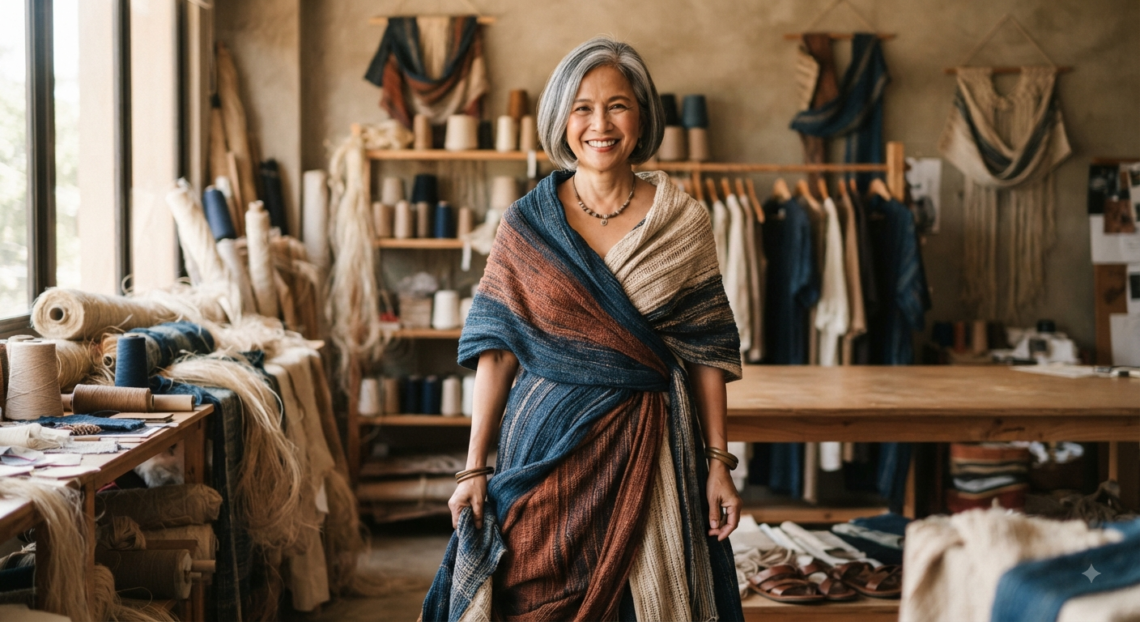
Banaca gave Dita Sandico a material with enough structure to hold dramatic shapes while remaining adaptable enough to fold, wrap, twist, and layer around the body. That physical behavior helped create her signature sculptural aesthetic.
The result was the Ditta Wrap, a versatile piece that could be styled in multiple ways rather than worn as one fixed garment. This was particularly useful for women who needed formal or national dress while traveling; Vogue reported that the wraps gained popularity among members and spouses of the Filipino diplomatic community because they were easier to transport and restyle than a full traditional terno.
The innovation was practical and cultural at the same time.
Instead of asking women to choose between heritage and convenience, the wrap brought both ideas into one product.
The Materials That Define Dita Sandico’s Design Language
Although banaca receives the most attention, Dita Sandico has worked across a broader ecosystem of Philippine fibers and textiles. Her design vocabulary has included abaca, piña-based fabrics, cotton weaving, piñalino, abel Iloko, Mangyan textiles, and experimental combinations of natural and modern fibers.
Several recurring elements define her approach:
- Banaca and abaca: structural natural materials strongly associated with her wraps and sculptural garments.
- Mangyan weaving and embroidery: indigenous craftsmanship connected to her longstanding relationship with communities in Mindoro.
- Abel Iloko: northern Philippine handwoven cotton traditions incorporated into contemporary fashion.
- Piña and piñalino: delicate fibers used for more refined formal garments and Filipino dress.
- Zero-waste reuse: fabric remnants at her atelier have been repurposed into items such as bags and visors rather than automatically discarded.
- Modern Filipiniana silhouettes: traditional references are reshaped into separates, wraps, accessories, sculptural pieces, and wearable contemporary forms.
That material diversity is an important part of her longevity. It has allowed Sandico to remain recognizably Filipino without reducing Philippine fashion to a single fabric or silhouette.
Dita Sandico, the Mangyan, and Community-Based Fashion
Perhaps the most important part of the Dita Sandico legacy is her relationship with weaving communities.
The Mangyan people of Mindoro have been particularly influential. Sandico’s childhood exposure to Mangyan weaving developed into continuing collaboration, while her later fashion work incorporated textiles, embroidery, and craftsmanship from indigenous artisans.
Her work has also involved artisans in Catanduanes, Ilocos, and Bulacan. By connecting weaving with commercial fashion, she helped create demand for skills that can otherwise struggle against industrially manufactured textiles and fast-fashion economics.
The relationship is significant because sustainable fashion is not solely an environmental question.
It is also an economic one.
A fabric may be natural, but genuine responsible design must still consider who produces it, whether traditional skills remain economically viable, how artisans participate in the value chain, and whether cultural knowledge can be transferred to future generations. Sandico’s career is valuable as a case study precisely because it connects those questions.
Is Dita Sandico a Sustainable Fashion Designer?
Yes. Dita Sandico is widely associated with sustainable and environmentally conscious Philippine fashion, although her model predates much of the vocabulary now used by the global sustainability industry.
Her official fashion philosophy emphasizes organic and indigenous fabrics, responsible production, longevity, and support for textile-producing communities. Her atelier has also described operating a zero-waste policy in which leftover fabric is reused for accessories rather than treated purely as waste.
This places her work close to several ideas now central to sustainable fashion: local sourcing, craft preservation, slower production, material longevity, waste reduction, artisan empowerment, and alternatives to disposable trend cycles.
Yet there is an important nuance. No garment should automatically be called environmentally perfect simply because it uses natural fiber.
The stronger argument is that Sandico represents a slower, community-linked design model in which the origin, maker, cultural context, and useful life of a textile receive substantially more attention than they generally do in mass-market fashion.
Modern Filipiniana Without Turning Heritage Into Costume
Another reason Dita Sandico remains relevant is her approach to Filipiniana.
Traditional national dress carries tremendous symbolic value, but designers face a difficult challenge: how do you preserve recognizable Filipino identity without freezing it in a historical form?
Sandico’s answer has often been modularity.
Her wraps, sculptural separates, layered garments, embroidered details, and natural-fiber accessories allow Filipino references to function within changing lifestyles. Vogue’s profile of the designer emphasized her effort to introduce the work to younger audiences as modern Filipiniana increasingly appeared in jackets, casual pieces, and other everyday formats.
That evolution matters because cultural preservation does not always mean keeping an object unchanged.
Sometimes survival requires adaptation.
International Recognition and the Global Reach of Dita Sandico
The work of Dita Sandico has traveled well beyond the Philippines. A 2026 retrospective on her career reported presentations of Philippine weaves in fashion centers and international destinations including Paris, Rome, Helsinki, Dubai, Los Angeles, New York, Moscow, Amsterdam, Tokyo, and Kuala Lumpur.
Her involvement in Philippine textile advocacy has also been recognized domestically. The Philippine Information Agency identified Maria Fernandina “Ditta” Sandico as a featured designer at the 2023 National Fibercrops Summit and specifically highlighted her work using abaca, cotton, and piña.
She has additionally received recognition including membership among The Outstanding Women in the Nation’s Service (TOWNS) awardees, while other profiles have cited distinctions related to entrepreneurship, intellectual property, and women’s leadership.
Recognition, however, is only one measure of her influence.
A stronger one is imitation: materials and styles once considered too rough, provincial, or unconventional for high fashion now sit comfortably inside the vocabulary of modern Filipino design.
Dita Sandico and the 2024 Paris Paralympics
One especially visible example of Sandico’s contemporary relevance came through the 2024 Paris Paralympic Games.
Philippine delegation clothing incorporated banaca and Mangyan-related textile work, demonstrating how traditional materials could move beyond eveningwear and ceremonial clothing into modern national representation. Coverage highlighted garments involving banaca and embroidered habol fabric associated with Mangyan artisans in Mindoro.
That appearance offered something larger than fashion exposure.
It placed indigenous Philippine textile knowledge inside a global sporting event where clothing functions as a statement of national identity.
From Fashion Designer to Visual Artist
The creative life of Dita Sandico also expanded beyond clothing.
During periods of personal transition and later during pandemic restrictions, she returned more deeply to painting and mixed-media artwork. Fabric scraps and banaca entered her visual pieces, effectively moving materials from the body onto the canvas.
Her Metta Morphe project explored female figures inspired by Philippine goddesses and mythology. The work connected fashion materials with themes of nature, spirituality, femininity, and empowerment, offering another way to understand Sandico’s creative philosophy.
This transition also reinforces an important theme running through her career: materials are not disposable inputs.
They carry stories and can acquire new meanings.
“It’s a Wrap” and Four Decades of Dita Sandico
In May 2026, Dita Sandico entered a new phase of her career with the launch of a book documenting approximately four decades of design and advocacy.
It’s A Wrap: Unravelling the Future of Fashion was published by Far Eastern University, written by Francine Medina Marquez, and edited by Gayle Zialcita. The book traces Sandico’s journey through indigenous textiles, weaving communities, fashion entrepreneurship, sustainability, and the international promotion of Philippine craftsmanship.
Its timing is particularly relevant.
Sustainable fashion is now discussed globally, yet Sandico’s experience shows what the concept looks like when viewed through decades of direct interaction with materials and makers rather than through a temporary marketing campaign.
The book also makes her career useful to a new generation of designers.
It turns individual experience into documented knowledge.
Why Dita Sandico Matters to Philippine Fashion
The long-term importance of Dita Sandico is not simply that she designed memorable garments.
Her deeper contribution lies in connecting parts of the fashion system that are often separated: farmer, fiber, weaver, embroiderer, designer, wearer, environment, and cultural identity.
That creates a much richer definition of Filipino luxury.
Luxury, in this context, is not merely an expensive label. It is the time required to weave cloth manually, the knowledge behind a traditional pattern, the difficulty of developing natural fibers, the ability to trace a garment back to a community, and the creativity required to transform heritage without erasing its origin.
Sandico’s work also challenges a persistent assumption that indigenous materials belong primarily in museums, souvenir shops, or ceremonial dress.
Her career demonstrates that heritage textiles can be experimental, elegant, commercial, globally legible, and thoroughly modern.
FAQs About Dita Sandico
Who is Dita Sandico?
Dita Sandico is a Filipina fashion designer, textile innovator, artist, entrepreneur, and advocate for indigenous Philippine craftsmanship. She is officially branded today as Ditta Sandico and is particularly known for modern Filipiniana, natural fibers, sustainable design, banaca wraps, and collaborations with Philippine weaving communities.
What is Dita Sandico famous for?
She is best known for developing and popularizing fashion made from banaca, a banana-abaca textile associated with artisans in Catanduanes. Her sculptural wraps helped create a contemporary approach to Filipiniana that could be folded, layered, styled in multiple ways, and transported more conveniently than many traditional formal garments.
What is banaca fabric?
Banaca is the name Sandico uses for a textile linked to banana and abaca fibers. Abaca, scientifically known as Musa textilis, belongs to the banana family, and Sandico worked with artisans to transform relatively rough abaca weaving into a more pliable material suitable for clothing, wraps, and accessories.
How does Dita Sandico support indigenous communities?
Her design practice involves long-term collaboration with weaving communities, particularly Mangyan artisans in Mindoro as well as producers in places such as Catanduanes, Ilocos, and Bulacan. By incorporating their fabrics and skills into contemporary fashion, her model creates commercial visibility for traditional craftsmanship while helping preserve techniques that depend on continuing demand and knowledge transfer.
Is Dita Sandico still active in fashion?
Yes. Her continuing relevance was reinforced in 2026, when a career retrospective book, It’s A Wrap: Unravelling the Future of Fashion, documented approximately 40 years of her work. The project highlighted her fashion collections, artisan relationships, sustainability philosophy, textile innovation, and plans to inspire younger designers to continue working with Philippine cultural heritage.
Conclusion: The Real Legacy of Dita Sandico
The story of Dita Sandico is ultimately a story about what happens when fashion begins with the material and the people who make it.
Across roughly four decades, Ditta Sandico has demonstrated that Philippine fibers do not need to imitate imported luxury materials to become desirable. Abaca can become sculptural. Handwoven cloth can travel internationally. Indigenous embroidery can coexist with contemporary silhouettes. A traditional textile can become a viable component of modern fashion without losing the story of where it came from.
For designers, researchers, fashion students, and consumers, the next step is straightforward: look beyond the finished garment. Learn who grew the fiber, who wove the textile, which community preserved the technique, how the designer transformed it, and whether purchasing the product helps keep that knowledge economically alive.
That is where the real significance of Dita Sandico becomes visible.
She did not simply create Filipino fashion.
She helped demonstrate that Filipino materials, Filipino hands, and Filipino cultural knowledge can define luxury on their own terms.