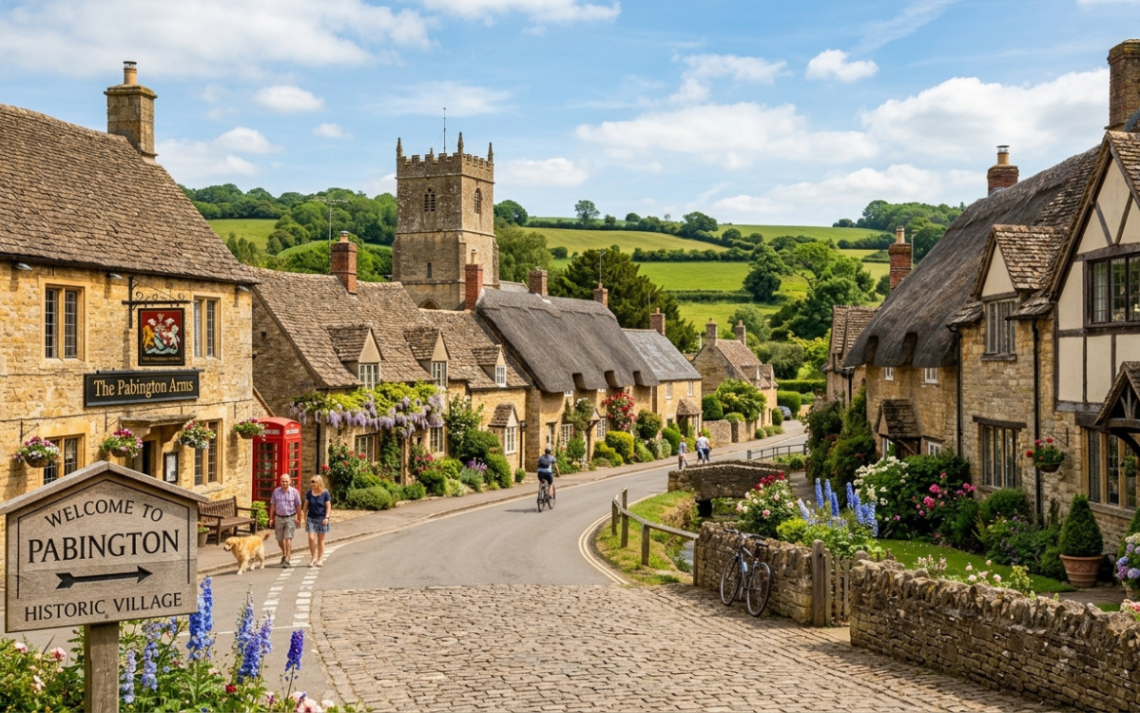
Pabington is an unusual name that looks familiar before you actually know what it means. Current evidence does not support treating the name as a standard dictionary word or a widely recognized town. The clearest documented use is as a very rare surname, while newer web references also use the term as a creative name, fictional label, username, or brand-style identity.
That distinction matters because many pages give the word a neat history that the available evidence cannot fully prove. A better way to understand it is to separate verified facts from plausible interpretation, then use context to decide what the word means in the specific place where you found it.
What Does Pabington Mean?
There is no single, authoritative definition for Pabington. It is better understood as a proper name or flexible coined term whose meaning depends heavily on context.
At the moment, the name can reasonably refer to several things:
- A rare family surname found in historical genealogy records.
- A fictional place name used in stories, roleplay, games, or creative projects.
- A username or digital identity chosen because the spelling is distinctive.
- A project, website, or brand name using an English-sounding naming pattern.
- A spelling error or playful variation of another word, particularly Paddington.
- A curiosity keyword people encounter online and search because its meaning is unclear.
The important point is that these uses are not interchangeable. If someone uses the term as a fictional village, that does not prove a historic settlement by that name existed. Likewise, a surname record does not automatically establish a place-name origin.
Is Pabington a Real Word?
If by “real word” you mean a standard English vocabulary item with a stable dictionary definition, the evidence is weak. Pabington does not function like ordinary words such as village, surname, or identity, where speakers broadly agree on a meaning.
That does not make the name meaningless. Proper nouns, usernames, product names, fictional locations, and family names can all carry meaning without appearing in general dictionaries.
This is one reason the term creates so much confusion. It has the shape of something established, yet its public meaning remains unusually loose.
Why Pabington Sounds Like an English Place Name
English place names contain old linguistic elements that can make newly coined names sound historically authentic. The Ashmolean Museum’s Anglo-Saxon place-name resource explains that ton or tun could mean a “house or village,” while ing could refer to “people.”
That helps explain why Pabington feels believable at first sight. The structure resembles naming patterns found across Britain.
But there is an important warning here.
Breaking the word into pieces such as “Pab + ing + ton” and assigning each part a precise historical meaning would be speculative unless early documentary forms can be found. Linguistic resemblance is evidence of plausibility, not proof of etymology.
That is a critical E-E-A-T distinction: a word can look historically convincing without having a verified medieval origin.
Is Pabington a Real Place?
There is no strong evidence establishing Pabington as a widely recognized modern town, city, district, or major geographic location.
That does not mean the spelling could never appear geographically. It might be used for a private property, fictional settlement, business, online game location, local nickname, or user-created map entry.
If you encountered the term in an address, property listing, travel post, or map screenshot, verify it before relying on it.
A sensible location-verification process includes checking:
- national mapping databases;
- postal address systems;
- local government records;
- historical gazetteers;
- archival maps;
- recognized place-name resources;
- genealogy databases where relevant.
The lack of a clearly documented settlement also explains why search results can become contradictory. When authoritative evidence is thin, confident-looking interpretations can quickly fill the information gap.
The Rare Pabington Surname: What Records Actually Show
The surname angle provides one of the strongest pieces of verifiable evidence.
Ancestry’s UK family-history database records the Pabington surname and reports that one family carrying the name appeared in Kent in the 1891 UK census. Its indexed results show only a small number of associated historical records, emphasizing just how uncommon the spelling appears to have been.
This evidence is important because it shows that the spelling was not simply invented by modern websites in the last few years.
It has appeared in historical family-record contexts.
Does the Pabington Surname Prove There Was a Lost Village?
No. That would be too large a leap.
Many surnames developed from locations, occupations, personal names, nicknames, family relationships, and spelling variations. The existence of a surname by itself cannot prove that a village with exactly the same spelling once existed.
A stronger historical claim would require evidence such as:
- parish registers;
- land deeds;
- medieval tax records;
- historical maps;
- manorial documents;
- early census material;
- recognized place-name dictionaries.
The responsible conclusion is narrower: the surname has historical documentation, while its exact linguistic origin remains uncertain.
That may sound less exciting than an elaborate origin story, but it is far more useful.
Pabington vs. Paddington: The Most Important Distinction
One of the most likely explanations for some searches is simple spelling confusion.
Pabington and Paddington are visually similar, especially when typed quickly, heard aloud, or read in a small font. Their meanings, however, should not automatically be merged.
Paddington is unquestionably established.
Official Visit London information identifies Paddington as an area of west London, while Network Rail documents the history of London Paddington station. Network Rail notes that a temporary station opened in 1838 before Brunel’s permanent station was developed later in the nineteenth century.
Paddington is also strongly associated with Michael Bond’s famous fictional bear. The official history of the character explains that Bond named the bear after the London railway station near where he lived.
So if the context includes:
- a London railway journey;
- Heathrow transportation;
- a west London neighborhood;
- Michael Bond;
- a marmalade-loving bear;
- Paddington Station;
then Paddington is almost certainly the intended spelling.
If the context involves a family record, obscure username, fictional world, creative project, or unusual business name, the spelling with b may be intentional.
How to Identify the Meaning in Context
Instead of asking only, “What does this word mean?” ask another question first:
Where did I see it?
That single change often produces a much more accurate answer.
1. Check the Surrounding Words
Suppose the term appears next to an address, railway station, London hotel, airport connection, or travel instructions. In that situation, test whether Paddington makes more sense.
If it appears beside a first name, birth date, marriage record, census year, or family tree, a surname interpretation becomes much more plausible.
Context beats guesswork.
2. Examine the Type of Source
A genealogy database, official map, fiction wiki, TikTok caption, online store, and gaming server do not carry the same evidentiary weight.
The same spelling can perform completely different functions on each platform.
Before accepting a definition, ask:
- Who published the information?
- Is the author identifiable?
- What evidence is supplied?
- Does the source link to primary records?
- Are other independent sources saying the same thing?
- Is a theory being presented as a proven fact?
A polished article can still be wrong.
3. Search Exact-Match Variations
When researching Pabington, search the spelling in quotation marks and compare it with similar names.
Useful variations include:
- Paddington
- Babington
- Partington
- Padington
- “Pabington surname”
This method helps reveal whether a search engine is correcting your query, clustering related names, or finding genuinely separate uses.
4. Trace the Earliest Reliable Appearance
A claimed ancient meaning should not be supported only by articles published recently.
If someone claims the name existed hundreds of years ago, look for evidence from that historical period or reputable databases based on historical documents.
Useful evidence may include:
- census records;
- digitized newspapers;
- parish registers;
- historic books;
- archives;
- land records;
- old directories;
- institutional databases.
The older the claim, the stronger the documentation should be.
Why the Name Works So Well as a Fictional or Digital Identity
The term has characteristics that make it naturally attractive for creative naming.
It is pronounceable. It feels familiar. It also remains distinctive enough that readers may stop and wonder whether they have encountered it before.
That combination can be valuable.
Possible creative applications include:
- a fictional English village;
- a fantasy-game settlement;
- a surname for a fictional family;
- a newsletter or media project;
- a username or creator identity;
- a software codename;
- a community name;
- a small consumer brand.
The advantage is memorability.
The disadvantage is ambiguity, especially because of its similarity to Paddington and established surnames such as Babington or Partington.
Creators therefore need to decide whether that ambiguity helps the project or makes the name harder to communicate.
Can You Use Pabington as a Brand Name?
Potentially. But finding an unusual word on Google does not automatically make it legally available for commercial use.
Before building a business around Pabington, conduct proper name clearance. WIPO’s Global Brand Database allows users to search international trademarks and collections supplied by participating national and regional intellectual-property offices. WIPO also recommends checking relevant national and regional registers because one database may not provide complete worldwide coverage.
A basic commercial naming review should cover:
- Trademark conflicts: Look for identical and confusingly similar marks in relevant product or service classes.
- Company-name availability: Check official corporate registries in the countries where you plan to operate.
- Domain availability: Review the .com and important country-code extensions.
- Social usernames: Test whether consistent handles are available.
- Search-result confusion: See whether search engines repeatedly assume users mean Paddington.
- Pronunciation: Ask whether people naturally pronounce the name as intended.
- Brand associations: Review existing search results for unwanted reputational connections.
For a significant commercial launch, professional trademark advice is much safer than relying on a basic web search.
Why So Many Different Explanations Exist Online
Ambiguous keywords create a predictable search-content problem.
Once people begin searching an unfamiliar term with little authoritative documentation, publishers have an incentive to provide an answer. If strong sources are unavailable, interpretations can start being repeated until speculation looks like established fact.
You can think of the information surrounding Pabington in three layers.
Layer One: Verified Evidence
Historical surname records belong here.
They provide something concrete that can be checked independently.
Layer Two: Reasonable Interpretation
The word’s resemblance to English naming patterns and its suitability for fictional or digital naming belong in this category.
These observations are logical, but they should not be presented as ancient historical facts.
Layer Three: Unsupported Storytelling
Be skeptical of claims involving:
- a forgotten medieval village;
- a precise ancient founder;
- a fixed cultural philosophy;
- a secret online movement;
- a universally accepted slang definition;
- an exact etymology presented without records.
Such claims may eventually prove true, but evidence needs to come first.
What We Can Verify and What Remains Uncertain
The most useful way to summarize the subject is through confidence levels.
Reasonably Well Supported
- The spelling appears in historical surname records.
- Available genealogy data suggests the surname was extremely uncommon.
- The name resembles established English surname and place-name patterns.
- Modern publishers use it in several creative and interpretive ways.
- Its spelling can easily be confused with Paddington.
Not Firmly Established
- One official dictionary definition.
- One confirmed creator of the modern term.
- A universally accepted internet-slang meaning.
- A verified historic town with this exact spelling.
- A definitive Old English derivation of the complete name.
- A single cultural group or movement responsible for the term.
This evidence-first approach offers more value than forcing the keyword into a convenient story.
Should Writers Treat Pabington as Internet Slang?
Not automatically.
For Pabington to be confidently described as slang, there would ideally be evidence that a recognizable community uses it repeatedly with a broadly shared meaning.
A collection of websites describing an unfamiliar term as “internet slang” does not establish that status by itself. Those sites may simply be repeating one another.
Slang develops through usage.
If a stable meaning eventually becomes common across social platforms, communities, dictionaries, or linguistic databases, the classification could change. Language is always evolving.
The available evidence simply does not justify pretending that evolution is already complete.
Frequently Asked Questions
What is Pabington?
Pabington is an uncommon proper name or flexible coined term rather than a standard English word with one universally accepted meaning. Its strongest documented use is as a rare surname, while modern online contexts may use it for fictional naming, usernames, projects, and brand-style identities.
Is Pabington a real town in England?
There is no strong evidence establishing it as a widely recognized modern English town or city. If you encounter the name geographically, verify it through official mapping, postal, local-government, archival, or recognized historical place-name resources before treating the location as genuine.
Is Pabington the same as Paddington?
No. Paddington is a documented west London area, a major railway station, and the name associated with Michael Bond’s famous bear. The spellings may be confused because they look and sound similar, but they should not automatically be treated as interchangeable.
Is Pabington a real surname?
Yes. Historical genealogy databases document Pabington as a surname. Ancestry’s UK information reports one family in Kent in the 1891 census and only a small number of associated indexed records, indicating that the name has historical usage but appears to have been extremely rare.
Can I use Pabington for a business, website, or username?
Potentially, particularly for a creative project or username. Commercial use requires more care: search trademark databases, corporate registries, domains, social handles, and similar spellings before committing money to the name.
Final Takeaway
Pabington is interesting precisely because the evidence does not collapse into one easy definition. It has a small but identifiable historical footprint as a surname, a convincing English-style naming structure, and enough ambiguity to work as a fictional, digital, or branding identity.
If you encountered the term somewhere specific, do not accept the first confident definition you find. Check the context, compare similar spellings, verify historical claims against reliable records, and separate documented facts from creative interpretation.
That approach gives you something far more valuable than a dramatic origin story: an answer that can actually withstand scrutiny.