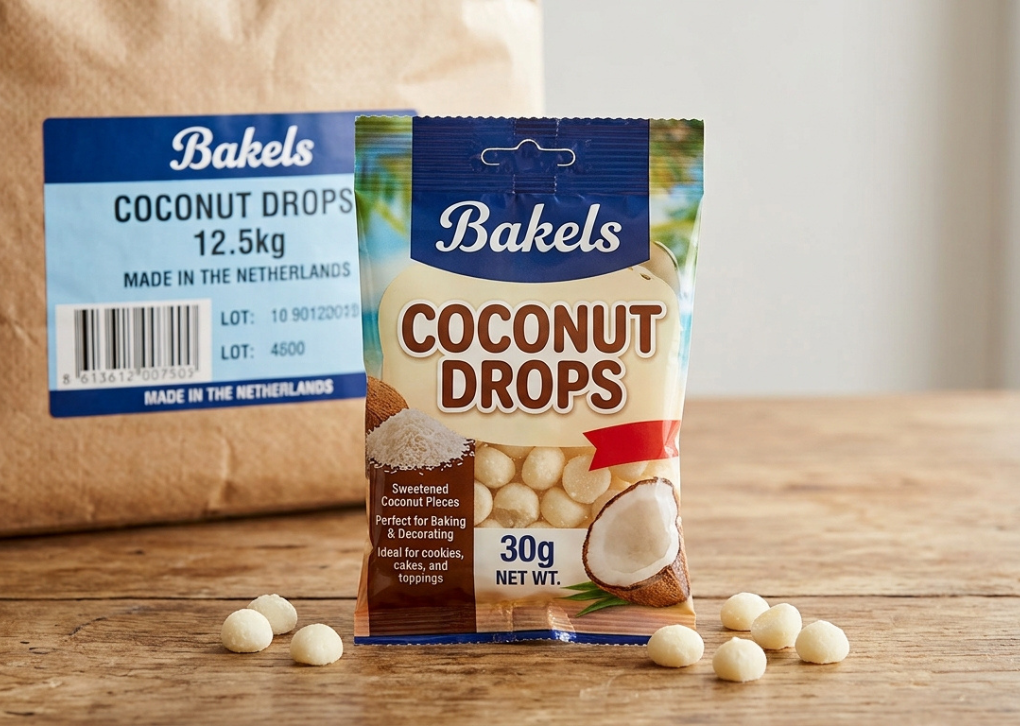
If you are searching for Bakels coconut drops 30g 12.5k, you are probably trying to identify a bulk bakery product, confirm its pack format, or decide whether it suits a commercial baking operation. The search phrase looks simple, but there is an important specification detail that many competing pages miss: the current Australian Bakels product specification for Coconut Drops, product code 631052, lists a 12.5 kg carton with 25 g drops, not 30 g.
That distinction matters. A five-gram difference changes theoretical carton yield, cost-per-piece calculations, production planning, and even how a buyer should match a wholesaler listing to the manufacturer’s current specification.
This guide separates verified manufacturer data from assumptions. It also shows bakers, cafés, retailers, foodservice buyers and procurement teams how to evaluate the product intelligently rather than relying on repeated catalogue descriptions.
What Is Bakels Coconut Drops 30g 12.5k?
The phrase Bakels coconut drops 30g 12.5k is commonly used online as a product-style search term for Bakels Coconut Drops in bulk foodservice packaging. However, Australian Bakels describes its current Coconut Drops product as frozen, ready-to-bake coconut drops under product code 631052, packed in a 12.5 kg carton at 25 g per drop.
That means these are not simply bags of desiccated coconut, coconut chips, or a loose baking inclusion. They are pre-portioned coconut bakery pieces intended to go from frozen storage into a baking workflow, giving operators a much more standardized starting point than scratch-made coconut portions.
The 30 g Versus 25 g Specification: What Buyers Should Know
Search results for Bakels coconut drops 30g 12.5k frequently repeat the idea that each piece weighs 30 g. Yet the manufacturer specification dated 20 September 2023 states a 12.5 kg carton containing 25 g drops.
There are several plausible reasons for the mismatch: an older pack specification, regional or distributor shorthand, a legacy ERP description, or repetition of an unverified third-party listing. A distributor may therefore still use Bakels coconut drops 30g 12.5k as legacy catalogue wording even when the current technical sheet shows a different portion weight.
The safest procurement rule is straightforward: match the product code, carton label and current technical specification before ordering. This is especially important when portion weight feeds directly into your food-cost model.
Verified Product Snapshot for Bakels Coconut Drops
For anyone researching Bakels coconut drops 30g 12.5k, manufacturer data is far more useful than generic product descriptions. Australian Bakels lists Coconut Drops code 631052 as a light-yellow, frozen, ready-to-bake product made in Australia from local and imported ingredients.
Key verified details include:
- Product code: 631052
- Format: Frozen, ready-to-bake coconut drops
- Current listed carton size: 12.5 kg
- Current listed portion size: 25 g per drop
- Coconut content: 32%
- Storage: Keep frozen between -18°C and -25°C
- Best-before period: 12 months from manufacture
- Certification claim: Kosher certified
- Country of origin: Made in Australia from local and imported ingredients
This is a more operationally meaningful profile than simply calling the product a “coconut ingredient.” It tells a bakery manager how the item arrives, how it must be stored, and how it fits into a production line.
Ingredients in Bakels Coconut Drops 30g 12.5k
The official ingredient list provides another important point of differentiation for Bakels coconut drops 30g 12.5k searches. Coconut is listed at 32%, followed by sugar, wheat flour, water, butter, milk solids, maize starch, raising agents, natural flavour and natural colour; the coconut ingredient itself includes sulphites as a preservative.
That formulation explains why the product should not be treated as a direct substitute for plain desiccated coconut on a gram-for-gram basis. It is a formulated bakery item containing flour, dairy, sugar and leavening components, so swapping it blindly into a recipe designed for raw coconut could alter sweetness, fat, hydration and structure.
This point is easy to miss. Coconut may be the defining flavour, but the finished product is much closer to a pre-portioned bakery dough or deposited coconut sweet than to a raw coconut ingredient.
Allergen Information Deserves Prominent Attention
Australian Bakels states that Coconut Drops contain wheat, gluten, milk and sulphites. Tree nuts, egg and soy may also be present because of shared equipment.
For bakeries, cafés and retailers, that information should feed directly into allergen matrices, point-of-sale labelling, staff training and cross-contact controls. A coconut-based product should never automatically be assumed gluten-free or dairy-free simply because plain coconut naturally contains neither ingredient.
Never rely on a third-party article for a final allergen declaration. Use the physical packaging and current manufacturer specification relevant to the batch you actually receive.
Nutrition Profile of Bakels Coconut Drops
People searching Bakels coconut drops 30g 12.5k may also want to understand the nutritional composition of the frozen product. Per 100 g, the official specification lists 1,790 kJ energy, 4.4 g protein, 23.5 g total fat, 20 g saturated fat, 47.3 g carbohydrate, 33 g sugars, 5.6 g dietary fibre and 130 mg sodium.
At the currently listed 25 g portion size, a simple quarter-scale calculation equates to roughly 448 kJ of energy, 5.9 g total fat and 8.25 g sugars per unbaked portion. These are arithmetic estimates derived from the manufacturer’s per-100 g data rather than independently declared serving values.
That distinction is important for commercial labelling. Businesses subject to nutrition-panel requirements should use an approved calculation process and their current product documentation rather than copying an informal per-piece estimate.
Why the 12.5 kg Carton Matters in Commercial Production
The 12.5 kg carton is where Bakels coconut drops 30g 12.5k becomes especially relevant to production managers. Bulk frozen bakery products can reduce manual scaling, mixing and depositing steps, but the real commercial benefit comes from repeatability and predictable throughput rather than simply purchasing a larger package.
Using the current 25 g manufacturer specification, 12.5 kg ÷ 25 g gives a theoretical yield of 500 drops per carton. That is a valuable starting point for production forecasts.
Actual usable yield can still differ. Breakage, handling loss, weight tolerances, damaged units or internal quality-control rejects may reduce the number of pieces that ultimately become saleable finished products.
What If Your Distributor Really Lists a 30 g Version?
If a supplier sells Bakels coconut drops 30g 12.5k and confirms that 30 g is genuinely the unit weight, the theoretical carton yield changes substantially. 12,500 g ÷ 30 g = approximately 416.7 portions, or roughly 416 complete 30 g pieces with residual mass if total case weight is exactly 12.5 kg.
Compare that with the theoretical 500 pieces from a 25 g specification. That is a difference of approximately 83 complete saleable units per carton before considering production losses.
This is why the 25 g versus 30 g discrepancy is not trivial. A buyer costing dozens or hundreds of cartons annually can create a meaningful purchasing forecast error if the ERP description, supplier invoice and physical product use different unit weights.
Costing Bakels Coconut Drops 30g 12.5k Correctly
A strong purchasing decision should be based on cost per saleable unit, not carton price alone. For Bakels coconut drops 30g 12.5k, begin with the supplier’s landed carton cost and divide it by the verified usable piece count after normal production losses.
For example, if the carton cost is represented by C, your preliminary ingredient cost under the current 25 g specification would be C ÷ 500 before waste, labour, utilities, packaging and retail margin. If your genuine format is 30 g, the denominator falls to roughly 416 complete pieces.
A practical bakery costing model should consider:
- Carton purchase price and freight
- Verified individual portion weight
- Actual usable yield rather than theoretical yield
- Freezer storage cost
- Baking energy
- Labour for tray-up, baking, cooling and packing
- Consumer packaging and labels
- Shrinkage, breakage and unsold stock
- Required gross margin
This method produces a commercially useful number. Merely assuming that a bulk carton must have the lowest cost per finished product can hide labour, waste and cold-storage costs.
Storage and Cold-Chain Requirements
One of the most important facts about Bakels coconut drops 30g 12.5k is that the current Australian product is frozen, not a shelf-stable dry ingredient. Bakels specifies storage between -18°C and -25°C and a best-before period of 12 months from the date of manufacture.
For commercial users, freezer discipline becomes part of product quality. Receiving teams should confirm that cartons arrive in acceptable frozen condition, check date coding, rotate stock systematically and minimize unnecessary exposure to ambient temperatures.
Cold storage also needs to enter capacity planning. A product that performs well operationally may still be unsuitable if a site lacks reliable freezer space for the volume required.
Do Not Invent a Baking Temperature
The public product specification verifies that the drops are ready to bake, but it does not provide a universal oven temperature or bake time in the specification surfaced here. That absence is worth respecting.
Convection settings, tray loading, oven recovery, frozen product temperature and desired finished colour can all affect the optimum bake profile. Precise baking instructions should therefore come from the carton, distributor technical documentation or Bakels technical support.
A generic article that confidently provides an unsupported oven temperature may look helpful while creating unnecessary production risk. In a professional bakery, validated process parameters beat guesswork.
Where Bakels Coconut Drops Fit Best
The clearest use case for Bakels coconut drops 30g 12.5k is a bakery or foodservice operation that wants a pre-portioned coconut sweet with less scratch preparation. Potential users include supermarket bakeries, cafés, grab-and-go counters, catering kitchens, canteens and high-volume bakery operations.
The product becomes especially attractive where consistency is required across multiple shifts or locations. Pre-portioned frozen pieces can simplify training, reduce manual scaling variation and make batch planning easier.
There is still operator skill involved. Baking, cooling, handling, merchandising and finished-product presentation remain under the control of the bakery.
It Is Not the Same as Bakels Kokomix
This distinction could prevent an expensive ordering mistake. Australian Bakels also sells Pettina Kokomix, a separate 10 kg dry mix whose stated functions include coconut drops, coconut slice and macaroons.
Kokomix is stored below 25°C under clean, dry conditions. The frozen Coconut Drops product, by contrast, requires freezer storage.
So if you want ready-to-bake frozen portions, product code 631052 is the relevant reference in the current Australian specification. If you want a dry mix from which your team can produce coconut products in-house, Kokomix represents a different production workflow.
Retail Packs Versus Bakels Coconut Drops 30g 12.5k Cartons
Searchers may encounter smaller Bakels Coconut Drops packs at Australian supermarkets, which can make Bakels coconut drops 30g 12.5k appear inconsistent across the web. Recent retailer listings show a 210 g Bakels Coconut Drops product at some Ritchies stores, while another IGA listing presents Coconut Drops as an 11-pack.
Those retail presentations do not invalidate the 12.5 kg foodservice specification. Instead, they demonstrate that the finished Coconut Drops can appear in different downstream retail formats.
This matters for search intent. Someone looking for a consumer pack may need a supermarket product, while a bakery purchasing department is more likely interested in case quantity, frozen logistics, piece count and unit economics.
How to Evaluate a Supplier Listing Before You Buy
When a wholesaler lists Bakels coconut drops 30g 12.5k, do not judge the stock by its title alone. Ask for enough technical detail to confirm that the actual carton matches your operational, financial and compliance requirements.
Check these points before placing a commercial order:
- Product code: Does it match Bakels 631052?
- Declared piece weight: Is it 25 g, 30 g or another specification?
- Net carton weight: Is it actually 12.5 kg?
- Storage state: Is the product supplied frozen?
- Remaining shelf life: How much usable life remains when delivered?
- Allergen declaration: Does the current packaging match your allergen records?
- Market specification: Was the product manufactured for your jurisdiction?
- Cold-chain condition: Has it remained within appropriate frozen distribution conditions?
- Carton integrity: Is the case sealed and undamaged?
This takes only a small amount of procurement effort. It can prevent incorrect costing, freezer-space surprises, allergen-record errors and disputes about what was actually ordered.
Bakels Manufacturer Experience and Product Provenance
Evaluating Bakels coconut drops 30g 12.5k becomes easier when the manufacturer context is clear. Bakels traces its history to 1904, while Australian Bakels states that it began operating in Australia in 1952.
Australian Bakels says it maintains manufacturing, quality-control, product-development, test-baking and customer-demonstration capabilities at its Silverwater, New South Wales operation. This matters because commercial bakery ingredients benefit from technical application support, not merely distribution.
The wider Bakels group states that it supports more than 2,000 products across over 120 countries and that its manufacturing companies maintain research-and-development resources for regional markets.
Those facts do not automatically make every Bakels product the right choice for every bakery. They do, however, provide a stronger manufacturer provenance trail than an anonymous marketplace listing or an uncited product blog.
Operational Advantages for Professional Bakeries
For many businesses investigating Bakels coconut drops 30g 12.5k, the biggest opportunity is labour control. Scratch coconut products can require ingredient scaling, mixing, portioning, deposit control, cleaning and additional quality checks.
A ready-to-bake format potentially moves several of those steps upstream to the manufacturer. That can give a bakery a more repeatable workflow when staff experience varies or labour availability is tight.
Standardization can also improve merchandising. More consistent piece weight usually makes pack assembly, multipack presentation and selling-price calculations easier to manage.
The product is not automatically “better” than scratch production. A premium artisan bakery may prefer a house formula because differentiation, texture customization or ingredient control is central to its value proposition.
Common Buying Mistakes to Avoid
The biggest mistake with Bakels coconut drops 30g 12.5k is assuming that every webpage using the phrase describes the same current specification. The verified Australian manufacturer document uses 25 g drops, while multiple third-party pages repeat 30 g without providing equivalent primary-source support.
Another error is treating the product like ambient dry stock. The current specification clearly describes a frozen product, making cold-chain capacity part of the buying decision.
Buyers should also avoid assuming that a coconut product must be gluten-free, overlooking sulphites, or using theoretical carton yield as guaranteed saleable yield. Each of those shortcuts can create downstream operational problems.
FAQ: Bakels Coconut Drops 30g 12.5k
1. What does Bakels Coconut Drops 30g 12.5k mean?
Bakels coconut drops 30g 12.5k is a search and catalogue-style phrase that appears to describe Bakels Coconut Drops with a 30 g unit weight in a 12.5 kg bulk carton. However, the current Australian Bakels specification for product 631052 lists a 12.5 kg carton containing 25 g drops.
Buyers should therefore confirm the exact product code and piece weight with their supplier. Do not automatically assume that the “30g” portion of an online title reflects the current manufacturer specification in your market.
2. Are Bakels Coconut Drops ready to bake?
Yes. Australian Bakels identifies product 631052 as frozen, ready-to-bake coconut drops.
Keep them within the specified frozen storage conditions and follow the validated baking directions supplied with the carton, your distributor documentation or Bakels technical guidance.
3. How many coconut drops are in a 12.5 kg carton?
Using the current official 25 g specification, the theoretical calculation is 12,500 g ÷ 25 g = 500 drops. That figure is useful for preliminary purchasing and costing.
If a supplier genuinely stocks a 30 g version, 12,500 g ÷ 30 g = approximately 416.7, meaning roughly 416 complete portions before allowing for weight tolerances or production loss. Confirm the physical specification before using either figure in a financial model.
4. Are Bakels Coconut Drops gluten-free or dairy-free?
No. The current Australian specification lists wheat, gluten, milk and sulphites among the allergens, with tree nuts, egg and soy potentially present because of shared equipment.
That makes the product unsuitable for marketing as gluten-free or dairy-free on the basis of its coconut content alone. Always verify the latest physical product label before communicating allergen information to customers.
5. How should Bakels Coconut Drops be stored?
For the current frozen product, Australian Bakels specifies a storage temperature between -18°C and -25°C. The specification also states a best-before period of 12 months from the date of manufacture.
Cold-chain management therefore matters from receiving through production. Bakeries should also rotate cartons systematically so older stock is used within its declared shelf-life window.
Conclusion: Verify the Specification, Then Cost the Product
Bakels coconut drops 30g 12.5k is a useful search term, but the smartest purchasing decision begins with the manufacturer specification rather than the keyword itself. The current Australian document for Coconut Drops product code 631052 identifies a 12.5 kg carton of 25 g frozen ready-to-bake drops, with 32% coconut, defined allergens, frozen storage requirements and a 12-month best-before period.
That specification difference creates genuine information gain for buyers. It affects theoretical carton yield, portion costing, inventory forecasts and the accuracy of supplier comparisons.
Before ordering, ask your supplier to confirm the product code, actual piece weight, net carton weight, storage requirement, shelf life and current allergen declaration. Then calculate your cost per usable finished piece using real production yield rather than an assumed carton count.
That is the next step. Verify the carton you can actually buy, run the numbers against your bakery’s selling price and production losses, and only then decide whether the product delivers the consistency, labour savings and margin your operation needs.