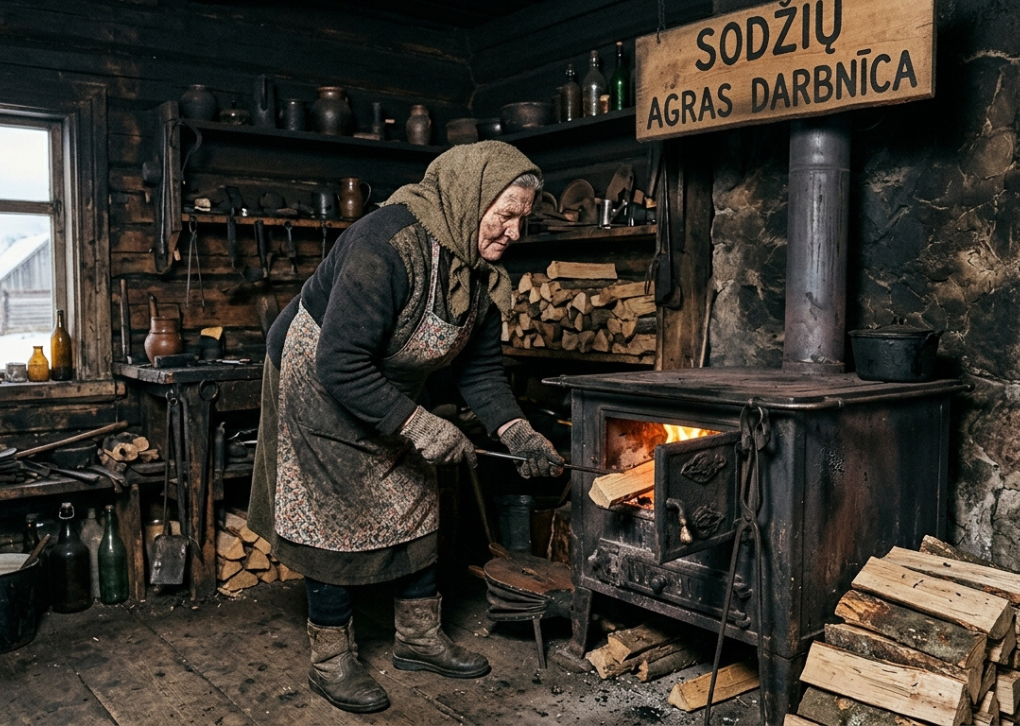
Sodziu looks like a simple word, yet searching for its meaning quickly creates a linguistic puzzle. Some sources describe it as a Lithuanian village concept. Others say it means “in short,” “basically,” or “so.” Those explanations appear contradictory because, in many cases, they are discussing two different Lithuanian words.
The distinction matters. When the subject is Lithuanian villages, rural settlements, farmsteads, or countryside history, the relevant established word is sodžius. When the subject is speech, verbal communication, or expressions comparable to “in a word,” the relevant form is žodžiu, derived from žodis, meaning “word.” Treating these terms as interchangeable creates a neat story, but poor linguistics.
This guide separates those meanings, explains why the spelling causes confusion, and explores the historical world behind the rural term.
What Does Sodziu Mean?
The safest answer is that Sodziu is an ambiguous, simplified online spelling rather than a precise Lithuanian dictionary headword.
If someone uses it while discussing villages, traditional settlements, Lithuanian heritage, or countryside life, they probably mean sodžius. Lithuanian dictionary material defines sodžius as a village and also records senses connected with a farmstead or estate.
There is also a more specific historical meaning. Lithuania’s Visuotinė lietuvių enciklopedija describes sodžius as a historical type of rural settlement believed to have existed from approximately the 12th through the 16th century. Over time, the term became a synonym for kaimas, the ordinary Lithuanian word associated with a village.
If the intended meaning is “orally,” “verbally,” or something resembling “in a word,” however, the correct Lithuanian form is žodžiu. That is a different word.
This distinction is the single most important fact to understand.
Why Is Sodziu So Confusing Online?
Much of the confusion comes from diacritics, transliteration, search behavior, and repeated online misinformation.
Lithuanian uses letters that English does not, including ž. When people type Lithuanian terms using keyboards without convenient diacritical characters, those marks are often removed. Search engines, usernames, URLs, international publications, and casual messages can therefore contain simplified spellings.
But removing diacritics can erase meaningful distinctions.
In this particular case, online content frequently associates the search spelling with either:
- sodžius — village, rural settlement, and historically a particular Lithuanian settlement type;
- žodžiu — the instrumental singular of žodis (“word”), also used adverbially for verbal or oral communication;
- kaimas — another Lithuanian term for village;
- sodyba — a homestead, farmstead, or estate;
- broader ideas involving Lithuanian countryside, rural heritage, farming, and traditional community life.
The problem begins when these separate concepts are presented as though they are definitions of one magical, culturally loaded word.
They are not.
Sodziu vs. Sodžius vs. Žodžiu: The Essential Difference
Understanding the spelling solves most of the mystery.
Sodžius: The Rural Meaning
Sodžius is a masculine Lithuanian noun. Dictionary sources give “village” as its principal English equivalent and also document meanings such as farmstead or estate. Kaimas is listed as a synonym in the village sense.
Lithuanian-language dictionary material similarly defines it around the idea of a peasant settlement or village.
That makes sodžius the appropriate term when the discussion concerns rural Lithuania.
Žodžiu: The Speech-Related Meaning
Žodžiu belongs to a completely different lexical family.
It is the instrumental singular of žodis, the Lithuanian noun for “word.” It is also documented with adjectival or adverbial meanings connected with oral, vocal, or verbal communication. Expressions containing it can correspond to English constructions such as “in a word.”
This explains why some online articles claim the search term means “basically,” “so,” or “in short.” They are describing usages associated with žodžiu, not the village noun sodžius.
A Quick Comparison
| Search/word form | Core idea | Best interpretation |
|---|---|---|
| Sodziu | Ambiguous web spelling | Context is required |
| sodžius | Village/rural settlement | Rural and historical context |
| žodžiu | Word/oral expression | Speech and conversational context |
| kaimas | Village | General village terminology |
| sodyba | Homestead/farmstead | Property or rural homestead |
This distinction prevents one of the biggest factual errors surrounding the keyword.
The Historical Meaning of Sodziu and Sodžius
The rural interpretation becomes much more interesting once we move beyond a one-word translation.
According to Lithuania’s national encyclopedia, the historical sodžius was a type of Lithuanian rural settlement thought to have existed between roughly the 12th and 16th centuries. It developed as earlier settlement structures changed and families dispersed across agricultural territory.
These settlements were not necessarily tidy clusters resembling a modern planned village. Historical descriptions indicate that buildings and homesteads could be irregularly dispersed, with settlement patterns closely related to agricultural land use.
That makes the term valuable to anyone studying Lithuanian rural history, historical geography, settlement development, genealogy, or Baltic cultural heritage.
It describes more than scenery. It belongs to the story of how communities occupied and worked the landscape.
How Lithuanian Rural Settlements Changed
Settlement patterns are never static. They change when agricultural systems, land ownership, administration, population, and economic pressures change.
A major transformation occurred during the Valak reform in the 16th century. According to the Lithuanian encyclopedia, many older settlements in Aukštaitija were reorganized into more regular street villages, fundamentally changing the earlier settlement pattern.
Meanwhile, the terminology evolved too. Settlements that survived changed physically: additional buildings appeared, enclosed areas and yards developed, and the term kaimas increasingly became associated with these communities. Eventually, sodžius functioned as a synonym for village.
This historical evolution explains why translating the word mechanically can lose useful context.
Sodziu and Traditional Lithuanian Village Life
Once the historical definition is established, the wider cultural associations make more sense.
A Lithuanian rural settlement existed within a working landscape. Homes, agricultural land, livestock, gardens, roads, forests, waterways, and neighboring households formed an interconnected economic environment.
Village life historically revolved around practical cycles rather than romantic notions of “simple living.” Planting, harvesting, food preservation, animal care, construction, repair, and preparation for winter all required accumulated local knowledge.
That is why modern discussions of Sodziu often expand into topics such as:
- Lithuanian countryside and rural heritage;
- traditional agriculture and seasonal work;
- family homesteads and wooden architecture;
- folk traditions, crafts, songs, and storytelling;
- local food production and preservation;
- community relationships and intergenerational knowledge;
- historical settlement patterns and land use.
These are legitimate contextual associations. They should simply not be mistaken for literal dictionary definitions of the word.
Sodziu, Sodyba, and Kaimas Are Not Identical
Three rural Lithuanian terms are particularly easy for English-language writers to blur together: sodžius, sodyba, and kaimas.
Kaimas
Kaimas is commonly associated with the straightforward concept of a village. Historical evidence also helps explain why sodžius eventually became synonymous with it.
Sodyba
Sodyba is closer to a homestead, farmstead, or estate than to an entire village. Dictionary data lists it among terms related to the farmstead sense of sodžius.
The difference is practical. A homestead concerns an individual property or household complex; a village concerns a settlement consisting of multiple households.
Sodžius
Sodžius occupies an especially interesting position because it has both historical settlement significance and a broader village sense.
Using these terms precisely produces a much clearer picture of Lithuanian rural culture.
How to Interpret Sodziu When You Encounter It
Context is the best diagnostic tool.
If a page mentions Lithuania, villages, farms, countryside, historical settlements, homesteads, agriculture, or rural heritage, interpret the search term as most likely pointing toward sodžius.
If the surrounding discussion concerns speaking, summarizing a story, saying something verbally, or expressions such as “in a word,” the intended Lithuanian form is probably žodžiu.
That simple context test is more reliable than accepting a universal definition for the unaccented spelling.
There is another useful rule: if linguistic precision matters—academic work, translation, genealogy, historical research, or language learning—use the proper Lithuanian spelling rather than Sodziu.
Search-friendly spelling and linguistically correct spelling are not always the same thing.
Is Sodziu a Lithuanian Conversational Expression?
This question deserves a precise answer because search results frequently say yes.
Lithuanian certainly has the form žodžiu, which is connected to žodis (“word”). It can function adverbially in relation to oral or verbal communication, while constructions such as vienu žodžiu are associated with the idea of “in a word.”
But that does not make sodžius and žodžiu two meanings of the same word.
They have different spellings, grammatical histories, and semantic functions.
A useful article should preserve that distinction rather than manufacture a “dual meaning” simply because the forms look similar after Lithuanian characters are removed.
Common Myths About Sodziu
Search results have accumulated several claims that deserve scrutiny.
Myth 1: Sodziu Has One Exact Meaning
Not in the way the keyword appears online.
The simplified spelling is ambiguous. Determining whether the writer means sodžius, žodžiu, or something else requires context.
Myth 2: Village and “In Short” Are Two Meanings of the Same Lithuanian Word
This is misleading.
The village meaning belongs to sodžius. The speech-related form žodžiu comes from žodis. Reliable linguistic references treat them separately.
Myth 3: Sodziu Literally Means a Philosophy of Simple Living
There is no need to invent such a definition.
Traditional rural life naturally evokes ideas of land, family, seasonality, community, and heritage. Those are cultural associations, however, not substitutes for the lexical meaning.
Myth 4: Every Online Definition Is Equally Reliable
Unusual low-volume keywords are particularly vulnerable to circular sourcing. One website publishes an unsupported interpretation; another paraphrases it; eventually repetition can make the claim appear established.
For culturally or linguistically specific terms, dictionaries, encyclopedias, academic material, and native-language institutions should carry more weight than generic keyword articles.
Why Sodziu Still Matters in Modern Culture
Historical village terminology might seem niche, yet it intersects with several very modern interests.
People researching family history may encounter rural place descriptions in archival material. Travelers increasingly seek countryside experiences beyond major cities. Heritage organizations preserve architecture, crafts, foodways, and settlement landscapes that urbanization might otherwise erase.
There is also an environmental dimension. Traditional landscapes reveal how generations adapted agriculture and settlement to local geography, although historical practices should not automatically be idealized as environmentally sustainable by modern standards.
Most importantly, studying rural terminology provides access to distinctions that disappear when every settlement is translated simply as “village.”
Language preserves categories. Categories preserve history.
Why Accurate Spelling Matters
Writing Sodziu may be convenient for an English-language search query, but Lithuanian diacritics are not decorative.
The character ž represents a distinct sound and forms part of the spelling of words such as sodžius, žodžiu, and žodis. Removing it can make already similar-looking words even easier to confuse.
For casual searching, simplified spelling is understandable. For educational or professional writing, retain the proper forms whenever possible.
That means writing:
sodžius when you mean the village or rural-settlement term;
and žodžiu when you mean the form related to žodis and verbal expression.
That one editorial decision immediately improves accuracy.
FAQ About Sodziu
What does Sodziu mean in English?
When Sodziu is being used to represent Lithuanian sodžius, the closest basic English translation is “village.” Dictionaries also record related senses involving a farmstead or estate. Historically, the term referred more specifically to a type of Lithuanian rural settlement.
Because the unaccented spelling is ambiguous, however, readers should check the surrounding context before translating it.
Is Sodziu a real Lithuanian word?
Sodziu as written is best treated cautiously, particularly in English-language web content. The established Lithuanian words relevant to the common search interpretations are sodžius and žodžiu.
If the topic is Lithuanian village history, sodžius is the relevant form. If the topic concerns oral expression or phrases involving “word,” žodžiu is likely intended.
Does Sodziu mean “basically” or “in short”?
Not if the intended word is sodžius.
The confusion comes from žodžiu, a different Lithuanian form derived from žodis (“word”). It occurs in speech-related usages and expressions comparable to “in a word.” Therefore, articles claiming that the village term itself literally means “basically” or “in short” are conflating separate words.
What is the difference between sodžius and kaimas?
Both can be associated with a village, but sodžius has important historical context. Lithuania’s national encyclopedia describes it as a historical settlement type and explains that the term later became a synonym for kaimas.
For historical research, that distinction can matter considerably more than it does in a basic English translation.
Is Sodziu connected with Lithuanian rural culture?
Yes, when Sodziu is being used as a simplified rendering associated with sodžius. The historical word belongs directly to Lithuania’s rural settlement history, so discussions naturally intersect with agriculture, homesteads, village organization, land use, architecture, family life, and cultural heritage.
The important qualification is that these are historical and cultural associations, not a license to assign every aspect of Lithuanian countryside culture to the literal definition of the word.
Conclusion: How to Understand Sodziu Correctly
The most useful way to understand Sodziu is not to search for one dramatic definition. Start by identifying which Lithuanian word the context actually points to.
For rural history, villages, and traditional settlements, look to sodžius. It is an established Lithuanian village term with a specific place in the country’s medieval and early-modern settlement history. For verbal communication and expressions involving “word,” look instead to žodžiu, derived from žodis.
That distinction clears away much of the misinformation surrounding the keyword.
If you are writing, translating, researching family history, or exploring Lithuanian culture, take one practical step next: preserve the original Lithuanian spelling and verify the term against a linguistic or historical reference before assigning it a broader cultural meaning.
Small spelling differences can carry entirely different histories. With Sodziu, they do.