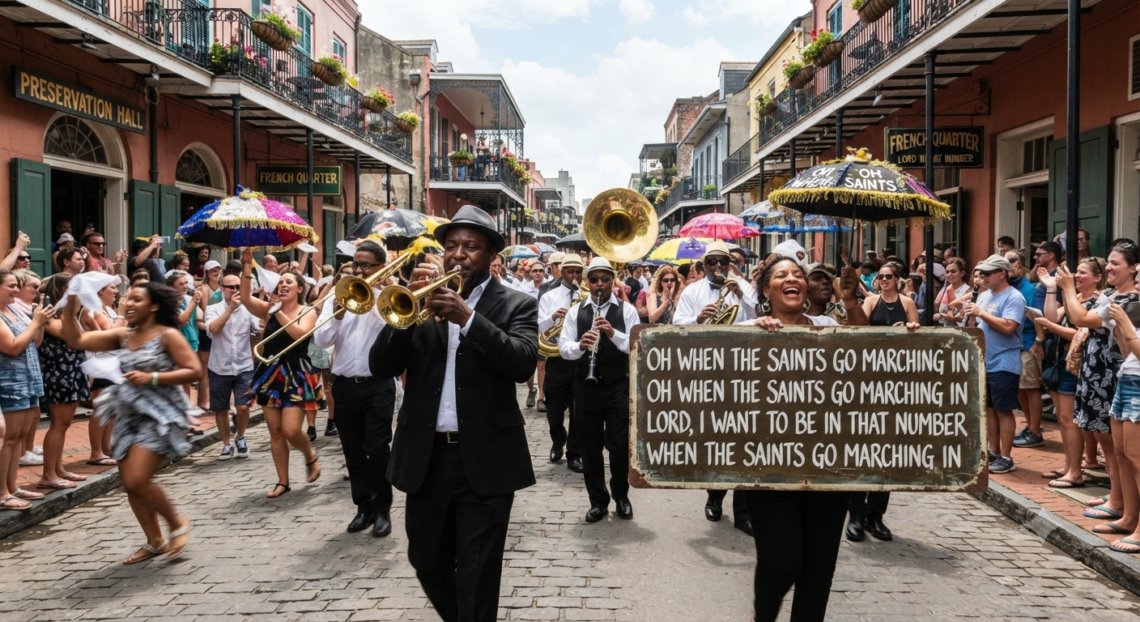
If you are searching for lyrics for oh when the saints go marching in, you are probably looking for more than a familiar chorus. This traditional African American spiritual has crossed from church worship into New Orleans jazz, funerals, parades, classrooms, sporting culture, and popular music, all while keeping its central message of hope: the desire to be counted among the faithful when the saints enter glory. Hymnary identifies the song in multiple hymnals as a traditional or African American spiritual, while United Methodist Discipleship notes that its exact origins are difficult to trace.
That long folk history matters. Unlike a modern pop song with one fixed studio lyric sheet, lyrics for oh when the saints go marching in can change from hymnal to hymnal and performer to performer. The chorus remains remarkably stable, but verses about the sun, trumpet, judgment, heavenly gathering, resurrection, or a final day of celebration often appear in different combinations. Hymnary’s catalog documents multiple published forms and scripture associations.
Traditional Lyrics for Oh When the Saints Go Marching In
The traditional text is built around the instantly recognizable title line and a simple recurring desire expressed by the singer: “I want to be in that number.” Rather than moving through a long narrative, each verse introduces an image or event and then returns to the singer’s hope of belonging among the saints.
That recurring structure is the heart of lyrics for oh when the saints go marching in. It works almost like a musical anchor: a leader introduces a new image, and the congregation or group returns to the same central idea. Published hymnals preserve several variants of this pattern, which helps explain why singers may remember slightly different wording.
Common traditional verses may refer to the sun refusing to shine, believers gathering around a heavenly throne, Christ being acknowledged as Lord, or a future day of rejoicing. Rather than treating one internet lyric page as the only correct version, it is more accurate to understand the song as a living spiritual with a stable refrain and flexible verse tradition.
Why the Lyrics Change From Version to Version
People often assume there must be a single “full” set of lyrics for oh when the saints go marching in. Historically, that is not how many spirituals and folk hymns functioned. Songs carried through oral and congregational traditions could accumulate verses, lose verses, borrow familiar religious imagery, or be adapted to suit a particular community or occasion.
A worship service, funeral procession, jazz performance, children’s singalong, or commercial recording may therefore use different verses while remaining recognizably the same song.
Hymnary lists versions connected with subjects such as eternal life, funerals, All Saints, salvation, heaven, the communion of saints, and resurrection. It also documents different verse selections and arrangements across hymnals. That evidence explains why two people can sing the opening confidently and then discover that they learned different later verses.
What Do Lyrics for Oh When the Saints Go Marching In Mean?
At surface level, the song feels joyful and straightforward. Underneath that simplicity is a serious spiritual theme: the singer wants to belong to the redeemed community at the end of earthly life and at the fulfillment of God’s kingdom.
The desire to be included among the saints is the emotional center. It is not simply about watching a heavenly procession. It expresses longing, belonging, faith, salvation, and hope.
That is why lyrics for oh when the saints go marching in can feel uplifting even when they are sung in settings connected with death or mourning. Death is not presented simply as an ending; the song points toward reunion and entrance into a larger spiritual community.
Hymnary connects published versions with passages and themes from Jude and Revelation, including heavenly worship and everlasting life. Images found throughout the verse tradition—cosmic signs, trumpets, gathering, judgment and a heavenly throne—fit the apocalyptic and resurrection language found in Christian scripture.
“Saints” Means More Than Famous Religious Figures
In everyday language, “saint” can sound like a title reserved for an exceptionally holy historical figure. Within the broader Christian meaning of the song, however, the word can refer to the faithful people of God collectively.
The singer is therefore not merely hoping to stand near celebrated figures from religious history. The singer wants to belong to the whole redeemed community.
That distinction gives lyrics for oh when the saints go marching in much of their emotional power. The underlying question becomes deeply personal: when that final gathering happens, will the singer be part of it?
Why the Song Sounds Happy Despite Its End-Times Imagery
Some traditional verses use images that can sound unsettling when read without music: a darkened sun, a trumpet, judgment, or the ending of the present order. Yet the lyrical perspective is generally hopeful rather than fearful.
The singer concentrates on inclusion, reunion, salvation and arrival.
That combination—solemn subject matter carried through confident communal music—is one reason lyrics for oh when the saints go marching in can function as a spiritual hymn, funeral song and exuberant jazz performance without feeling contradictory.
The subject may be mortality. The emotion is hope.
Where Did “When the Saints Go Marching In” Come From?
The exact origin cannot easily be attributed to one songwriter. United Methodist Discipleship describes the piece as deeply rooted in the African American community and explains that, like many folk-related songs, its beginnings are difficult to trace precisely. Hymnary similarly catalogs it as traditional and, in several hymnals, specifically identifies it as an African American spiritual.
That uncertain authorship is important when researching lyrics for oh when the saints go marching in. Search results sometimes present a standardized text as though an individual songwriter sat down and produced one final authorized version.
The historical story is much richer.
The song belongs to a musical culture in which performance, memory, worship and community transmission could shape a piece over generations. Variations are therefore not necessarily mistakes. They are evidence of how traditional music survives.
A similarly titled gospel piece, “When the Saints Are Marching In,” appeared during the late nineteenth century, but historical discussions distinguish it from the traditional song now commonly called “When the Saints Go Marching In.” The familiar spiritual circulated before Louis Armstrong’s celebrated treatment helped establish it as part of the jazz canon.
How Louis Armstrong Changed the Song’s Cultural Reach
Louis Armstrong did not write lyrics for oh when the saints go marching in, but his role in the song’s international reputation is difficult to overstate.
The Library of Congress records that Armstrong made his famous New Orleans-style recording for Decca on May 13, 1938, using an arrangement by his pianist and musical director Luis Russell.
That performance helped carry a spiritual already known in religious and folk traditions into the wider jazz world. Armstrong’s recording was selected for the Library of Congress National Recording Registry in 2021, an honor recognizing recordings considered culturally, historically or aesthetically important.
The recording highlights something essential about the song: rhythm can change interpretation without changing the central message.
Sing it slowly and the music may feel contemplative, processional or prayerful. Shift into a bright New Orleans jazz groove and essentially the same ideas become exuberant, public and irresistibly communal.
Why New Orleans Is Closely Connected With the Song
The song became particularly associated with New Orleans through jazz performance culture. Armstrong’s influential recording consciously drew on a New Orleans approach, helping cement the tune as one of the most recognizable examples of sacred material entering the jazz repertoire while retaining its spiritual identity.
That crossover explains why lyrics for oh when the saints go marching in can appear in remarkably different environments.
A church congregation might hear a promise of eternal life. A brass band may emphasize celebration and movement. A jazz ensemble hears an open framework for improvisation. A school group encounters an accessible melody. A sports crowd may simply respond to its instantly recognizable hook.
Same song. Different cultural lenses.
Biblical Images Hidden Inside the Familiar Words
Readers often search lyrics for oh when the saints go marching in because they know the melody but have never stopped to examine the words. Once the verse tradition is considered alongside Christian scripture, the song becomes considerably richer.
Important recurring ideas include:
- The saints marching in: an image of the faithful entering God’s final kingdom or heavenly gathering.
- The trumpet: a biblical symbol associated with divine announcement, resurrection and judgment.
- The sun refusing to shine: apocalyptic imagery associated with cosmic signs and the day of the Lord.
- Gathering around the throne: imagery closely related to Revelation’s descriptions of heavenly worship.
- Being counted among the saints: the singer’s personal desire for salvation, belonging and eternal life.
Hymnary’s indexed scripture references include Jude and Revelation, while its subject classifications repeatedly connect the hymn with everlasting life, heaven, funerals and the communion of saints.
These religious images also explain why the song is more substantial than its simple melody might initially suggest. Beneath a tune that beginners can quickly learn sits an entire theology of mortality, judgment, community, resurrection and hope.
Why the Song Works So Well for Children, Beginners and Groups
There is also a practical musical reason lyrics for oh when the saints go marching in remain so easy to remember. The refrain relies on repetition, a strong rhythmic profile and a melody recognizable after only a few notes.
That combination makes the piece useful for classrooms, beginning instrumentalists, congregational singing and community music-making. Hymnary’s catalog shows the song appearing both in children’s resources and broader congregational hymn collections.
Its structure also lends itself naturally to call and response. A leader can introduce a phrase or verse, the group can answer, and new verses can be selected without dismantling the basic musical framework.
For beginner musicians, that creates another advantage. Once the basic harmonic and melodic pattern is understood, performers can focus on rhythm, dynamics, improvisation and ensemble playing instead of struggling with complicated song architecture.
Simplicity becomes a strength rather than a limitation.
From Spiritual Hymn to Jazz Standard
One of the most fascinating elements of lyrics for oh when the saints go marching in is how successfully they survived the song’s transition between musical worlds.
Many songs become strongly associated with one setting. This one did the opposite.
Its religious foundation remained recognizable while jazz musicians found enormous expressive freedom in its rhythm and melodic simplicity. The tune could be swung, improvised over, arranged for brass, expanded into ensemble passages or transformed into a rousing finale.
Armstrong’s recording was especially important in establishing that jazz identity, but the relationship between the song and New Orleans musical culture grew far beyond a single record.
That adaptability helps explain the song’s longevity. The meaning is strong enough to survive musical reinvention.
Common Mistakes When Searching for Lyrics for Oh When the Saints Go Marching In
The first mistake is assuming every version online should match word for word. It will not. Traditional song families can preserve several legitimate variants, and Hymnary documents this variation across multiple published hymnals and arrangements.
The second mistake is confusing “When the Saints Go Marching In” with similarly titled older gospel compositions. Historical songs with names such as “When the Saints Are Marching In” are discussed alongside it, but similar titles do not automatically mean identical compositions.
The third mistake is assuming Louis Armstrong wrote the piece. His 1938 recording became enormously influential, but the song already belonged to a much older spiritual and gospel tradition by the time Armstrong recorded it.
A fourth mistake matters if you plan to reproduce or commercially use a particular modern edition: do not assume every arrangement has the same copyright status simply because the underlying song is traditional. The U.S. Copyright Office recognizes original musical arrangements and other derivative versions of earlier compositions as potentially containing new copyrightable authorship, and it distinguishes musical compositions from individual sound recordings.
For publication, recording or commercial distribution, verify the specific arrangement or edition you intend to use.
How to Choose the Right Version to Sing
Start with purpose.
For congregational worship, use the text printed in your church’s chosen hymnal or properly licensed worship resource. Doing so keeps the congregation together and avoids the awkward moment when half the room sings one traditional variant while everyone else knows another.
For a jazz performance, choose an arrangement appropriate to your ensemble and determine beforehand which verses, if any, will be sung.
In a classroom, a simple refrain and a limited number of traditional verse themes may be sufficient. At a funeral or memorial, verses centered on reunion, resurrection, heaven and final gathering may be more appropriate than versions emphasizing dramatic apocalyptic imagery.
In other words, the “right” lyrics for oh when the saints go marching in depend on context.
The refrain provides continuity. Verse selection controls emotional tone.
Why “When the Saints Go Marching In” Still Endures
Few pieces can move between sacred and secular spaces this comfortably without becoming unrecognizable. That adaptability is a major reason the song continues to resonate.
The melody is simple.
The message is enormous.
Lyrics for oh when the saints go marching in compress mortality, faith, community, judgment, hope and celebration into words ordinary people can remember and sing together.
Then jazz contributed another layer. Armstrong and generations of New Orleans musicians demonstrated that spiritual hope did not have to be expressed only through solemn music. It could arrive through trumpet calls, syncopation, improvisation, movement, brass and collective joy.
That contrast is arguably the song’s greatest artistic achievement.
It can sound like a prayer and a parade at the same time.
FAQ About Lyrics for Oh When the Saints Go Marching In
What are the main lyrics for Oh When the Saints Go Marching In?
The traditional song centers on a repeated refrain in which the singer expresses a desire to join the saints. Beyond that central refrain, the verses vary considerably.
Hymnary documents versions involving a darkened sun, heavenly gathering, Christ’s lordship and other images connected with eternal life and God’s final kingdom. There is therefore no need to assume that every legitimate performance must contain exactly the same set of verses.
Who wrote “When the Saints Go Marching In”?
There is no securely established single songwriter for the traditional spiritual.
Major hymn resources classify it as traditional and frequently identify it as an African American spiritual. Historical discussions likewise describe its precise origins as difficult to trace, which is characteristic of songs transmitted through longstanding folk and congregational traditions.
Is “When the Saints Go Marching In” a gospel song or a jazz song?
Both descriptions are appropriate depending on the context, although its roots are religious.
It developed as a spiritual or hymn and later became deeply associated with jazz, especially New Orleans jazz. Louis Armstrong’s influential 1938 Decca recording played a major role in establishing that wider musical identity.
Why are there different lyrics for Oh When the Saints Go Marching In?
Because the song developed through folk, spiritual and congregational traditions rather than beginning as a single fixed modern commercial release.
Different communities, performers and hymnals preserved different verse combinations while retaining the recognizable central refrain. Hymnary’s collection of published versions provides clear evidence of those variations.
So when two versions sound slightly different, one does not necessarily have to be “wrong.”
What does being “in that number” mean?
The idea expresses the singer’s hope to belong among the faithful in the final heavenly gathering.
Within the song’s religious context, it represents salvation, belonging, eternal life and participation in the community of saints rather than simply observing that community from the outside. Hymnary reinforces this interpretation by classifying versions of the hymn under themes including everlasting life, heaven, funerals and the communion of saints.
Final Takeaway
When someone searches lyrics for oh when the saints go marching in, the most useful answer is bigger than a copied lyric sheet. This is a traditional spiritual built around an unforgettable central refrain and a flexible family of verses shaped by worship, oral tradition, hymn publishing, African American religious music, New Orleans culture and jazz performance.
That flexibility is not a flaw. It is part of the song’s history.
If you plan to perform it, first identify your setting—church, classroom, memorial, jazz performance or community event—and then choose a trusted hymnal or musical arrangement appropriate to that purpose. If you are preparing a published or commercial version, verify the rights associated with the specific modern arrangement or recording you intend to use.
And if you want to understand the song rather than simply memorize it, listen beneath the cheerful melody.
Its central idea is profound: the singer does not want merely to watch the final procession. The singer wants to belong.