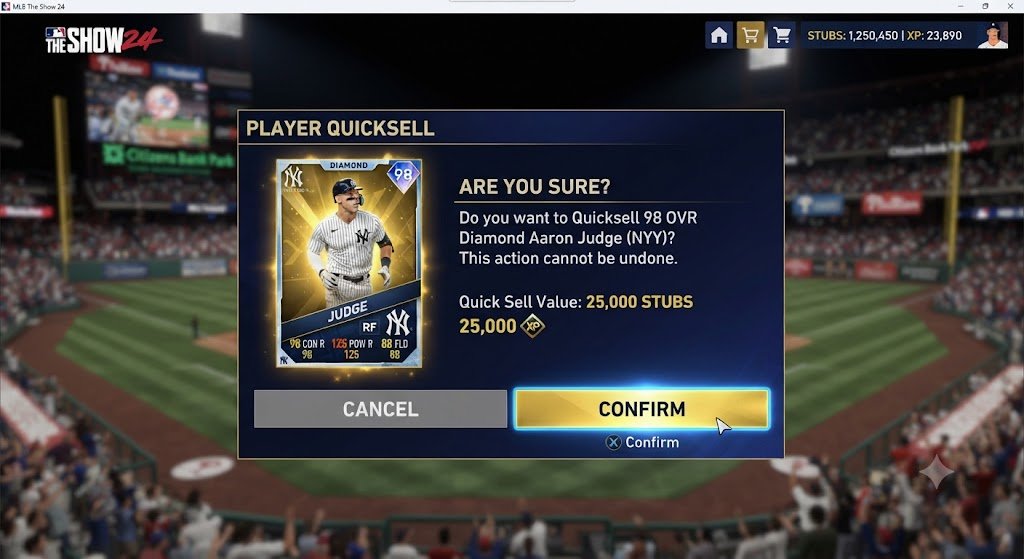
MLB The Show quicksell is one of the simplest features in Diamond Dynasty, yet it is also one of the easiest places to lose Stubs. One button gives you an instant, fixed payout. That speed is useful, but only when you understand card floors, market tax, Live Series ratings, non-Live discounts, and collection restrictions.
This guide explains the current MLB The Show 26 system as of July 2026. It covers exact player-card values, when quick selling beats the Community Market, how roster updates change investment returns, and the mistakes that quietly drain a no-money-spent account.
What Does MLB The Show Quicksell Mean?
An MLB The Show quicksell converts an eligible card or item directly into Stubs at a fixed price. The transaction is immediate, there is no waiting for another player to buy the card, and the standard Community Market transaction tax is not deducted from the payout.
Current reference tables also show that a card’s quick-sell value depends on its overall rating and whether it is a Live Series or non-Live Series item.
That makes MLB The Show quicksell different from two marketplace actions:
- Sell Now: You accept the best active buy order.
- Create Sell Order: You choose a listing price and wait for a buyer.
- Quick Sell: You accept the game’s fixed value immediately.
The fixed value works like a price floor. A market listing can produce more Stubs, but only if its after-tax payout exceeds that floor.
MLB The Show Quicksell Values for Player Cards
The current player-card table separates Live Series cards from non-Live Series cards. Live Series items receive the full listed amount. Non-Live cards generally receive half of the Live Series value, rounded down.
| Overall | Rarity | Live Series QS | Non-Live QS |
|---|---|---|---|
| 64 and below | Common | 5 | 2 |
| 65–74 | Bronze | 25 | 12 |
| 75 | Silver | 50 | 25 |
| 76 | Silver | 75 | 37 |
| 77 | Silver | 100 | 50 |
| 78 | Silver | 125 | 62 |
| 79 | Silver | 150 | 75 |
| 80 | Gold | 400 | 200 |
| 81 | Gold | 600 | 300 |
| 82 | Gold | 900 | 450 |
| 83 | Gold | 1,200 | 600 |
| 84 | Gold | 1,500 | 750 |
| 85 | Diamond | 3,000 | 1,500 |
| 86 | Diamond | 3,750 | 1,875 |
| 87 | Diamond | 4,500 | 2,250 |
| 88 | Diamond | 5,500 | 2,750 |
| 89 | Diamond | 7,000 | 3,500 |
| 90 | Diamond | 8,000 | 4,000 |
| 91 | Diamond | 9,000 | 4,500 |
| 92–99 | Diamond | 10,000 | 5,000 |
These values show why rating thresholds matter. An 84-to-85 Live Series upgrade raises the fixed payout from 1,500 to 3,000 Stubs. An 89-to-90 move raises it from 7,000 to 8,000.
The return is not linear. Serious roster investors should calculate the specific tier jump rather than thinking only in terms of “gold to diamond.”
Live Series vs. Non-Live Series Cards
The biggest source of confusion in MLB The Show quicksell calculations is card type. Two cards can share the same overall rating and rarity while having different fixed payouts.
A 90 OVR Live Series card currently quick sells for 8,000 Stubs. A 90 OVR non-Live card is listed at 4,000.
Captains, legends, flashbacks, special editions, event rewards, and many program cards generally fall into the non-Live category. Checking only the large OVR number can therefore produce a bad estimate.
Before using MLB The Show quicksell, inspect:
- The card series and program source
- Whether it is Live Series or a special card
- The actual quick-sell amount shown on the confirmation screen
- Whether the item is sellable, collected, equipped, or otherwise restricted
The confirmation value displayed in your inventory is the final number that matters.
The 10% Tax Rule That Changes Every Decision
The Community Market deducts a 10% transaction fee from completed card sales, while quick selling pays the fixed amount without that market deduction. This means a market price that looks higher can still return fewer Stubs.
For any MLB The Show quicksell comparison, use this formula:
Net marketplace payout = Listing price × 0.90
To find the minimum listing needed to beat a quick sell:
Break-even listing price = Quicksell value ÷ 0.90
Consider an 85 OVR Live Series diamond:
- Quick-sell payout: 3,000 Stubs
- Break-even market listing: 3,334 Stubs
- Listing at 3,300 returns about 2,970 Stubs
- Listing at 3,400 returns about 3,060 Stubs
Listing at 3,300 is worse than the instant option, even though 3,300 appears higher than 3,000. This is the core math behind every profitable MLB The Show quicksell decision.
MLB The Show Quicksell Break-Even Prices
The following figures are rounded up to the first whole Stub that should at least match or exceed the fixed payout after tax.
| Live Series OVR | Quick Sell | Approx. Break-Even Listing |
| 80 | 400 | 445 |
| 81 | 600 | 667 |
| 82 | 900 | 1,000 |
| 83 | 1,200 | 1,334 |
| 84 | 1,500 | 1,667 |
| 85 | 3,000 | 3,334 |
| 86 | 3,750 | 4,167 |
| 87 | 4,500 | 5,000 |
| 88 | 5,500 | 6,112 |
| 89 | 7,000 | 7,778 |
| 90 | 8,000 | 8,889 |
| 91 | 9,000 | 10,000 |
| 92–99 | 10,000 | 11,112 |
These thresholds are especially valuable when a card is trading close to its floor. If the best realistic sale is below break-even, quick selling is economically stronger.
When the market is comfortably above break-even and demand is active, creating a sell order normally produces more Stubs.
When MLB The Show Quicksell Is the Better Choice
MLB The Show quicksell is not automatically lazy or inefficient. It is rational in several common situations.
The Market Price Is Too Close to the Floor
Suppose an 83 OVR Live Series card has a fixed value of 1,200 Stubs and the realistic listing price is 1,300. After tax, the market returns only 1,170.
The quick sell wins by 30 Stubs and completes instantly.
You Need Immediate Liquidity
A player may need Stubs to complete a limited-time collection, purchase a card before a price spike, or fund a profitable flip. In that case, accepting a slightly lower return can be reasonable if the released Stubs create a larger opportunity elsewhere.
This is a capital-efficiency decision. The fastest payout is not always the highest payout, but idle Stubs also have an opportunity cost.
The Card Has Weak Demand
Low-volume cards can sit in the market while competing sellers continuously undercut one another. When the spread above the floor is tiny, the extra waiting and repricing may not justify a marginal gain.
Always examine actual market activity, not just the lowest visible sell order. A card can have an attractive listed price but almost no buyer demand.
You Are Liquidating a Large Investment Stack
For dozens or hundreds of upgraded Live Series cards, the fixed payout creates a predictable exit. You know the return per card and do not depend on market depth.
This becomes especially useful after a successful roster update investment.
When You Should Not Quicksell
The easiest way to misuse MLB The Show quicksell is to treat every duplicate as disposable. Some duplicates are worth far more than their fixed value because of collections, exchanges, scarcity, pack removal, roster-update speculation, or active lineup demand.
Do not use MLB The Show quicksell immediately when:
- The lowest sell order is well above the tax-adjusted break-even price.
- The card is needed for a collection you plan to complete.
- The item is temporarily scarce or no longer available in packs.
- A roster update, content drop, exchange, event, or collection may increase demand.
- The card has strong gameplay value and could replace a more expensive option.
- You have not checked whether a duplicate is the only sellable copy.
A 10,000-Stub diamond can still trade for 30,000, 100,000, or more if supply is limited and demand is strong. The fixed value is a floor, not a fair-market appraisal.
Roster Update Investing and Quicksell Floors
Live Series investing is where MLB The Show quicksell knowledge becomes a serious bankroll tool. Investors buy cards before roster attribute updates, hoping an OVR increase pushes the card into a higher payout tier.
For example, buying an 84 OVR Live Series player near 1,500 Stubs creates a clear upgrade thesis. If the card reaches 85, its fixed payout becomes 3,000.
The investment is only attractive when the purchase price leaves enough profit after accounting for:
- Downgrade risk
- A missed upgrade
- Capital being locked for several days
- Market hype already included in the price
- Better investments available elsewhere
Current investing guides similarly emphasize buying near the quick-sell floor and avoiding cards whose prices have already been inflated by hype.
Use this expected-value formula:
Expected value = (Upgrade probability × New exit value) + (No-upgrade probability × Expected fallback value) − Entry cost
This is more reliable than saying, “He is playing well, so he must go diamond.”
Real-life performance matters. However, in-game attributes, platoon splits, recent sample size, positional weighting, downgrade exposure, and the price already paid all affect the investment.
Official support also states that after roster attribute updates, existing buy and sell orders can be cancelled and refunded when they fall outside the Stub limits created by the player’s new OVR. That protects the updated price floor, but it also means investors should review open orders around update windows.
A Low-Risk Flipping Method Near Quicksell Value
One advanced MLB The Show quicksell strategy is floor-based flipping. The objective is to place buy orders at or very near a card’s fixed value, then relist the card above its tax-adjusted break-even point.
Consider this example:
- Buy an 84 OVR Live Series card for 1,500
- Quick-sell floor: 1,500
- Sell-order target: 1,850
- After 10% tax: approximately 1,665
- Potential profit: approximately 165 Stubs
The downside is limited if the card remains eligible for the same fixed payout. You can exit near your purchase price when the flip does not work.
However, “low risk” does not mean “no risk.” Rating downgrades can lower the floor, a card may become difficult to sell, and rapid market changes can erase the spread.
Floor-based flips work best when:
- Transaction volume is high.
- The buy-sell spread is stable.
- The market price is comfortably above break-even.
- A roster update is not likely to reduce the card’s OVR.
- You are not overconcentrated in one player.
The quick-sell floor and tax-adjusted spread are widely used in Diamond Dynasty market analysis tools.
How to Quicksell a Card
The menu wording for MLB The Show quicksell can vary slightly by platform or interface update, but the basic process is straightforward:
- Open Diamond Dynasty.
- Go to My Inventory or the relevant collection screen.
- Select the player card or item.
- Open its card options.
- Choose Quick Sell or Quick Sell Duplicates.
- Read the displayed payout carefully.
- Confirm only after checking the market.
The transaction is generally immediate and irreversible. The confirmation screen is therefore your last protection against selling the wrong card.
Why a Card May Not Be Sellable
A card can be blocked from sale because it is active in a lineup, Mini Seasons squad, or event roster. Official support advises removing equipped cards from those locations before trying to sell them.
The same support guidance states that collected cards cannot later be sold.
Common reasons include:
- The card is equipped in a lineup.
- It has been locked into a collection.
- The reward was issued as No Sell.
- The visible copy is not the sellable duplicate.
- An active order or squad assignment is interfering.
- The item has a category-specific restriction.
Do not assume every No Sell card can still be quick sold. Restrictions have varied by card source and game edition, so use the current card options and confirmation screen as the authoritative check.
Common MLB The Show Quicksell Mistakes
Confusing Sell Now With Quick Sell
Sell Now accepts another player’s buy order and remains subject to market tax. Quick Sell uses the fixed game value.
They are not interchangeable.
Ignoring the Non-Live Discount
A special 95 OVR card may quick sell for 5,000 rather than the 10,000 associated with a Live Series card in the same rating range.
The card’s series matters just as much as its displayed OVR.
Listing Below Break-Even
Many players list a card slightly above its fixed value without subtracting the 10% fee. This creates a guaranteed loss compared with quick selling.
A higher gross price does not necessarily mean a higher net payout.
Locking Cards Before Checking Their Value
Collection progress can be valuable, but locking a card removes future selling flexibility. Confirm that the collection reward is worth more to your account than the Stub value you are giving up.
This is especially important with expensive Live Series diamonds.
Selling Every Duplicate Instantly
Duplicates can gain value when exchanges, collections, events, roster changes, or supply shortages increase demand. Check the market and content context before selling.
The best time to sell may be several days after you acquire the card.
A 20-Second Selling Checklist
Before confirming any MLB The Show quicksell, ask:
- Is this Live Series or non-Live?
- What is the exact fixed payout?
- What will the market sale return after the 10% tax?
- Is this card needed for a collection, exchange, event, or lineup?
- Could a roster or content update change demand?
- Is the card scarce, out of packs, or unusually liquid?
- Am I selling the correct duplicate?
This short process prevents most avoidable losses.
Frequently Asked Questions
What Is the MLB The Show Quicksell Value for a Diamond?
It depends on the card’s OVR and series. Current Live Series diamond values range from 3,000 Stubs at 85 OVR to 10,000 Stubs at 92–99 OVR.
Non-Live diamond cards generally pay half of the comparable Live Series amount, rounded down.
Is It Better to Quicksell or Sell on the Market?
Compare the fixed payout with the market price after the 10% fee. Divide the quick-sell value by 0.90 to find the approximate break-even listing.
Below that point, quick selling is usually better. Well above it, a market listing is normally stronger.
Does Quick Selling Have a Tax?
Current market references show no 10% Community Market tax on the fixed quick-sell payout. The tax applies to completed marketplace transactions.
This is why listing a card only slightly above its fixed value can reduce your final return.
Can You Quicksell Collected or No Sell Cards?
A collected card cannot be sold later according to official support, and No Sell restrictions can depend on the card’s source. Some duplicates may remain usable or sellable while the locked copy does not.
Check the exact card options rather than assuming every duplicate shares the same status.
Can You Undo an MLB The Show Quicksell?
The current quick-sell process is described as instant and irreversible. Once confirmed, the card is removed and the Stubs are credited.
Always check the market price, card series, and copy count before finalizing.
Final Takeaway
MLB The Show quicksell should be treated as a financial decision, not a cleanup button. First identify the card type. Then compare the fixed payout with the after-tax marketplace return, review collection and lineup restrictions, and consider whether upcoming content could change demand.
Use the quick sell when it gives the best net return, releases capital for a better opportunity, or provides a safe exit from a roster investment. Use the market when demand creates a meaningful premium.
That one habit—calculating before clicking—can preserve thousands of Stubs across a Diamond Dynasty season.