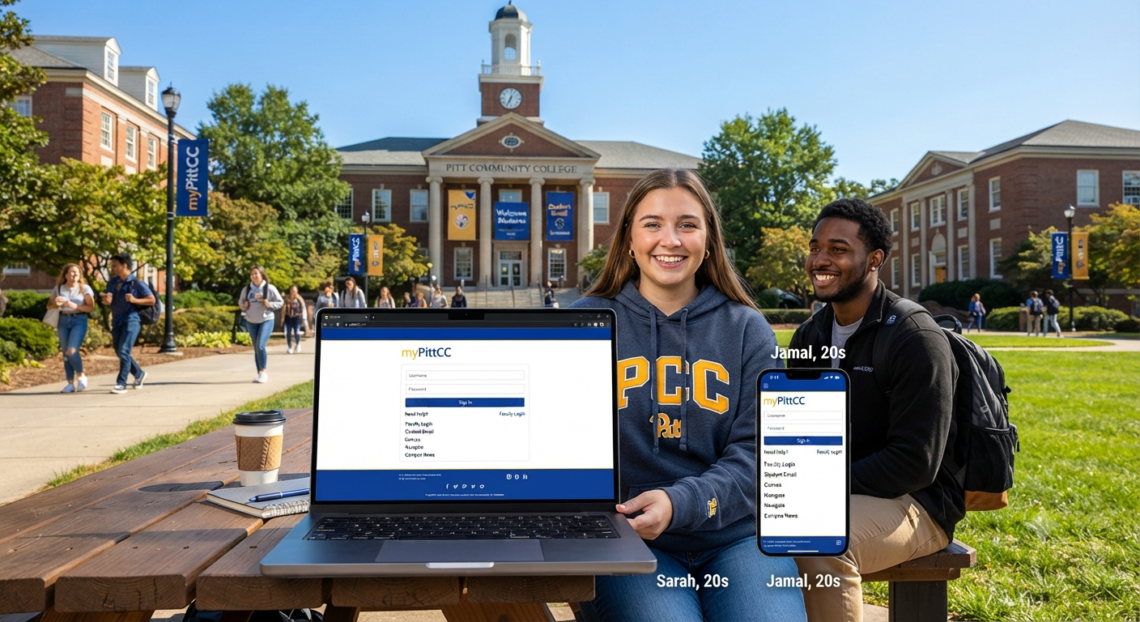
Mypittcc is the search term many students use when trying to reach myPittCC, the official online portal for Pitt Community College. It acts as a central access point for student email, Moodle, registration tools, financial-aid information, grades, schedules, payments and other college services.
Pitt Community College describes the platform as a single-sign-on system. This means one institutional account can provide access to several connected resources without requiring a separate username and password for every service.
This guide explains what the portal does, how to sign in correctly, how account credentials are created, what to do when access fails and how to use the platform more efficiently. Because portal screens and security procedures can change, official Pitt Community College instructions should always be treated as the final authority.
What Is Mypittcc?
Mypittcc refers to the secure student and employee portal operated for the Pitt Community College community. The college’s official branding normally appears as myPittCC, so users searching for “my pitt cc,” “PittCC portal” or “Pitt Community College login” are generally looking for the same platform.
The portal is much more than a login page. It connects students with essential academic and administrative tools, including:
- PCC student email
- Moodle online courses
- Class registration and schedule planning
- Financial-aid information
- Official grades
- Account balances and tuition payments
- Parking decal registration
- College announcements and student resources
Pitt Community College states that students need the portal to check email, access Moodle and open the PCC Services area used for registration, financial-aid status and official grades.
Why the Portal Matters
A student can miss an important deadline even while attending classes regularly. Registration windows, account notices, instructor messages, financial-aid updates and online-course activities may all appear through connected college systems.
That makes Mypittcc part of a student’s regular academic routine rather than a website used only during enrollment. Checking it consistently can help prevent missed assignments, unpaid balances, schedule mistakes and unanswered college communications.
How to Access the Mypittcc Login Page
The safest route is to begin on the official Pitt Community College website and select the myPittCC link displayed near the top of the page. The college’s new-student instructions specifically direct users to visit its main website and click that portal link.
Follow these steps:
- Open the official Pitt Community College website.
- Select myPittCC from the upper navigation area.
- Enter your full institutional username.
- Enter your current password.
- Complete multi-factor authentication when prompted.
- Use the portal dashboard or quick-launch links to open the required service.
Avoid signing in through unfamiliar advertisements, unofficial login websites or links sent by unknown accounts. A fraudulent page may imitate the Microsoft or college sign-in screen to capture usernames, passwords and authentication codes.
Mypittcc Username Format Explained
For a standard PCC account, the official login instructions say the username is built from the student’s first initial, middle initial, full last name and final three digits of the seven-digit PCC ID. It is entered in lowercase, without spaces, and followed by @my.pittcc.edu.
For example, a hypothetical student named Billy Michael Doe with an ID ending in 765 would use a format similar to:
Students who have no middle initial—or whose middle initial was not recorded—may need to leave it out. Small details matter. A capital letter, accidental space, incorrect initial or confusion between the number zero and the letter “o” can cause a failed login.
Where to Find the Seven-Digit PCC ID
The seven-digit identification number may appear on a student ID card or official college correspondence. Curriculum students who cannot locate it are directed to contact the Registrar’s Office, while Continuing Education students should contact the Continuing Education Registration and Records Office.
Technical Support cannot provide the ID number for security reasons.
Do not post your full ID publicly or send it through an unverified message. It is part of the information used to establish and recover account access.
First-Time Password Rules
New accounts use an initial password formula described in the college’s login instructions. The default password combines the student’s six-digit birth date, uppercase first-name initial, lowercase last-name initial and full seven-digit PCC ID.
For example, the structure may look like this:
MMDDYY + uppercase first initial + lowercase last initial + seven-digit ID
After signing in, the user is prompted to create a new password. Current official guidance requires the password to:
- Contain at least 14 characters
- Avoid containing the account name
- Avoid using more than two consecutive characters from the user’s full name
- Include characters from at least three approved categories
- Use uppercase letters, lowercase letters, numbers or symbols
The college also states that an account may display a password-expiration notice when the password has not been changed for 360 days. Advance warnings normally appear before expiration, after which the user is prompted to create another password.
A strong password should be unique to Mypittcc. Reusing a password from social media, shopping accounts or personal email means one unrelated security breach could expose the student portal.
Setting Up Multi-Factor Authentication
Multi-factor authentication, commonly shortened to MFA, adds a second verification step after the password. Pitt Community College supports the Microsoft Authenticator app as well as phone-based verification through a call or text message.
The college recommends Microsoft Authenticator because completing the one-time setup can make future verification easier.
During setup, students generally sign in with the full @my.pittcc.edu address, enter their password and respond to the message indicating that additional information is required. They can then link Microsoft Authenticator or register a phone number capable of receiving verification calls or text messages.
Practical MFA Tips
- Register a device you control and use regularly.
- Keep Microsoft Authenticator installed when moving to a new phone.
- Update verification details before losing access to an old number.
- Never approve a sign-in request you did not initiate.
- Never share a one-time verification code with another person.
- Review repeated authentication prompts immediately.
An unexpected MFA prompt may indicate that someone else knows the password. Reject the request, reset the password through the official recovery process and contact the Helpdesk if suspicious activity continues.
What Can You Do Inside Mypittcc?
The value of Mypittcc comes from the connected services available after authentication. Exact dashboard labels may evolve, but the main student tasks remain centered on communication, course access, registration and account management.
Access Moodle and Online Courses
Moodle is Pitt Community College’s learning management system for online lessons, assignments, quizzes, announcements and course materials. The college’s post-registration guidance says students can enter Moodle from the portal’s Quick Launch area.
Courses may not appear inside Moodle until the first official day of class.
Online students should not assume that a missing course several days before the semester means registration has failed. First confirm the class start date and registration schedule.
When a course remains missing after its expected start date, contact the instructor or the appropriate college support office. Include your full name, course number and section so the issue can be investigated efficiently.
Check PCC Student Email
College email is a formal communication channel. Instructors and administrative departments may use it for class instructions, deadlines, financial notices, account updates and requests for action.
PCC’s distance-learning guidance advises online students to contact instructors from their institutional email address. The message should include the course name, course number, section, student name and relevant contact information.
Using the official account creates a clearer communication record than contacting an instructor from an unrelated personal email address. It also makes it easier for the recipient to identify the student and confirm enrollment.
Register and Plan Classes
The portal connects to student services used for planning schedules and registering for courses. Students should review prerequisites, account holds, advisor requirements, section formats and start dates before submitting their selections.
A course that fits a timetable is not automatically the right course. Confirm whether it is offered as:
- Traditional classroom instruction
- Fully online instruction
- Synchronous online instruction
- Hybrid instruction
- Blended instruction
Attendance expectations can differ between these formats. Pitt Community College’s new-student guidance explains that online students may need to complete an attendance quiz, while hybrid or blended students may need to attend class and complete the quiz.
Review Financial Aid and Make Payments
New-student instructions direct users to the Students area to view account information, make payments and review financial-aid status.
Students should check both the financial-aid section and the actual account balance. An application, award notice or estimated aid amount does not necessarily mean that every charge has already been covered or that all requirements have been completed.
Save transaction confirmations and revisit the account after making changes. Registration can be affected when payment responsibilities or financial-aid documentation remain unresolved.
View and Print the Class Schedule
Students can use the registration or planning area to review their timetable and print a schedule. The college places this function under Plan/Schedule and Advising within the Students section.
Review the schedule again shortly before classes begin. Room assignments, instructor details or course-delivery information may be updated after initial registration.
Register for a Parking Decal
The portal also connects students with parking decal registration. PCC’s new-student instructions direct users to the Registration area under the Students tab, where they can select the relevant parking registration option.
Students should complete any required tuition or enrollment steps before attempting to collect a student ID or parking decal. Requirements and collection hours should be checked through current college instructions.
How to Reset a Forgotten Mypittcc Password
The official recovery process uses Microsoft’s password-reset system. Students enter their full portal email address, complete the CAPTCHA, choose the forgotten-password option and verify their identity through a previously configured call, text message or alternate email.
Use this sequence:
- Open the official PCC password-reset instructions.
- Follow the provided link to Microsoft’s recovery tool.
- Enter your complete institutional email address.
- Complete the identity-verification challenge.
- Select an available recovery method.
- Enter the verification code you receive.
- Create a compliant new password.
- Enter the new password again for confirmation.
- Sign in and test the connected services.
The new password must be at least 14 characters long and satisfy the college’s complexity requirements. It must not contain the account name or excessive consecutive characters from the user’s full name.
Password recovery may fail when no usable verification method has been registered, the phone number has changed or the institutional username is entered incorrectly. In that situation, contact the official Helpdesk rather than repeatedly guessing passwords.
Mypittcc Login Problems and Fast Fixes
Most login failures are caused by a small credential, browser or verification issue. Work through these checks in order before contacting support.
“My Username Is Not Recognized”
Confirm your initials, full last name, final three ID digits and @my.pittcc.edu ending. Use lowercase letters and remove all spaces.
Students with no recorded middle initial should try the format without it, consistent with the college’s official guidance.
“My Password Is Incorrect”
Check Caps Lock and your keyboard layout first. Make sure you have not confused the number zero with the letter “o.”
When the password has previously been changed, the original default formula will no longer work. Use the official password-reset process rather than continuing to enter the first-time password.
“I Cannot Complete MFA”
Confirm that your phone has an internet or mobile-network connection and that notifications are enabled. For text verification, check that the registered number is still active.
When using Microsoft Authenticator, open the application directly rather than relying only on a notification. Do not approve a request unless you personally started the sign-in attempt.
“Moodle Opens but My Course Is Missing”
Verify the official start date and your registration status. PCC states that Moodle courses do not appear until the first day of class.
When the start date has passed, contact the instructor and provide your course name, number and section. Support may also be needed if multiple registered courses are missing.
“The Portal Keeps Reloading or Shows a Blank Page”
Close duplicate sign-in tabs, then clear cookies associated with PCC and Microsoft services. Try opening the portal in a private or incognito browser window.
You can also test another updated browser and temporarily disable extensions that block scripts, redirects or cookies. Make sure the device’s date and time settings are correct, as inaccurate settings can interfere with secure authentication.
“My Account Is Locked”
Stop entering passwords repeatedly. Additional failed attempts may make the problem harder to diagnose.
Wait briefly, confirm the username format and use the official recovery tool. Contact the Helpdesk when the account remains inaccessible after a successful password reset.
Security Best Practices for Mypittcc Users
A college account may contain personal information, academic records and access to private communications. Protect it with habits that are simple enough to follow every day.
- Use a unique password containing at least 14 characters.
- Maintain an active MFA method.
- Sign out when using a shared or public computer.
- Do not save credentials in a browser you do not control.
- Verify the website before entering a password.
- Reject unexpected authentication requests.
- Report suspicious emails instead of opening attachments.
- Keep your recovery number and alternate email current.
- Never share your password or authentication code.
- Lock your device when stepping away.
Pitt Community College publishes acceptable-use, email, internet, text-messaging and network-security policies for students and employees.
Users should follow those institutional requirements in addition to standard cybersecurity practices. Academic access can be disrupted when an account is compromised or used in a way that violates college policies.
Tips for Using the Portal More Efficiently
A few practical habits can make the portal easier to manage.
Create a Weekly Check Routine
Choose specific days to review:
- Institutional email
- Moodle announcements
- Upcoming assignment deadlines
- Class schedule changes
- Account balance
- Financial-aid requirements
- Registration notices
During active online courses, email and Moodle should normally be checked more frequently than once a week. The appropriate schedule depends on the instructor’s expectations and course format.
Use Official Email for College Business
Messages sent from the PCC account are easier for instructors and departments to recognize. Use a clear subject line and include the information needed to identify your course or account issue.
Never place your password or MFA code in an email. Technical staff do not need either one to begin investigating an access problem.
Save Important Confirmations
Keep records of:
- Course registration
- Tuition payments
- Financial-aid submissions
- Schedule changes
- Password-reset confirmations
- Support case details
Screenshots can be helpful, but remove or hide sensitive information before sharing them. A complete screenshot containing a student ID, verification code or personal details can create a security risk.
Resolve Access Problems Before Deadlines
Do not wait until minutes before an assignment, registration closing time or payment deadline to test your account. Open every essential service at the beginning of the term and after changing your password.
Confirm that email, Moodle, registration tools and account information all load correctly. Solving an access issue early leaves time to contact the appropriate department.
Official Help and Support
When self-service steps do not solve the problem, use official college support. Pitt Community College lists the Technical Support Helpdesk email as and its phone number as 252-493-7487.
Published remote-support hours are Monday through Thursday from 8 a.m. to 5 p.m. and Friday from 8 a.m. to 3 p.m.
In-person assistance is also listed at the Technical Support Helpdesk in the Vernon White Building. Additional support locations include the PCC Library, Academic Skills Lab and Goess Computer Lab.
Before contacting support, record:
- The exact error message
- The service that is not working
- The approximate time the problem occurred
- The device being used
- The browser name
- Troubleshooting steps already attempted
Do not send your password, default password formula or MFA verification code. Support staff can investigate an account without receiving those secrets.
Frequently Asked Questions
1. Is Mypittcc the official Pitt Community College portal?
The official name is normally styled myPittCC. It is Pitt Community College’s single-sign-on portal for institutional email, Moodle and student-service functions such as registration, financial aid and official grades.
Students should access it through the official Pitt Community College website. Using the main college website reduces the risk of entering credentials on an unofficial or fraudulent login page.
2. What username should I use for Mypittcc?
The standard format uses the first initial, middle initial, full last name and final three digits of the seven-digit PCC ID. It is followed by @my.pittcc.edu and should be entered without spaces or capital letters.
Students without a middle initial—or whose middle initial was not recorded—may need to omit it. Confirm the spelling of the last name and make sure numbers have not been replaced with similar-looking letters.
3. Why can I sign in but not see my Moodle class?
A class may not become visible in Moodle until its first official day. Confirm the course start date, registration status and section before reporting a technical issue.
When the course should already be available, email the instructor from your PCC student account. Include your full name, course number and section, then contact technical support when appropriate.
4. Can the Helpdesk tell me my seven-digit student ID?
The college states that Technical Support cannot provide the seven-digit ID for security reasons. Curriculum students should contact the Registrar’s Office, while Continuing Education students should use their designated Registration and Records contact.
Students may also find the number on their PCC identification card or certain official college correspondence. It should be stored securely and never posted publicly.
5. What should I do after resetting my Mypittcc password?
Sign in through the official portal, complete MFA and test the services you use most, including email, Moodle and student services. Update any saved password only on trusted personal devices.
Reject unexplained MFA requests and contact the Helpdesk when one connected service continues to fail. A successful password reset does not always resolve an unrelated browser, Moodle or registration issue.
Conclusion: Make the Portal Part of Your Academic Routine
Mypittcc works best when students treat it as their central academic dashboard. Sign in through the official college website, secure the account with a unique password and MFA, check institutional email frequently and review Moodle from the first day of class.
Registration, financial aid, account balances and class schedules should also be checked before important deadlines. Do not assume that an application, payment or course selection has been completed until the updated status appears in the appropriate system.
Start by confirming that your username, recovery methods and MFA settings are correct. Then open each essential service once—email, Moodle, schedule, financial aid and account balance—so a login problem does not become an emergency when an assignment, registration window or payment is due.





3 Comments on “Mypittcc Login and Student Portal Guide: Access, Features, Password Reset and Troubleshooting”