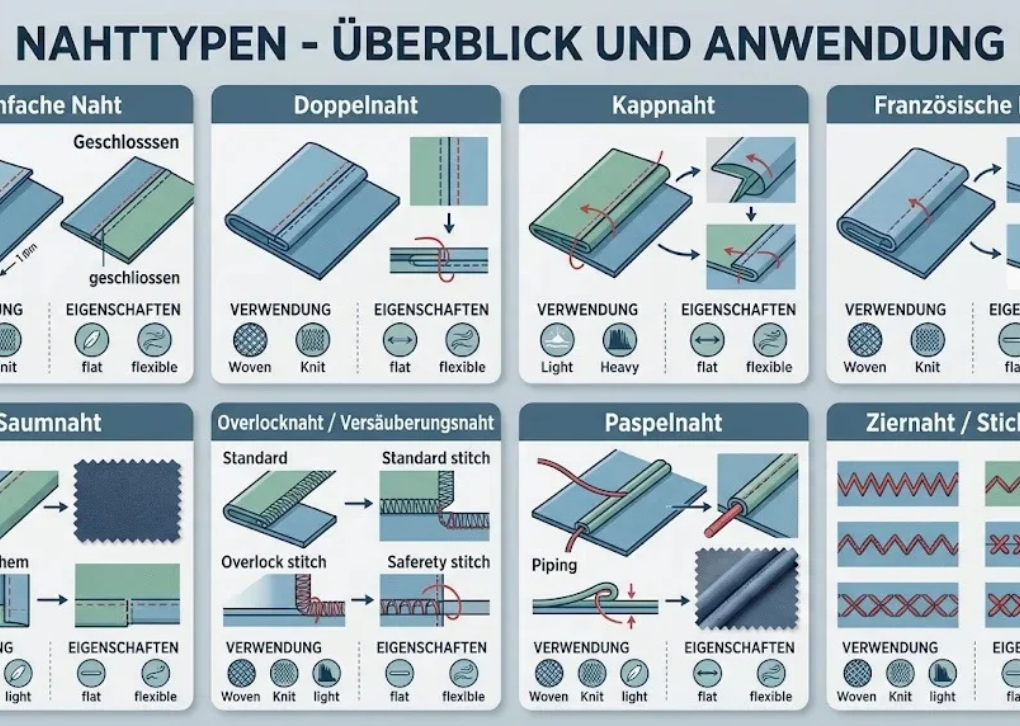
Nahttypen is a German term meaning types of seams, and understanding these techniques is one of the most important skills in sewing, tailoring, fashion design, and textile manufacturing. Whether you are making clothing, repairing garments, creating home textiles, or learning professional sewing techniques, choosing the right seam can determine how well your finished project looks, fits, and lasts.
Not all seams serve the same purpose. Some are designed for strength, others for flexibility, decoration, comfort, or preventing fabric edges from fraying. A lightweight silk blouse, for example, requires a different construction approach than a pair of denim jeans or a stretchy sportswear garment.
This comprehensive guide explores the major seam constructions, their German and English names, practical applications, sewing techniques, common mistakes, and professional methods for achieving durable results.
What Does Nahttypen Mean in Sewing?
The word Nahttypen combines two German words: Naht, meaning seam, and Typen, meaning types or categories. In garment construction, it refers to the different methods used to join, secure, finish, or decorate fabric through stitching.
A seam is created when two or more fabric sections are connected, usually with thread and a sewing machine. However, professional textile construction also includes specialized seam formations, edge finishes, and decorative stitching techniques.
Understanding the difference between these elements is essential because they influence both the appearance and performance of a garment.
Seam Types vs. Stitch Types: Understanding the Difference
One common misunderstanding is treating seams and stitches as identical.
A seam describes how fabric pieces are arranged and joined, while a stitch describes the thread formation used to create that connection.
For example:
Plain seam: A construction method for joining fabric pieces.
Straight stitch: A basic stitch formation commonly used to sew plain seams.
French seam: A seam construction that encloses raw fabric edges.
Zigzag stitch: A stitch formation useful for flexible sewing and edge finishing.
Overlock stitch: A stitch formation commonly used to construct or finish fabric edges.
This distinction helps beginners select the correct technique rather than assuming that one sewing-machine setting works for every construction method.
Why Understanding Different Nahttypen Matters
The seam construction you choose affects much more than appearance. It can influence how a garment stretches, moves, survives washing, and responds to daily wear.
An unsuitable seam may cause puckering, broken stitches, uncomfortable bulk, or premature fabric damage.
Strength and Durability
Garments experience different levels of stress depending on their purpose. Workwear, jeans, and outdoor clothing generally require stronger constructions than decorative curtains or lightweight fashion accessories.
Flat-felled and properly constructed lapped seams are often selected for demanding applications because they can provide durable joining methods.
Comfort and Flexibility
Seams must accommodate body movement, particularly in sportswear, leggings, underwear, and fitted clothing.
A rigid straight stitch may break when used across a highly elastic fabric. Stretch-compatible stitch formations and suitable thread are therefore important.
Professional Appearance
A well-constructed seam creates a cleaner finish, controls fraying, and helps garments retain their intended shape.
This becomes particularly important with transparent fabrics, luxury garments, tailored clothing, and products where the inside construction remains visible.
Essential Nahttypen Every Sewing Beginner Should Know
The following seam constructions form the foundation of many sewing projects, from everyday clothing to professional fashion manufacturing.
1. Plain Seam (Einfache Naht)
The plain seam is one of the most widely used construction methods. Two fabric pieces are generally placed with their right sides facing each other and sewn along the intended seam line.
After stitching, the seam allowances can be pressed open or together, depending on the fabric and garment design.
Common applications:
Shirts and blouses
Dresses and skirts
Pillowcases
Lightweight trousers
Everyday garment construction
How to sew it:
Align the fabric edges with the right sides together.
Pin or clip the fabric sections securely.
Sew along the designated seam allowance.
Finish the raw edges when necessary.
Press the seam according to the garment requirements.
A standard 1.5 cm seam allowance is common in some home-sewing patterns, but allowances vary by pattern, manufacturer, and construction method.
2. French Seam (Französische Naht)
The French seam is particularly valuable for delicate, lightweight, or slightly transparent fabrics. Its defining characteristic is that the raw fabric edges become enclosed inside the finished seam.
This creates a neat interior without requiring a separate overlock finish.
Best suited for:
Chiffon
Lightweight cotton
Silk
Organza
Fine blouses and dresses
To create a French seam, begin with the wrong sides of the fabric together and sew a narrow first seam. Trim the allowance carefully, turn the fabric so the right sides face each other, and sew again to enclose the first allowance.
For a total allowance of 1.5 cm, one practical method is a first seam at 0.5 cm followed by a second seam at 1 cm, after trimming the first allowance sufficiently.
French seams are attractive but can become bulky when applied to thick materials.
3. Flat-Felled Seam (Kappnaht)
A flat-felled seam is a durable construction that encloses raw edges and produces a neat, relatively flat finish.
It is frequently associated with denim garments, casual shirts, and workwear.
Advantages include:
Enclosed raw edges
Strong construction when sewn correctly
Neat appearance
Resistance to fraying
Suitable performance under repeated wear
The technique involves joining the fabric sections, trimming one seam allowance, folding the other around it, and stitching the folded allowance down.
Because multiple fabric layers overlap, needle selection and machine feeding become important when working with heavy denim.
4. Overlocked Seam (Overlocknaht)
An overlocked seam uses specialized stitch formations to join fabric or finish raw edges. An overlocker, also called a serger, typically trims and stitches the fabric edge during the same operation.
This method is especially common in ready-to-wear clothing manufacturing.
It works well for knit fabrics, T-shirts, casual clothing, and garments requiring efficient edge finishing.
However, an overlocked edge finish and a structurally joined overlock seam are not necessarily the same thing. The machine configuration and construction method determine whether the stitching joins fabric layers or merely protects an exposed edge.
5. Lapped Seam (Überlappungsnaht)
A lapped seam is formed by overlapping fabric sections rather than joining them exclusively with right sides facing.
The overlapping layers are secured with one or more rows of stitching, depending on the required appearance and strength.
This construction appears in certain leather goods, technical textiles, outerwear, and decorative applications.
It can reduce the need for conventional turned seam allowances, although the suitability of the construction depends on the material and intended use.
6. Bound Seam (Eingefasste Naht)
A bound seam uses binding material to cover exposed seam allowances or fabric edges.
The binding may be made from bias-cut fabric, a commercially prepared strip, or another suitable textile.
It is particularly useful for unlined jackets, decorative interior finishes, and fabrics that benefit from carefully controlled edge protection.
A Hong Kong finish is a related technique in which binding is applied to individual seam allowances, commonly using lightweight bias strips.
7. Welt Seam (Weltnaht)
A welt seam is created by stitching fabric pieces together, pressing the seam allowances to one side, and securing them with an additional row of stitching through the garment.
The visible topstitching creates a defined construction detail.
Welt seams are used in selected sportswear, shirts, jackets, and decorative garment designs.
They should not be confused with welt pockets, which are a separate garment-construction feature.
8. Mock Flat-Felled Seam
A mock flat-felled seam imitates the appearance of a traditional flat-felled seam but may use a simpler construction process.
It is often chosen when the desired visual effect is more important than reproducing the complete enclosed-edge structure.
Depending on the method, seam allowances may be finished separately before topstitching.
This makes the technique useful for beginners who want a workwear-inspired appearance without handling a complicated folded construction.
Comparison of Common Nahttypen
The table below provides a practical overview of major seam constructions and their most suitable applications.
| Seam type | German term | Suitable fabrics | Main advantage |
|---|---|---|---|
| Plain seam | Einfache Naht | Cotton, linen, woven fabrics | Simple and versatile |
| French seam | Französische Naht | Silk, chiffon, fine cotton | Enclosed, clean finish |
| Flat-felled seam | Kappnaht | Denim, shirting, workwear | Durable construction |
| Overlocked seam | Overlocknaht | Knits, jerseys, many wovens | Efficient joining or finishing |
| Lapped seam | Überlappungsnaht | Leather, technical fabrics | Overlapping construction |
| Bound seam | Eingefasste Naht | Jackets, woven fabrics | Decorative edge protection |
| Welt seam | Weltnaht | Shirts, jackets, casualwear | Visible topstitching |
| Mock flat-felled seam | Imitierte Kappnaht | Cotton, denim, medium-weight wovens | Similar appearance with simpler sewing |
There is no universally superior construction. The best choice depends on the fabric, expected mechanical stress, garment design, and available sewing equipment.
Advanced Nahttypen Used in Professional Garment Construction
Beyond basic sewing methods, professional manufacturers use specialized seams to improve performance, fit, appearance, and manufacturing efficiency.
Flatlock Seam (Flatlocknaht)
A flatlock seam is designed to create a relatively flat connection between fabric sections. It is particularly useful in garments where bulky seam allowances could cause discomfort.
Flatlock constructions are commonly associated with activewear, base layers, and performance clothing.
There is an important technical distinction: an overlocker can produce a flatlock-style seam by sewing and opening the fabric layers, while industrial flatseaming equipment can produce specialized multi-thread constructions.
Coverstitched Seam (Überdecknaht)
Coverstitching is commonly used to finish the hems of stretch garments. The characteristic construction usually shows parallel rows of stitching on one side and a thread formation covering the fabric edge on the other.
You will frequently encounter this technique on T-shirt hems, leggings, and sportswear.
A coverstitch machine differs from a conventional overlocker because it is designed for specific covering and hemming operations rather than trimming fabric edges during ordinary overlocking.
Piped Seam (Paspelnaht)
A piped seam incorporates a narrow strip of fabric or decorative piping into the joining area.
It adds definition to garment edges and can create a contrasting design detail.
Common applications include cushions, upholstery, jackets, handbags, and decorative clothing.
The piping itself is primarily a design and finishing element; it should not automatically be considered a structural reinforcement.
Princess Seam (Prinzessnaht)
Princess seams are shaped construction lines used to create a fitted garment silhouette. They often run vertically through the bodice and help distribute shaping without relying entirely on traditional darts.
These seams are common in tailored dresses, jackets, coats, and fitted tops.
Unlike a French seam or flat-felled seam, the term describes a shaping seam location and function, not one specific method of finishing the fabric edges.
How Nahttypen Are Classified in Industrial Sewing
Professional textile manufacturing uses standardized classifications to describe seam construction more precisely.
The international standard ISO 4916 provides a system for classifying seam types according to how textile components are arranged and joined.
The classification includes eight seam classes, such as superimposed, lapped, bound, flat, and ornamental constructions.
Coats Group plc+1
This standardized terminology helps manufacturers communicate technical requirements and maintain consistency across production processes.
Why Standardized Seam Classification Matters
In large-scale garment manufacturing, two seams may look similar but have different structural characteristics.
Technical documentation helps distinguish these differences by specifying construction arrangements, stitch types, thread requirements, and other production details.
For example, a garment specification may identify both the seam configuration and the stitch formation instead of relying on a general description such as “strong seam.”
Choosing the Right Nahttypen for Different Fabrics
Fabric behavior should guide seam selection. Weight, elasticity, weave structure, thickness, and fraying tendency all influence the construction process.
Lightweight Fabrics
Chiffon, voile, fine cotton, and lightweight silk benefit from seam constructions that control raw edges without adding unnecessary bulk.
French seams are often a good choice because they create a clean interior.
However, very narrow seam allowances must be handled carefully to prevent loose fibers from escaping.
Medium-Weight Woven Fabrics
Cotton poplin, linen blends, and many dressmaking fabrics work well with conventional plain seams.
The seam allowances can be finished with zigzag stitching, overlocking, binding, or another suitable method.
Pressing is especially important because it improves the final appearance and helps the seam lie correctly.
Heavyweight Fabrics
Denim, canvas, and other sturdy materials may require stronger needles, appropriate thread, and constructions designed to withstand repeated stress.
Flat-felled seams are frequently used in denim and workwear.
Before sewing thick intersections, check whether your machine can feed multiple layers evenly without skipped stitches.
Stretch and Knit Fabrics
Jersey, rib knit, interlock, and elastane-blend materials require constructions that accommodate movement.
A narrow zigzag, suitable stretch stitch, or correctly adjusted overlock seam can provide the necessary flexibility.
The important consideration is not simply whether the stitch looks elastic, but whether the completed seam can stretch sufficiently without breaking.
Recommended Sewing Settings for Common Materials
The following settings are practical starting points, not universal rules. Always test them on scraps of the actual fabric.
| Fabric | Suggested needle | Starting stitch length | Suitable construction |
|---|---|---|---|
| Lightweight cotton | Universal 70/10–80/12 | 2.0–2.5 mm | Plain or French seam |
| Chiffon | Microtex 60/8–70/10 | 1.8–2.2 mm | Narrow French seam |
| Medium linen | Universal 80/12–90/14 | 2.5–3.0 mm | Plain or bound seam |
| Denim | Jeans 90/14–110/18 | 2.5–3.5 mm | Flat-felled seam |
| Jersey | Ballpoint or stretch 75/11–90/14 | Machine-dependent | Stretch or overlock seam |
| Canvas | Universal or jeans 90/14–110/18 | 2.8–3.5 mm | Plain or reinforced seam |
Needle size, stitch length, and thread thickness should be adjusted according to the actual fabric and machine manufacturer’s recommendations.
Common Mistakes When Working With Nahttypen
Even experienced sewists encounter construction problems when fabric characteristics and machine settings are poorly matched.
Using the Wrong Seam Allowance
A seam allowance that is too narrow can weaken the construction or make finishing difficult.
An excessively wide allowance can create unnecessary bulk, especially around curved areas.
Follow the pattern’s specified allowance and account for any additional fabric needed for folded constructions.
Ignoring Fabric Stretch
A rigid stitch may work perfectly on stable cotton but fail on highly elastic jersey.
Test the seam by gently stretching a sewn sample in the direction it will experience during wear.
If the thread breaks before the fabric reaches its expected extension, the construction needs adjustment.
Skipping Pressing
Pressing is not merely a cosmetic step. It helps establish seam direction, control thickness, and produce accurate garment shaping.
Professional sewing workflows frequently include pressing between construction stages rather than waiting until the garment is complete.
Choosing an Incorrect Needle
A dull or unsuitable needle can cause skipped stitches, fabric damage, or uneven thread formation.
Use ballpoint or stretch needles for appropriate knit fabrics, sharp microtex needles for many tightly woven delicate fabrics, and jeans needles for dense denim.
Failing to Test Seam Strength
A seam may look attractive while performing poorly under tension.
For garments that will experience substantial movement or repeated stress, test the construction before sewing the final garment.
How to Test Seam Quality Before Finishing a Garment
A small test sample can prevent costly mistakes and wasted fabric.
Use the following procedure:
Cut two fabric scraps with the same grain orientation as the final garment.
Sew them using the planned construction, needle, and thread.
Inspect both sides for puckering, skipped stitches, and uneven tension.
Apply gentle tension in the expected direction of wear.
Stretch the sample if the finished garment requires elasticity.
Wash and dry the sample according to the intended care instructions.
Check whether the seam has distorted, frayed, or weakened.
For professional production, formal seam-strength and seam-slippage testing may be necessary. A home test is useful for screening construction problems, but it does not replace laboratory evaluation.
Sewing Machine vs. Overlocker vs. Coverstitch Machine
Understanding machine capabilities makes it easier to select the right construction method.
| Machine | Main function | Common applications |
|---|---|---|
| Conventional sewing machine | Straight, zigzag, and specialty stitches | General garment construction |
| Overlocker/serger | Joins or finishes edges with overedge stitching | Knit garments and edge finishing |
| Coverstitch machine | Creates covering and hemming stitches | T-shirt hems and activewear |
| Industrial flatseamer | Produces specialized flat seam constructions | Performance apparel |
| Industrial double-needle machine | Creates parallel stitch rows | Workwear and decorative topstitching |
A conventional sewing machine can produce many professional-quality seams. Specialized equipment becomes particularly valuable when working with demanding materials, complex constructions, or high production volumes.
Sustainable Sewing and the Importance of Durable Nahttypen
Seam construction can also influence the lifespan and repairability of textile products.
A garment with properly selected stitching, durable thread, and well-finished allowances may withstand repeated wear and laundering more effectively than one with unsuitable construction.
However, stronger stitching alone does not guarantee a longer-lasting garment. Fabric quality, fit, abrasion resistance, laundering conditions, and overall design also matter.
For sustainable garment making, prioritize repairable constructions, appropriate seam allowances, and thread compatibility instead of assuming that additional stitching always improves durability.
Frequently Asked Questions About Nahttypen
1. What are the most common Nahttypen used in clothing?
The most common constructions include plain seams, French seams, flat-felled seams, overlocked seams, and various topstitched or lapped constructions.
Plain seams are especially versatile for everyday woven garments, while overlocked constructions are common in commercially manufactured knit clothing. French seams are often selected for delicate fabrics, and flat-felled seams are popular in durable workwear.
2. Which seam type is strongest for heavy-duty clothing?
Flat-felled seams are widely used for durable clothing because they enclose raw edges and can distribute stress effectively when properly constructed.
However, seam strength depends on more than construction alone. Thread strength, stitch density, fabric properties, seam allowance, and manufacturing quality all influence performance.
3. Can I sew professional Nahttypen without an overlocker?
Yes. A standard sewing machine can create plain seams, French seams, flat-felled seams, bound seams, and many decorative constructions.
For raw-edge finishing, a suitable zigzag or overcasting stitch may replace some overlocker operations. The result may look different, but a carefully executed finish can still be durable and professional.
4. What is the difference between a French seam and a flat-felled seam?
Both constructions can enclose raw fabric edges, but they differ in appearance and assembly.
A French seam encloses the allowances inside a narrow folded seam and is particularly useful for lightweight fabrics. A flat-felled seam folds and secures allowances into a flatter construction, making it suitable for many shirts, jeans, and workwear applications.
5. Which Nahttypen are best for stretchy fabrics?
Stretch-compatible overlock seams, flatseam constructions, and seams made with appropriate zigzag or stretch stitches are often suitable for elastic fabrics.
The correct choice depends on the garment’s required stretch, thickness, comfort, and intended activity. Testing the finished seam on fabric scraps is the most reliable way to identify problems before completing the garment.
Conclusion: Mastering Nahttypen for Better Sewing Results
Understanding Nahttypen helps transform sewing from a series of basic stitching operations into a deliberate construction process.
Start with plain seams, French seams, and flat-felled seams to develop a strong foundation. Then explore overlocked, bound, lapped, and specialized stretch constructions as your skills and projects become more demanding.
Before beginning your next project, identify the fabric’s properties, select the appropriate seam construction, test the stitch settings, and inspect a sample after pressing and washing. These simple habits can improve durability, comfort, and appearance while reducing avoidable sewing mistakes.
Technical References and Further Reading
For readers interested in professional terminology and industrial sewing standards, these resources provide additional technical information:
These references are useful for checking terminology, comparing seam constructions, and understanding how home-sewing techniques relate to industrial garment production.