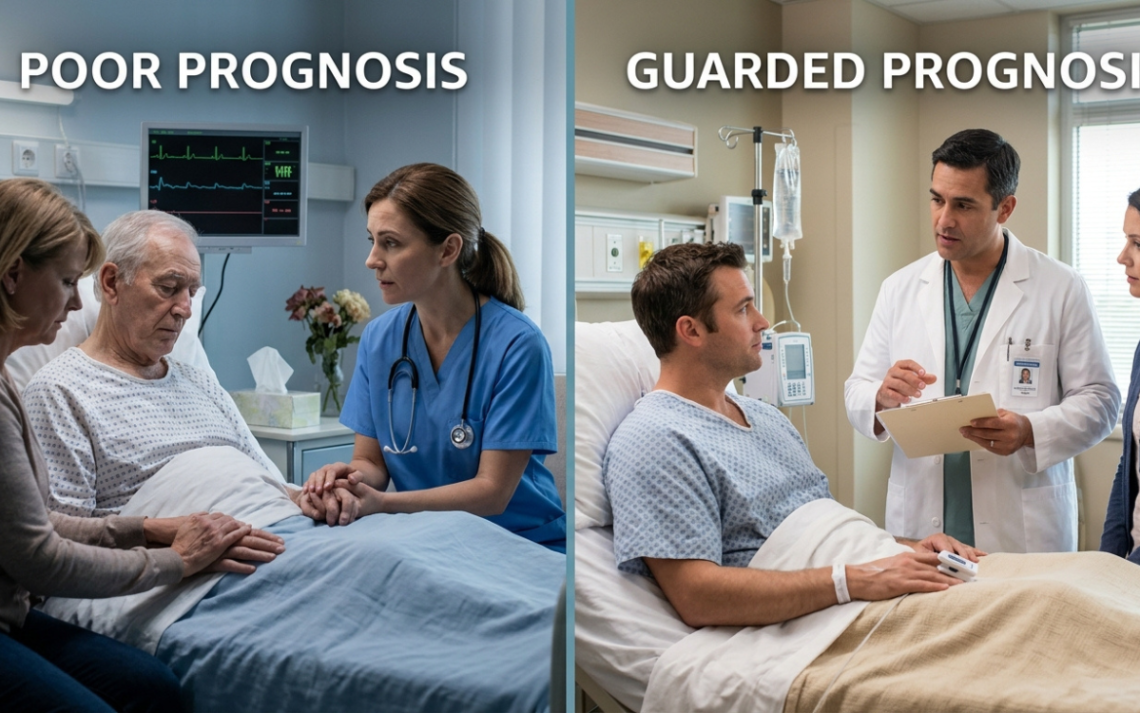
When doctors discuss a poor vs guarded prognosis, they are describing how they expect a patient’s illness, injury, or medical condition may progress over time. These terms are often misunderstood because they sound similar, but they communicate different levels of uncertainty and expectation.
A prognosis is a medical prediction about the likely course and outcome of a disease. It is not a guaranteed outcome. Instead, physicians use available evidence, clinical experience, diagnostic tests, treatment response, and individual patient factors to estimate what may happen next.
The difference between a poor prognosis and a guarded prognosis often comes down to certainty, severity, and the likelihood of improvement. A guarded prognosis means doctors are uncertain and concerned, but recovery may still be possible. A poor prognosis usually indicates that the expected outcome is unfavorable, with a higher likelihood of serious complications, limited recovery, or reduced survival.
Understanding these terms can help patients and families communicate better with healthcare providers and make informed decisions about treatment options, care planning, and expectations.
What Does Prognosis Mean in Medicine?
A prognosis is a healthcare provider’s professional assessment of a patient’s future health outlook. It considers many variables rather than relying on a single diagnosis.
Doctors typically evaluate:
- The type and severity of the disease
- The patient’s age and overall health
- Response to current treatments
- Presence of complications
- Laboratory results and imaging findings
- Functional ability and quality of life
- Risk factors that influence recovery
For example, two patients with the same cancer diagnosis may receive different prognoses because their disease stage, genetics, treatment response, and overall health are different.
A prognosis can change. Some patients initially described as having a guarded prognosis improve significantly after surgery, medication, rehabilitation, or other interventions.
Poor vs Guarded Prognosis: The Main Difference Explained
The terms poor prognosis and guarded prognosis are not interchangeable. They represent different medical expectations.
What Is a Guarded Prognosis?
A guarded prognosis means the outcome is uncertain and requires close monitoring. Doctors may be worried about the patient’s condition, but there is still a reasonable possibility of stabilization, improvement, or recovery.
The word “guarded” essentially means that healthcare providers are cautious when predicting the future.
A guarded prognosis may be used when:
- A patient has a serious illness but treatment options remain available
- The condition could improve or worsen quickly
- Doctors need more time to evaluate treatment effectiveness
- The patient has significant risks but some positive indicators exist
For example, a person recovering after a major trauma, severe infection, or complicated surgery may have a guarded prognosis because the next few days or weeks are critical.
A guarded prognosis does not automatically mean death is expected. It means the medical team cannot confidently predict a favorable outcome.
What Is a Poor Prognosis?
A poor prognosis indicates that doctors believe the expected outcome is unfavorable. This may mean the disease is advanced, difficult to treat, or associated with a high risk of complications.
A poor prognosis may occur when:
- A condition is progressive and cannot be reversed
- Available treatments have limited effectiveness
- The disease has reached an advanced stage
- The risk of disability or death is significant
- The patient’s body is not responding to therapy
A poor prognosis does not mean treatment is useless or that improvement is impossible. It means the statistical likelihood of a good outcome is lower compared with other situations.
Poor vs Guarded Prognosis: Key Differences at a Glance
| Factor | Guarded Prognosis | Poor Prognosis |
|---|---|---|
| Medical expectation | Uncertain outcome | Unfavorable expected outcome |
| Chance of improvement | Possible but unclear | Less likely |
| Doctor’s confidence | Limited information or mixed signs | Strong concern based on disease factors |
| Common situations | Critical illness, early treatment stages | Advanced disease, irreversible conditions |
| Future outlook | Depends heavily on response to care | Often associated with serious limitations |
Why Doctors Use the Term “Guarded Prognosis”
Medical professionals often avoid making absolute predictions because every patient responds differently.
A guarded prognosis allows doctors to communicate seriousness without suggesting that the outcome is already decided.
For example, a patient in an intensive care unit after organ failure may have a guarded prognosis because:
- Their condition is unstable
- Multiple outcomes are possible
- Treatment response is still being evaluated
The medical team may watch trends such as:
- Blood pressure stability
- Oxygen levels
- Organ function
- Infection markers
- Neurological responses
Small improvements can significantly change the outlook.
Factors That Influence a Poor or Guarded Prognosis
A prognosis depends on a combination of medical and personal factors.
Disease Severity
The stage and progression of an illness strongly influence prognosis.
Advanced cancers, severe heart disease, progressive neurological disorders, and irreversible organ damage often carry more serious outlooks.
Treatment Response
A patient who responds well to medication, surgery, chemotherapy, rehabilitation, or other therapies may experience a better prognosis.
Doctors frequently adjust their expectations based on whether treatments are working.
Overall Health and Medical History
A patient’s baseline health can affect recovery.
Important considerations include:
- Existing chronic conditions
- Immune system strength
- Nutritional status
- Mobility level
- Previous medical complications
A healthier patient may tolerate aggressive treatment better.
Age and Functional Status
Age alone does not determine prognosis, but it can influence recovery ability.
Doctors often consider whether a patient can perform daily activities, maintain independence, and tolerate medical interventions.
Examples of Poor vs Guarded Prognosis
Real-world examples can make these terms easier to understand.
Example of a Guarded Prognosis
A patient is admitted with severe pneumonia requiring intensive care support. The infection is serious, but antibiotics and respiratory treatment are showing some effect.
The doctor may describe the prognosis as guarded because the patient remains at risk, but improvement is possible.
Example of a Poor Prognosis
A patient has an advanced-stage disease that has continued progressing despite multiple treatments. The available options may focus more on comfort, symptom management, and quality of life.
The physician may describe the prognosis as poor because the likelihood of significant recovery is limited.
Does a Poor Prognosis Mean There Is No Hope?
No.
A poor prognosis is a medical assessment based on probability, not a prediction of an unavoidable outcome.
Medicine involves uncertainty. Some patients outperform expectations, while others decline despite aggressive treatment.
A poor prognosis can help families and doctors:
- Set realistic goals
- Discuss available treatments
- Consider supportive care options
- Prepare emotionally and practically
- Focus on quality of life
The goal is not to remove hope but to provide honest information.
Can a Guarded Prognosis Become a Good Prognosis?
Yes, a guarded prognosis can improve.
Medical teams often reassess prognosis as new information becomes available.
Positive changes may include:
- Improved test results
- Successful treatment response
- Increased physical strength
- Reduced complications
- Better organ function
For some patients, a serious early condition improves dramatically with appropriate medical care.
How Families Should Talk With Doctors About Prognosis
Medical terminology can feel confusing or frightening. Families should ask direct questions.
Useful questions include:
- “What factors are affecting the prognosis?”
- “What improvements would indicate recovery?”
- “What are the biggest risks right now?”
- “What outcomes are realistic?”
- “What treatment options remain available?”
- “How will we know if the condition is improving?”
Doctors can provide more meaningful answers when they understand what the family wants to know.
Prognosis vs Diagnosis: Understanding the Difference
Many people confuse diagnosis and prognosis.
A diagnosis identifies what disease or condition a person has.
A prognosis explains what may happen because of that condition.
For example:
- Diagnosis: Stage IV lung cancer
- Prognosis: The expected response to treatment and likely disease progression
Knowing the diagnosis does not automatically reveal the prognosis. Other patient-specific factors matter.
Frequently Asked Questions About Poor vs Guarded Prognosis
1. Is a guarded prognosis worse than a poor prognosis?
Not necessarily. A guarded prognosis means the outcome is uncertain and doctors are cautious. A poor prognosis generally means the expected outcome is unfavorable. The terms describe different concerns rather than a simple ranking system.
2. Does a poor prognosis mean a patient will die?
No. A poor prognosis means doctors believe the chances of a favorable outcome are limited based on current medical information. Some patients with poor prognoses still experience improvement or respond unexpectedly well to treatment.
3. How long does a guarded prognosis last?
There is no fixed timeline. A guarded prognosis may last hours, days, weeks, or longer depending on the condition. Doctors update the prognosis as the patient’s situation changes.
4. Can treatment change a poor prognosis?
Yes. Treatments can sometimes improve outcomes, especially when new therapies become available or when a patient responds better than expected. However, the degree of improvement depends on the underlying condition.
5. Should families ask doctors for a specific survival estimate?
Yes, but they should understand that survival estimates are based on averages and cannot predict exactly what will happen to one individual. Doctors can explain likely scenarios, risks, and factors that may influence outcomes.
Final Thoughts: Understanding Poor vs Guarded Prognosis Clearly
The difference between poor vs guarded prognosis comes down to medical uncertainty and expected outcomes. A guarded prognosis signals serious concern but leaves room for possible improvement. A poor prognosis indicates that the medical outlook is less favorable.
Patients and families should remember that prognosis is not a final verdict. It is a professional estimate based on current evidence.
The best next step is to have an open conversation with the healthcare team. Ask questions, understand the available options, and focus on the factors that can still be influenced—such as treatment decisions, symptom management, rehabilitation, and quality of life.