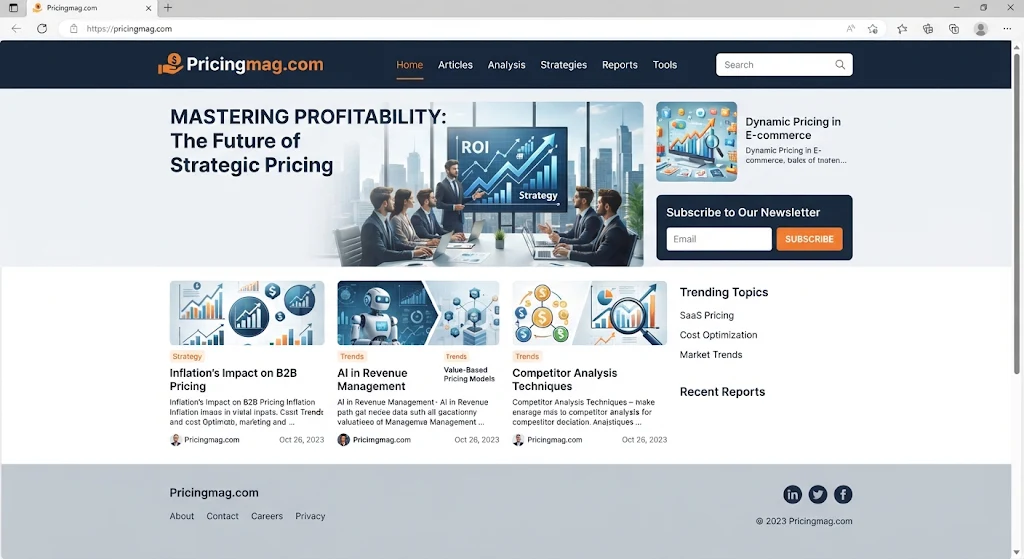
PricingMag.com is an online publication dedicated to helping eCommerce businesses make smarter pricing decisions, understand automated repricing, and improve their marketplace strategies. For Amazon sellers, wholesalers, and digital marketplace businesses, choosing the right product price can directly influence profitability, competitiveness, and customer demand. This is where Pricingmag com offers a specialized resource for understanding pricing technology and making informed commercial decisions.
Unlike general business blogs that cover a wide range of unrelated topics, PricingMag focuses on the practical challenges sellers encounter when managing prices in competitive online marketplaces. Its content explores repricing software, Amazon Buy Box strategies, B2B pricing, pricing automation, and comparisons between popular repricing solutions.
The platform is particularly relevant to sellers who want to understand the financial impact of pricing decisions before investing in third-party software. Rather than treating every repricing tool as a universal solution, its editorial approach emphasizes business requirements, operating costs, profit margins, and measurable outcomes.
This guide examines what PricingMag.com offers, who can benefit from it, how its resources can support eCommerce decisions, and what readers should consider when using its recommendations.
What Is PricingMag.com?
PricingMag.com is an independent editorial website focused on pricing and repricing in the US digital marketplace. Its primary audience includes Amazon sellers, eCommerce entrepreneurs, wholesalers, resellers, and businesses that need to manage product prices across competitive online marketplaces.
The website operates as a specialized industry publication rather than a repricing software provider. It does not position one particular software product as the answer to every seller’s problem. Instead, it publishes research, educational resources, software comparisons, and practical pricing guidance.
According to its About page, the publication was created to address a common problem in the repricing industry: many software comparisons and educational articles are written by the companies selling the products being reviewed. PricingMag aims to offer an editorial perspective that focuses on the seller’s business outcomes rather than software promotion.
pricingmag.com+1
The Main Purpose Behind PricingMag
The platform focuses on helping sellers answer important business questions, including:
Is automated repricing worth the monthly subscription?
Why is a competitor consistently winning the Amazon Buy Box?
How can sellers protect their profit margins while remaining competitive?
Which repricing software suits a particular product catalogue?
Are separate B2B and B2C pricing strategies necessary?
How can businesses calculate profitable wholesale discounts?
These questions reflect real challenges faced by online retailers. A small pricing adjustment can influence sales volume, profit per order, marketplace visibility, and long-term business performance.
Who Publishes the Content?
The articles are credited to the PricingMag Research Team rather than individual author personas. The website explains that its content is developed collaboratively through research, writing, fact-checking, and subsequent updates.
It also states that its research prioritizes primary sources, including Amazon documentation and marketplace policies. Its editorial approach includes dated verification and corrections when information changes.
pricingmag.com
What Does PricingMag.com Cover?
The website organizes its editorial coverage around four major subject areas: repricing, B2B pricing, software tools, and pricing-related data.
Each category addresses a different part of the online selling process.
1. Amazon Repricing Strategies
Repricing is one of the central subjects covered by PricingMag.com. It refers to adjusting product prices in response to market conditions, competitor activity, inventory levels, and predefined business rules.
For example, imagine an Amazon seller offering a product for $25 while another seller reduces the same product’s price to $24.50. The first seller may need to reconsider their pricing strategy to remain competitive.
However, immediately reducing the price is not always the right decision. If the product costs $20 to purchase and fulfill, matching a competitor without considering marketplace fees could significantly reduce profitability.
The website explores topics such as:
Automated repricing: How software adjusts prices based on predefined rules.
Competitor price monitoring: Tracking competing product offers.
Buy Box optimization: Understanding the factors influencing Featured Offer placement.
Minimum and maximum prices: Setting boundaries to protect profitability.
Price-war management: Avoiding unnecessary reductions when competitors repeatedly undercut one another.
Inventory-based repricing: Adjusting prices according to stock availability and sales velocity.
These resources can help sellers understand the difference between competing on price and competing profitably.
2. B2B and Amazon Business Pricing
Business-to-business pricing is another important area of coverage. Unlike traditional retail transactions, B2B purchases often involve larger quantities, negotiated commercial terms, and repeat orders.
Amazon Business provides sellers with opportunities to offer business-specific prices and quantity discounts to eligible customers.
For instance, a seller might offer:
Standard price: $20 per unit.
Business price: $19 per unit.
Discount for 10 or more units: $18.50 per unit.
Discount for 25 or more units: $17.75 per unit.
These prices are illustrative, but they demonstrate how quantity-based pricing can encourage larger purchases.
PricingMag explores subjects such as Amazon Business repricing, quantity discount structures, B2B Featured Offers, and the relationship between shipping costs and business pricing.
pricingmag.com+2
For wholesalers and distributors, understanding these concepts is particularly useful because a discount that attracts a large order can also eliminate the profit expected from that transaction.
3. Repricing Software Reviews and Comparisons
Choosing repricing software can be challenging, particularly when multiple providers advertise similar features.
PricingMag publishes software profiles, comparison articles, pricing breakdowns, and alternative-product guides to help readers evaluate available options.
Its editorial coverage includes products such as:
Alpha Repricer.
Repricer.com.
Seller Snap.
BQool.
Informed Repricer.
Aura.
RepricerExpress.
Instead of focusing exclusively on feature lists, its comparisons examine practical purchasing considerations, including listing limits, subscription fees, marketplace support, automation capacity, and B2B capabilities.
For example, a repricer that costs $100 per month may be suitable for a small seller but insufficient for a business managing tens of thousands of listings. The more expensive option might be worthwhile if it provides the processing capacity and features that the business actually needs.
The important distinction is that the best repricing software depends on the seller’s requirements, not simply the number of features advertised.
4. Pricing Technology and Marketplace Data
Pricing technology continues to evolve as online marketplaces introduce new tools, policies, and competitive requirements.
PricingMag also covers developments that influence how sellers approach pricing decisions.
Its data-focused coverage includes:
Marketplace pricing policies.
Automated pricing technology.
Amazon Featured Offer developments.
Changes affecting B2B sellers.
Pricing software capabilities.
Market competition and seller performance.
This information can help businesses understand why an existing pricing strategy might stop working and whether a change in marketplace rules requires a different approach.
For sellers operating in competitive categories, staying informed is an important part of maintaining a sustainable pricing strategy.
Key Features and Resources Available on PricingMag.com
Beyond its main editorial categories, the website offers several types of resources designed to support different stages of the seller decision-making process.
Detailed Educational Guides
The educational articles explain specific pricing concepts in accessible language. Rather than assuming every reader has technical knowledge of marketplace algorithms, the content aims to explain how different pricing mechanisms affect actual selling decisions.
Examples include guides on recovering lost B2B Featured Offer placement, understanding landed prices, and identifying factors that influence Amazon’s offer selection.
pricingmag.com+2
Software Head-to-Head Comparisons
Direct comparisons help readers evaluate two repricing solutions against the same business requirements.
For example, a comparison might examine:
Monthly subscription costs.
Maximum supported listings.
Available marketplace integrations.
Repricing speed and processing limits.
Business pricing functionality.
Inventory management capabilities.
Customer support options.
This approach is useful when a seller has already shortlisted two products and needs to understand which one offers better value.
Pricing Breakdowns
Software subscription prices can be misleading when sellers only examine the advertised starting price.
Additional features, usage limits, premium plans, and optional integrations can increase the actual cost.
PricingMag’s pricing articles aim to examine these details so businesses can estimate the financial commitment before purchasing a subscription.
Practical Calculators and Decision Resources
Numerical calculations are essential when making pricing decisions. A percentage discount that appears small may represent a substantial reduction in actual profit.
PricingMag includes practical resources such as a tiered discount calculator to help sellers evaluate how much they can reduce their prices without exceeding their acceptable profit limits.
pricingmag.com
These resources can be useful for:
Calculating wholesale discount limits.
Evaluating minimum selling prices.
Estimating repricing software costs.
Comparing subscription plans.
Understanding the financial effect of quantity discounts.
How PricingMag.com Helps Amazon Sellers Make Better Pricing Decisions
Pricing decisions should be based on more than competitor prices. Sellers must consider product acquisition costs, fulfillment expenses, marketplace fees, shipping, and the minimum profit required to sustain their business.
PricingMag’s decision-oriented content helps readers approach these factors systematically.
Understanding the Amazon Buy Box
The Amazon Buy Box, now commonly referred to by Amazon as the Featured Offer, is the prominent offer area containing purchasing options such as Add to Cart and Buy Now.
Winning this placement can improve a seller’s visibility, but the lowest product price does not automatically guarantee success.
Amazon considers factors associated with the overall offer, including total price, shipping, delivery experience, stock availability, and seller performance. The precise weighting of these factors is not publicly disclosed.
PricingMag explores these considerations to help sellers distinguish between a pricing problem and an operational problem.
pricingmag.com+1
For example, reducing a product’s price may not solve the problem if a competitor offers a more reliable delivery promise.
Protecting Profit Margins
A common mistake among new marketplace sellers is treating revenue as profit.
Consider this simplified example:
| Business expense | Amount |
|---|---|
| Product purchase cost | $10.00 |
| Fulfillment and shipping | $3.00 |
| Marketplace fees | $3.00 |
| Other variable expenses | $1.00 |
| Total cost | $17.00 |
| Selling price | $22.00 |
| Profit before other overheads and taxes | $5.00 |
If the seller reduces the selling price to $19, the profit falls to $2, assuming the other costs remain unchanged.
That is a 60% reduction in profit from a price reduction of approximately 13.6%.
PricingMag emphasizes the importance of understanding these financial relationships before adjusting prices or configuring automated repricing rules.
Choosing the Right Automation Strategy
Not every seller needs sophisticated repricing automation.
A business with a small catalogue and relatively stable competition may manage its prices manually. Another business with thousands of listings and frequent competitor changes may benefit considerably from automated repricing.
The decision should consider:
The number of active product listings.
How frequently competitors change their prices.
The time required for manual price management.
The complexity of existing pricing rules.
The cost of repricing software.
The potential financial benefit of automation.
This practical approach helps sellers avoid paying for features they do not actually need.
Is PricingMag.com a Repricing Software Platform?
No. This distinction is important.
PricingMag.com is an editorial and research publication, not a tool that directly changes product prices in Amazon Seller Central.
It provides educational information, comparisons, research, and pricing-related resources. Sellers who want automated price adjustments must use a compatible marketplace tool or an available platform feature.
For example, Amazon offers its own Automate Pricing functionality, while independent providers offer additional repricing capabilities.
PricingMag helps readers understand these options, but users should visit the relevant software provider to access its product, connect their marketplace account, and configure pricing rules.
This distinction makes the website useful as a research destination rather than a replacement for operational eCommerce software.
Is PricingMag.com Independent and Trustworthy?
Trust is especially important when evaluating commercial software. A misleading recommendation can result in unnecessary subscription expenses or pricing decisions that damage business margins.
PricingMag presents itself as an independent publication and explains several principles behind its editorial model.
Its Editorial Independence Policy
The website states that its reviews, rankings, and comparison placements are not available for purchase. It also explains that sponsored content, when published, is clearly identified rather than presented as an independent review.
Its About page describes a separation between its editorial and commercial activities, with the stated intention of preventing client relationships from influencing product coverage.
pricingmag.com
This is a meaningful transparency commitment, although readers should still evaluate the evidence supporting individual recommendations.
Primary-Source Research
The publication says it prioritizes official Amazon documentation and marketplace policies when researching articles.
This is important because third-party software companies sometimes describe platform features using simplified marketing language.
Checking the original platform documentation helps readers distinguish between an official marketplace rule and a software provider’s interpretation of that rule.
Transparent Methodology
An important part of trustworthy product research is explaining what has actually been verified.
Readers should look for:
The date when prices were checked.
Official sources supporting platform-related claims.
Clear distinctions between vendor claims and independent findings.
Explanations of comparison criteria.
Disclosure of missing or unavailable information.
Corrections when published information becomes outdated.
One qualification is worth noting: an independent editorial approach does not automatically mean every product has been tested hands-on. Some PricingMag articles explicitly distinguish published-source research and illustrative calculations from proprietary benchmarks or practical product testing.
pricingmag.com+1
For this reason, readers should treat vendor performance claims as claims until supported by independently reproducible evidence.
Who Should Use PricingMag.com?
PricingMag is most relevant to people who make or influence online marketplace pricing decisions.
Here are the audiences most likely to benefit.
Amazon FBA and FBM Sellers
Amazon sellers can use the platform to understand repricing automation, competitor monitoring, Featured Offer competition, and the financial implications of price adjustments.
Whether a seller uses Fulfillment by Amazon (FBA) or Fulfillment by Merchant (FBM), maintaining profitable prices requires an understanding of costs and competitive conditions.
Wholesale Distributors
Wholesalers frequently deal with bulk orders, quantity discounts, shipping expenses, and different customer segments.
PricingMag’s B2B resources can help these businesses evaluate discount structures and understand how pricing decisions influence larger transactions.
Private-Label Businesses
Private-label sellers often have greater control over their product positioning and pricing compared with resellers competing on identical listings.
They may use the website’s pricing resources to understand promotional strategies, profitability, and the potential value of automated pricing systems.
eCommerce Entrepreneurs
People planning to launch an online store can explore the basics of pricing software and marketplace competition before investing in third-party tools.
Understanding the costs and limitations of different solutions early can prevent unnecessary expenses as a business grows.
eCommerce Agencies and Consultants
Agencies supporting online sellers can use pricing-related articles as research material when advising clients about marketplace management, pricing automation, and business profitability.
However, professional recommendations should always be supported by current platform documentation and the client’s actual sales data.
How to Get the Most Value from PricingMag.com
Reading pricing guides is useful, but applying the information to real business situations is what produces meaningful results.
Here is a practical approach for getting the most value from the website.
Step 1: Identify Your Pricing Challenge
Start by identifying the specific issue affecting your business.
For example, are you losing the Featured Offer, struggling with competitor price changes, or finding it difficult to maintain profit margins?
A clearly defined problem makes it easier to identify the most relevant research.
Step 2: Explore Relevant Guides
Visit the website’s article library and select content related to your particular challenge.
You can explore software reviews, repricing guides, B2B pricing explanations, and pricing comparisons.
Official website: PricingMag.com.
Step 3: Compare Software Requirements
Before selecting a repricing solution, prepare a list of your operational requirements.
Consider your catalogue size, monthly sales, marketplace integrations, available budget, and required automation features.
Compare these requirements against the actual capabilities and subscription limits of each software provider.
Step 4: Calculate Your Profitability
Never configure automated pricing rules without establishing acceptable minimum prices.
Calculate your product costs, marketplace fees, shipping expenses, fulfillment charges, and desired contribution margin.
Your minimum price should protect your business from selling products at an unacceptable loss.
Step 5: Test Changes Before Scaling
If you decide to introduce a new pricing strategy, start with a controlled group of products.
Monitor important metrics such as:
Profit per unit.
Conversion rate.
Sales volume.
Featured Offer percentage.
Inventory turnover.
Total repricing software expenses.
Compare the results with your previous performance before applying the strategy across your entire catalogue.
Advantages and Limitations of PricingMag.com
Like any specialized information platform, PricingMag has strengths as well as limitations.
Understanding both helps readers decide how to use its resources effectively.
| Advantages | Limitations |
|---|---|
| Focuses on a specialized pricing niche | Primarily relevant to digital marketplace sellers |
| Provides software comparisons | Vendor prices can change |
| Covers Amazon B2B pricing | Some information is US-market focused |
| Explains repricing concepts | Not a replacement for marketplace software |
| Emphasizes profitability | Not every review represents hands-on testing |
| Offers practical pricing resources | Readers should verify current marketplace policies |
What Makes Its Approach Different?
One notable characteristic is its emphasis on decision-making rather than simply presenting software features.
A conventional software review might explain how many integrations a platform supports or how quickly it updates prices.
A more useful purchasing guide also asks whether those features solve the seller’s actual problem and whether the financial benefit justifies the subscription.
That distinction is valuable in an industry where businesses can easily spend money on automation without understanding its contribution to profitability.
PricingMag.com vs. Traditional eCommerce Blogs
General eCommerce publications cover many subjects, including digital marketing, website development, product sourcing, customer acquisition, and marketplace operations.
PricingMag takes a narrower editorial approach.
| Comparison factor | PricingMag.com | General eCommerce blogs |
|---|---|---|
| Main focus | Pricing and repricing | Broader online business topics |
| Amazon pricing | Specialized coverage | Varies by publication |
| B2B pricing | Dedicated subject area | Often secondary |
| Software comparisons | Repricing-focused | Multiple software categories |
| Pricing calculations | Specialized resources | Depends on the publisher |
| Target audience | Marketplace sellers and pricing professionals | General eCommerce audience |
Neither approach is universally better.
A general eCommerce publication may be more useful when researching marketing strategies or store development. However, sellers investigating repricing tools or Amazon Business pricing may find a dedicated publication more relevant.
The Future of Pricing Research and Automated Repricing
The eCommerce industry continues to evolve as marketplaces introduce new pricing technologies and sellers gain access to more sophisticated automation.
Several developments are particularly relevant to the subjects covered by PricingMag.
Artificial Intelligence in Pricing Decisions
Artificial intelligence can help analyze large amounts of marketplace information, identify patterns, and support more sophisticated pricing strategies.
However, AI-powered repricing should not be judged by its marketing label alone.
Businesses should understand what information the software analyzes, which decisions it automates, and whether users can establish minimum prices and override automated changes.
Greater Attention to Profit-Based Pricing
Selling more products does not necessarily mean earning more money.
As competition increases, sellers need to pay closer attention to contribution margins, operating expenses, and the financial impact of discounts.
Profit-based pricing strategies are likely to remain an important consideration for businesses that want sustainable growth.
Expansion of B2B eCommerce
Business buyers often have different purchasing requirements from individual consumers.
Bulk orders, negotiated discounts, repeat purchases, and delivery expectations create additional pricing considerations.
As B2B marketplace activity develops, resources explaining business-specific pricing structures will remain useful to wholesalers and marketplace sellers.
More Sophisticated Marketplace Analytics
Sellers increasingly need to understand more than their own listed prices.
Competitor activity, inventory availability, delivery performance, market demand, and pricing history can all influence commercial decisions.
Better analytics can help businesses identify why their pricing strategies succeed or fail rather than making adjustments based on assumptions.
Frequently Asked Questions (FAQs)
1. What is PricingMag.com used for?
PricingMag.com is used to research eCommerce pricing strategies, Amazon repricing software, marketplace competition, and B2B pricing. It publishes educational guides, product comparisons, software pricing breakdowns, and practical resources to help sellers make informed pricing decisions. It is an information platform rather than an automated repricing service.
2. Is PricingMag.com a free website?
The website provides publicly accessible articles and research guides that readers can explore without purchasing repricing software through the publication. However, its About page also mentions premium products, including data reports and a paid newsletter. Readers should check the website for the latest availability and terms of any premium offerings.
3. Does PricingMag.com provide Amazon repricing software?
No. PricingMag.com is an editorial publication, not an Amazon repricing application. It reviews and compares third-party repricing solutions and explains how sellers can use pricing automation. To change product prices automatically, sellers need a compatible software tool or Amazon’s own pricing functionality.
4. Who can benefit from using PricingMag.com?
Amazon FBA and FBM sellers, wholesale distributors, private-label businesses, eCommerce entrepreneurs, and marketplace consultants can benefit from its resources. Its content is particularly relevant to businesses that need to manage competitive product prices, understand bulk discounts, evaluate repricing subscriptions, or protect their profit margins.
5. Is PricingMag.com a reliable source for repricing information?
PricingMag presents an editorial independence policy, explains its research approach, and states that it prioritizes primary sources such as Amazon documentation. These are useful transparency indicators. However, readers should examine individual articles, publication and verification dates, source references, and testing disclosures before relying on a particular recommendation. Software prices and marketplace policies should also be confirmed directly with their respective providers.
Conclusion: Is PricingMag.com Worth Exploring?
PricingMag.com offers a specialized destination for people interested in Amazon repricing, eCommerce pricing strategies, B2B transactions, and marketplace software comparisons.
Its strongest feature is its focus on practical business decisions. Rather than treating automated repricing as a universal solution, the publication encourages sellers to consider their operational requirements, subscription costs, competitive conditions, and actual profitability.
For Amazon sellers, wholesalers, and eCommerce professionals, these resources can provide a useful starting point when researching pricing technology or reviewing an existing pricing strategy.
If you manage an online selling business, start by visiting PricingMag.com. Explore its repricing guides, compare relevant software solutions, and evaluate your own profit margins before making changes to your pricing strategy.
SEO publishing recommendation: The article is structured around the primary keyword PricingMag.com and related search topics, including Amazon repricing, B2B pricing, repricing software comparisons, pricing strategies, and eCommerce profitability. The exact keyword density should be checked in your SEO editor after final formatting rather than forced into sentences.