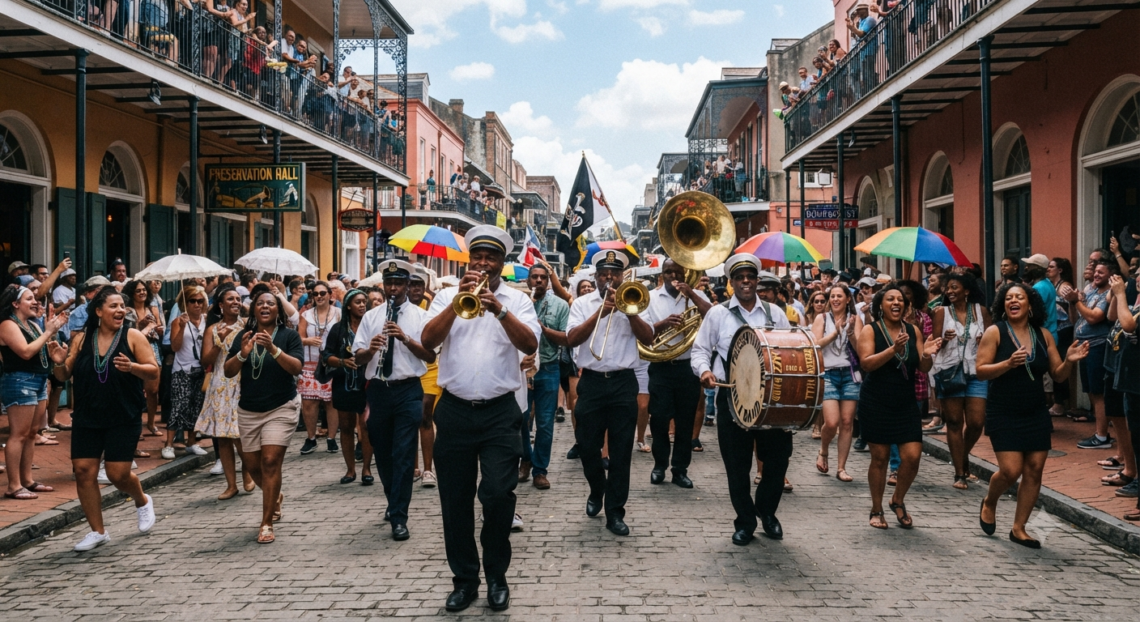
If you are searching for Song when the saints go marching in lyrics, you are probably looking for more than a few familiar words. This enduring American spiritual carries a story that moves from Black sacred tradition and church processions to New Orleans brass bands, jazz stages, classrooms, football crowds, and recordings heard around the world.
The song is deceptively simple. Its short, repeatable lines make it easy to sing, but the imagery points toward judgment, eternal life, resurrection, communal hope, and the desire to belong among the redeemed. Hymnary classifies the familiar text as an African American or “Negro Spiritual,” lists its representative text as public domain, and connects modern hymnal versions with biblical passages including Revelation and Jude.
What Do Song When the Saints Go Marching In Lyrics Mean?
At the heart of Song when the saints go marching in lyrics is one uncomplicated wish: the singer wants to be among the faithful when the saints enter the promised kingdom. That is why the best-known refrain feels both personal and communal. It is one person speaking, yet the image is a whole people moving together.
A short line captures the emotional center: “Lord, I want to be in that number.” The words are not mainly about watching a parade from the sidewalk. They express the desire to participate—to belong to the company of believers at the fulfillment of Christian hope.
The “marching” image also matters. Marching suggests direction, order, movement, and arrival. In worship, the image can evoke the faithful progressing toward heaven; in New Orleans performance culture, that same motion became physically visible in processions, brass bands, and the celebratory second line.
The Core Symbols Behind Song When the Saints Go Marching In Lyrics
Readers sometimes treat Song when the saints go marching in lyrics as little more than a cheerful singalong, but several recurring images carry deeper religious and cultural weight.
- The saints: the faithful community, often understood as those who belong to God rather than only formally canonized saints.
- Marching in: entry into a divine kingdom, heavenly city, or final gathering.
- Being “in that number”: a first-person expression of hope for salvation and belonging.
- The sun, moon, and cosmic imagery: signs that some traditional variants associate with the end times or divine judgment.
- The throne and heavenly gathering: imagery closely aligned with Revelation’s visions of worship, redemption, and eternal life.
- Repetition: a feature that supports congregational singing, call-and-response energy, memory, and musical improvisation.
Hymnary’s representative text and indexing connect the hymn with Revelation 5, 7, 14, and 21, as well as Jude and Psalm 121. Different hymnals categorize it under themes such as eternal life, heaven, resurrection, funerals, All Saints, hope, and the communion of saints.
Are There Different Song When the Saints Go Marching In Lyrics?
Yes. In fact, variation is part of the song’s identity. Song when the saints go marching in lyrics exist in multiple traditional forms because the piece circulated through oral, church, folk, gospel, and jazz traditions rather than being preserved as one universally fixed pop-song text.
Some versions emphasize the saints entering heaven. Others introduce images involving the sun, trumpets, a heavenly throne, judgment, resurrection, or reunion with family and friends. Hymnary documents multiple text families and hymnal instances, showing why listeners may encounter significantly different verses under the same familiar title.
This is useful to remember when comparing Song when the saints go marching in lyrics online. A version can be historically legitimate even if it differs from the words you remember from school, church, a jazz performance, or a children’s songbook.
Why the Lyrics Change From Version to Version
Traditional spirituals develop through performance. Singers preserve different verses, communities adapt lines, bandleaders shorten texts for particular performances, and musicians improvise around recognizable refrains.
Louis Armstrong’s famous recording offers a clear example. The Library of Congress notes that the traditional spiritual included different verses, while Armstrong’s 1938 performance concentrated primarily on the familiar opening material instead of cycling through every known variation.
That flexibility is not a flaw. It is one of the reasons the song has survived.
Where Did Song When the Saints Go Marching In Lyrics Come From?
The exact authorship is not as simple as many lyric websites make it appear. The Library of Congress describes the familiar piece as a traditional Christian hymn, most likely emerging during the late nineteenth or early twentieth century.
An important historical distinction often gets missed. A different spiritual titled “When the Saints Are Marching In” was published in 1896, but the Library of Congress says that work bears no meaningful resemblance to the now-famous tune beyond its similar title.
That distinction matters for Song when the saints go marching in lyrics because search results frequently combine similarly named religious songs into a single origin story. A more evidence-based description is that the familiar song emerged from Christian and African American spiritual traditions, spread through communal performance, and became deeply intertwined with the musical culture of New Orleans.
Hymnary supports that broader classification. Modern hymnal records identify the source variously as a Negro Spiritual, African American spiritual, spiritual, or traditional, while its representative traditional text is listed as public domain.
The Earliest Known Recordings
The story did not begin with Louis Armstrong. According to the Library of Congress, the Paramount Jubilee Singers recorded a version in November 1923 under the title “When All the Saints Go Marching In.”
Blind Willie Davis followed with a recording known as “The Saints” in 1928. The song also appeared in the Broadway production The Green Pastures in 1930 and the 1936 film adaptation.
Those dates show that Song when the saints go marching in lyrics already had a documented musical life before Armstrong’s celebrated Decca session. Armstrong did not create the song.
What he did was change its reach.
How Louis Armstrong Made the Song a Jazz Standard
Louis Armstrong’s relationship with the tune began long before he recorded it commercially. The Library of Congress recounts Armstrong remembering the song from his youth and playing a version while at the Colored Waif’s Home for Boys, where music became an important part of his development.
He later encountered and performed church hymns in the world of New Orleans brass bands and funeral processions. That experience meant the boundary between sacred music and street performance was already familiar to him.
Armstrong wanted to record the song for OKeh Records in 1931, but the label declined to release his idea. Seven years later, on May 13, 1938, he recorded it for Decca with an arrangement by pianist and musical director Luis Russell.
That performance changed how generations experienced Song when the saints go marching in lyrics. Armstrong did not merely sing a hymn over jazz accompaniment; the recording reshaped the material through rhythmic swing, instrumental personality, ensemble responses, trombone and trumpet improvisation.
The Library of Congress’s National Recording Registry describes the recording as a striking combination of sacred material and jazz performance, highlighting Armstrong’s vocal presentation, J.C. Higginbotham’s trombone, and Armstrong’s soaring trumpet work. The 1938 recording was selected for the National Recording Registry in 2020 because of its cultural, historical, or aesthetic significance.
Not Everyone Approved of the Jazz Version
There was genuine resistance. Some religious listeners objected to a spiritual associated with church worship being transformed into music suitable for jazz performance and dancing.
Armstrong defended his interpretation by pointing to New Orleans tradition, where sacred songs had already been performed by brass bands during parades and church-related occasions. That debate reveals something important: what now sounds like an obvious jazz standard once challenged assumptions about where sacred music belonged.
Why Song When the Saints Go Marching In Lyrics Are Closely Tied to New Orleans
The New Orleans connection goes far beyond tourist branding. The city helped transform a sacred spiritual into music capable of moving between worship, mourning, street processions, community celebration, and jazz improvisation.
The Library of Congress explains that spirituals entered the repertoires of early New Orleans bands. At funerals, musicians developed the practice of swinging sacred material while returning from the cemetery, encouraging joyful movement among followers associated with the second line.
That context changes the emotional meaning of Song when the saints go marching in lyrics. The same song can contain sorrow and joy at once.
A slow performance may sound reflective or mournful. Increase the tempo, bring in brass and percussion, and the emotional message changes toward release, continuity, communal resilience, spiritual confidence, and celebration.
Smithsonian Folkways archives also document performances of the tune in New Orleans jazz and street-music settings, reinforcing how thoroughly the song became integrated into the city’s musical traditions.
Song When the Saints Go Marching In Lyrics and Biblical Meaning
The Bible does not contain the song as a direct quotation. Still, Song when the saints go marching in lyrics draw from biblical ideas deeply familiar in Christian preaching and hymnody: a gathering of believers, heavenly worship, judgment, resurrection, redemption, and eternal life with God.
Revelation is particularly relevant. Hymnary associates versions of the hymn with passages from Revelation depicting redeemed communities before God, worship around the heavenly throne, and the renewed creation.
Jude is also connected with the hymn in several modern hymnals. That biblical text contains imagery involving the Lord coming with holy ones, which naturally resonates with a song centered on saints moving toward a final divine gathering.
This theological framework helps explain why the song can work at funerals without being entirely mournful. Its perspective is forward-looking.
Death is not presented simply as disappearance. The larger theme is hope—hope of redemption, reunion, belonging, and eternal life.
Why the Song Is So Easy to Sing, Play, and Remember
Part of the staying power of Song when the saints go marching in lyrics comes from musical design. The central refrain is short, repetitive, rhythmically adaptable, and easy for a group to learn quickly.
That apparent simplicity creates room for musicians. A beginning trumpet or piano student can play the melody plainly, while an experienced jazz ensemble can reshape it through syncopation, breaks, solos, call and response, rhythmic displacement, altered phrasing, and collective improvisation.
The song bends without breaking.
The Library of Congress notes that children commonly encounter the tune at an early age and that beginning musicians frequently use the familiar melody as accessible practice material. Armstrong’s interpretation demonstrated the opposite extreme: a simple foundation becoming a sophisticated jazz vehicle.
That combination—easy entry, enormous interpretive freedom—is unusual. It helps explain why the piece has remained useful to churches, schools, jazz bands, marching groups, professional musicians, and casual singers.
Famous Versions and Performers to Know
Louis Armstrong remains the defining name, but Song when the saints go marching in lyrics have traveled through gospel, jazz, blues, folk, rock, and mainstream popular music.
The Library of Congress notes that artists ranging from Elvis Presley and B.B. King to Van Morrison and Bruce Springsteen have performed or recorded the song. Armstrong, meanwhile, continued featuring it prominently during his later performing career.
For listeners interested in understanding the song rather than simply collecting covers, contrast radically different interpretations. Start with Armstrong’s 1938 Decca performance, then hear a church or gospel version, a traditional New Orleans brass-band treatment, and a stripped-down folk or blues performance.
Listen for what changes.
Tempo. Instrumentation. Vocal phrasing. Emotional intensity. Improvisation. The relationship between soloist and ensemble.
Then listen for what remains recognizable. That is the deeper lesson behind Song when the saints go marching in lyrics: the musical framework is stable enough to retain its identity, yet flexible enough to absorb the personality and traditions of each community performing it.
Are Song When the Saints Go Marching In Lyrics Public Domain?
Hymnary identifies its representative version of the traditional text as public domain. That is an important distinction, but it should not be misunderstood.
Public-domain status for an underlying traditional song does not necessarily mean that every modern arrangement, recording, edited adaptation, sheet-music edition, or newly created verse is free of copyright. Copyright can exist separately in a particular arrangement or sound recording.
So if you plan to publish, record, arrange, synchronize, or commercially distribute Song when the saints go marching in lyrics, distinguish between the underlying traditional work and the particular version you intend to use.
For a commercial recording, website, video, church project, or printed edition, verify the status of the exact arrangement and source material. Do not assume that seeing the word “traditional” automatically makes every modern treatment unrestricted.
How to Use the Song in Teaching, Worship, or Music Practice
Because the tune is familiar and structurally forgiving, Song when the saints go marching in lyrics can support several kinds of learning.
Music teachers can use it to introduce melody, rhythm, phrasing, call and response, jazz improvisation, ensemble listening, and transposition. History or cultural-studies teachers can use it to explore African American spiritual traditions, New Orleans music, jazz development, funeral processions, and the movement of music between sacred and secular environments.
Worship leaders can focus on themes of eternal life, resurrection, hope, heaven, and the communion of saints. Instrumental teachers can use the melody for breath control, articulation, rhythm changes, first improvisation exercises, or group arrangement practice.
The cultural context should travel with the music.
Teaching it only as a catchy children’s or novelty tune strips away much of the history that explains why it became so significant.
FAQ About Song When the Saints Go Marching In Lyrics
1. Who wrote “When the Saints Go Marching In”?
There is no single securely established songwriter for the familiar traditional version. The Library of Congress describes the song as a traditional Christian hymn probably dating from the late nineteenth or early twentieth century, while Hymnary classifies modern instances as African American or Negro spirituals.
That is why websites assigning the universally recognized traditional song confidently to one individual should be approached carefully. Similar titles and later gospel compositions can easily become mixed into the song’s origin story.
2. What is the main meaning of Song when the saints go marching in lyrics?
The central meaning of Song when the saints go marching in lyrics is the hope of belonging among the faithful at a final heavenly gathering. The singer does not merely want to watch the saints arrive; the desire is to be counted among them.
Depending on the traditional verse set, the song may also evoke judgment, resurrection, cosmic signs, reunion, heavenly worship, and eternal life. Those themes help explain why it appears in church services, funerals, memorials, and joyful processions.
3. Why is “When the Saints Go Marching In” associated with funerals?
In New Orleans tradition, sacred songs became part of brass-band funeral culture. The Library of Congress describes bands swinging spiritual music on the return from the cemetery, when the emotional atmosphere could shift toward joyful movement and second-line participation.
That musical movement fits the song’s message remarkably well. Grief is present, but the larger emphasis can turn toward hope, faith, community, and the conviction that death is not the end of the story.
4. Did Louis Armstrong write the song?
No. Armstrong did not write it. The Library of Congress explicitly describes the song as traditional and documents performances and recordings that predate Armstrong’s famous 1938 recording, including the Paramount Jubilee Singers’ 1923 version.
His importance lies in interpretation and popularization. Armstrong’s Decca performance helped establish the tune as an internationally recognizable New Orleans jazz standard, and that recording was later selected for preservation in the National Recording Registry.
5. Why do different websites show different Song when the saints go marching in lyrics?
Because Song when the saints go marching in lyrics belong to a traditional piece with multiple verse families. Hymnals, gospel singers, jazz musicians, folk performers, and local communities preserved or emphasized different material as the song moved between generations.
When exact wording matters, compare a reputable hymnal source with the specific recording you are listening to. One online lyric page should not automatically be treated as the single historically definitive version.
Conclusion: Why This Simple Spiritual Still Matters
The most useful way to understand Song when the saints go marching in lyrics is to hear them as more than a catchy refrain. They sit at the intersection of African American spiritual tradition, Christian hope, New Orleans procession culture, communal memory, jazz improvisation, and twentieth-century popular music.
Their simplicity is exactly what makes them powerful. A congregation can sing the song. A child can learn the melody. A brass band can turn it into a street celebration. Louis Armstrong could take the same basic musical material and make it unmistakably his own.
Your next step should be to listen comparatively. Start with Armstrong’s 1938 recording, then play a traditional gospel interpretation and a New Orleans brass-band version.
Pay attention to what changes: tempo, instrumentation, vocal delivery, rhythm, improvisation, and emotional mood. Then notice what survives every transformation.
That exercise reveals why Song when the saints go marching in lyrics have endured for generations—and why this seemingly simple spiritual became one of the most recognizable musical expressions associated with New Orleans and American sacred-jazz tradition.