The WWF global conservation organization is one of the most recognizable environmental networks in the world, but its work goes far beyond saving iconic animals. Founded in 1961, WWF now operates through local leadership in more than 100 countries, combining biodiversity science, policy advocacy, community partnerships, sustainable finance, market transformation, and field conservation to address the connected crises of nature loss and climate change.
That breadth matters. A tiger project can fail if forests disappear, a river restoration plan can collapse if upstream agriculture remains unsustainable, and a protected area can become unjust or ineffective if local communities are excluded. The modern WWF global conservation organization therefore works less like a single-species charity and more like a conservation network trying to influence entire ecological, economic, and governance systems.
What Is the WWF Global Conservation Organization?
WWF is an independent international conservation network whose central mission is to stop the degradation of the natural environment and build a future in which people live in harmony with nature. Its stated approach centers on conserving biological diversity, ensuring renewable natural resources are used sustainably, and reducing pollution and wasteful consumption.
The WWF global conservation organization is not one giant office directing every project from a single headquarters. It is a worldwide network of national organizations and country offices that share a brand, mission, standards, and conservation priorities while working within different legal, cultural, ecological, and political contexts.
This structure is easy to miss, and it explains why readers may see slightly different descriptions of WWF’s reach. WWF’s global site says the network is active through local leadership in 100+ countries and has more than five million supporters, while WWF-US describes its work as spanning nearly 100 countries and six continents.
Is WWF the World Wildlife Fund or the World Wide Fund for Nature?
Both names are connected to the same conservation network. WWF was founded as the World Wildlife Fund in 1961; as its mandate expanded beyond individual wildlife species, the name changed to World Wide Fund for Nature in 1986 in most countries, while the United States and Canada retained “World Wildlife Fund.” WWF later standardized the initials WWF as its global name to reduce confusion across languages.
That evolution is more than branding trivia. It reflects how the WWF global conservation organization moved from a narrower wildlife-protection model toward landscape conservation, climate action, sustainable resource use, food systems, finance, and policy.
How the WWF Global Conservation Organization Began
WWF emerged in 1961 from concern that existing conservation bodies had ambitious scientific priorities but insufficient funding to act at scale. Sir Julian Huxley’s writing about habitat and wildlife destruction in East Africa helped trigger the idea; Victor Stolan raised the need for an international fundraising organization, Max Nicholson developed the concept, and the IUCN executive board endorsed the plan that became associated with the Morges Manifesto.
The first national organizations were established in the United Kingdom, Switzerland, and the United States. The panda—simple, emotionally resonant, and inexpensive to reproduce in black and white—became one of the most recognizable symbols in nonprofit conservation.
Over time, the WWF global conservation organization broadened its theory of change. Protecting a species remained important, but conservation increasingly required work on habitat conversion, infrastructure, commodity production, freshwater use, illegal wildlife trade, carbon emissions, financial flows, and the rights and livelihoods of people living closest to biodiversity.
What Does WWF Actually Do?
A useful way to understand WWF is to separate its public image from its operational model. The WWF global conservation organization does fund and participate in field projects, but it also tries to change the systems that determine whether nature is protected or depleted.
Its work typically includes:
- Wildlife conservation: protecting threatened species and reducing pressures such as poaching, illegal trade, habitat loss, and unsustainable exploitation.
- Forests and landscapes: reducing deforestation, restoring degraded ecosystems, improving land management, and addressing supply-chain drivers.
- Freshwater conservation: protecting rivers, wetlands, watersheds, and freshwater species while balancing human water needs.
- Oceans: supporting sustainable fisheries, marine protection, coastal resilience, blue finance, and nature-positive ocean economies.
- Climate and energy: reducing emissions, strengthening ecosystem resilience, and promoting nature-based climate solutions.
- Food and markets: shifting agriculture, seafood, commodities, corporate supply chains, and finance toward more sustainable practices.
- Locally led conservation: supporting Indigenous Peoples, local communities, local institutions, and rights-holders in shaping conservation decisions.
- Policy and global agreements: engaging with governments and multilateral processes such as the Convention on Biological Diversity and the 30×30 target.
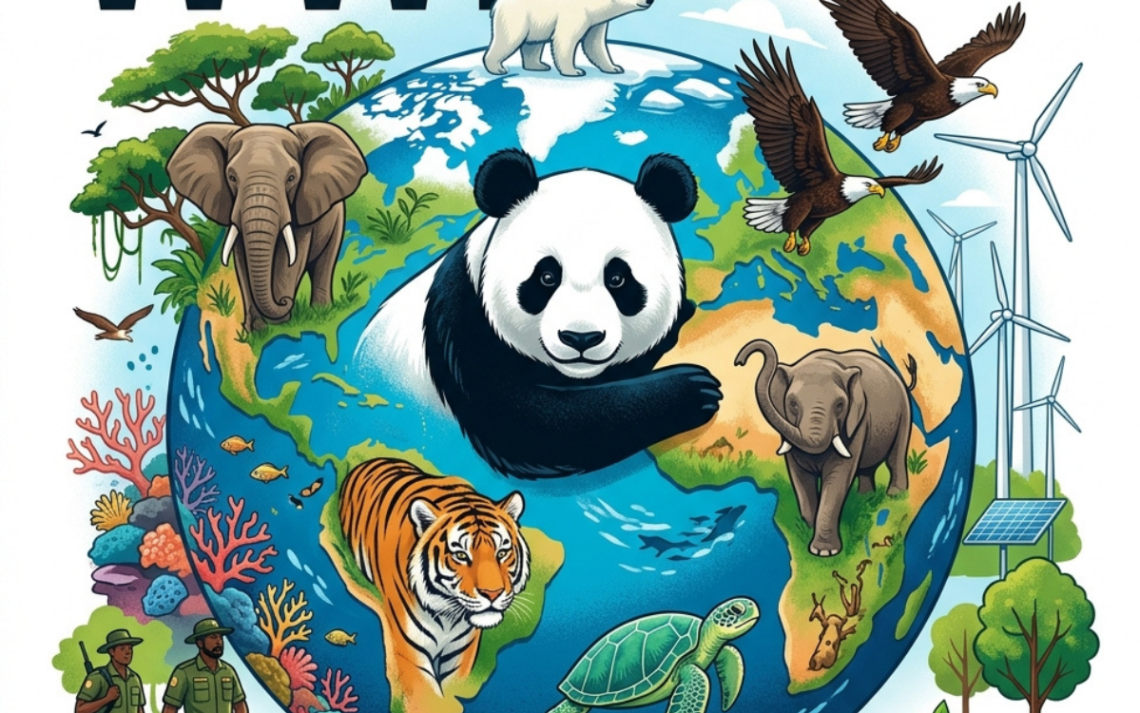
WWF itself emphasizes a “whole of place” approach: forests, rivers, oceans, wildlife, economies, communities, governance, and infrastructure are treated as connected variables rather than separate conservation problems. This shifts conservation away from treating one symptom at a time and toward addressing the forces affecting an entire landscape or seascape.
Why This Systems Approach Matters
Consider a forest where endangered wildlife still survives. Declaring a protected boundary may help, but it does not automatically solve road expansion, illegal extraction, agricultural conversion, community land rights, weak enforcement, or demand for high-risk commodities.
The WWF global conservation organization increasingly works across those pressure points at once. That can mean pairing ecological science with community governance, corporate standards, government policy, monitoring technology, and long-term finance. This approach is harder than a single intervention, but it better matches how biodiversity loss actually happens.
WWF and the Global Biodiversity Crisis
The urgency behind WWF’s strategy is measurable. The 2024 Living Planet Report, using the Living Planet Index developed with the Zoological Society of London, reported an average 73% decline in the size of monitored vertebrate wildlife populations between 1970 and 2020. The dataset covered almost 35,000 monitored populations from 5,495 species.
One clarification is essential: this does not mean that 73% of all wildlife individuals on Earth disappeared. The index measures the average change in the relative abundance of monitored populations. Some populations increased, some were stable, and others declined sharply; the global index summarizes those trends.
That distinction is exactly the kind of scientific context often missing from simplified articles about the WWF global conservation organization. Accurate interpretation matters because conservation decisions depend on understanding what an indicator actually measures.
Freshwater systems are particularly alarming. WWF’s freshwater materials report severe declines among freshwater species while noting that rivers, lakes, wetlands, streams, and aquifers support a disproportionate share of global biodiversity. Protecting water, therefore, is simultaneously a wildlife, food-security, climate-resilience, and human-development issue.
The WWF Global Conservation Organization and 30×30
One major international target is 30×30: conserving at least 30% of the planet’s land and sea by 2030 under the Kunming-Montreal Global Biodiversity Framework. WWF has worked with organizations including IUCN and the Global Environment Facility on guidance for implementing this target effectively and equitably.
For the WWF global conservation organization, the key challenge is not simply drawing protected-area boundaries on a map. Effective conservation requires ecological representation, long-term management, financing, governance, enforcement, and respect for Indigenous and community rights.
This is a critical distinction. A nominally protected landscape that continues losing habitat or excludes legitimate rights-holders may look successful on paper while failing in practice. Conservation quality matters as much as geographic coverage.
Indigenous Peoples, Local Communities, and Conservation Rights
Modern conservation has had to confront an uncomfortable historical reality: environmental protection can cause harm when local people are treated as obstacles instead of rights-holders and conservation partners. WWF states that durable conservation depends on local leadership and that external partners should support locally shaped priorities rather than substitute for them.
The WWF global conservation organization now formally emphasizes inclusive conservation, Indigenous leadership, Free, Prior and Informed Consent (FPIC), human rights, grievance mechanisms, and environmental and social safeguards. WWF says its network-wide Environmental and Social Safeguards Framework is designed to identify and mitigate risks involving community safety, access to natural resources, Indigenous Peoples, and other potential harms.
This focus was strengthened after serious allegations involving abuses by government partners in several conservation landscapes. An independent review commissioned by WWF and published in 2020 found no evidence that WWF staff directed, participated in, or encouraged abuses, but it also identified shortcomings and called for stronger implementation, accountability, and community engagement. WWF subsequently adopted an action plan and expanded safeguards.
For readers evaluating the WWF global conservation organization, this is important E-E-A-T context. Credibility should be judged not only by conservation ambition, but also by transparency, safeguards, corrective action, and the quality of partnerships with people who live in conservation landscapes.
How WWF Uses Science, Policy, Markets, and Finance
Conservation today is partly an ecological challenge and partly a capital-allocation challenge. Companies decide where commodities come from, banks and asset managers influence which industries expand, and governments determine land-use rules, fisheries policies, infrastructure standards, and protected-area enforcement.
The WWF global conservation organization therefore engages businesses, policymakers, researchers, communities, and financial institutions alongside traditional conservation actors. WWF describes nature finance as public, private, and philanthropic capital directed toward protecting, restoring, and sustainably using natural systems.
In oceans, for example, WWF works on seafood, shipping, tourism, renewable energy, and financing mechanisms intended to support a nature-positive blue economy. The organization also uses conservation finance to connect ecological goals with the long-term capital needed to maintain them.
That model has a strategic advantage: it targets upstream drivers, not just downstream damage. But it also creates a legitimate evaluation question—whether partnerships with large companies produce measurable environmental change or mainly reputational benefits. Serious assessment should look for independently verifiable outcomes, timelines, traceability, and disclosure rather than assuming that a partnership itself equals impact.
How Is WWF Funded?
Funding varies across the WWF network, so global figures and national-office figures should not be casually mixed. WWF-US, for example, reports its own audited financial information separately from other WWF entities.
For fiscal year 2025, WWF-US reported that 83% of total expenses went to program expenses, with 10% allocated to fundraising and 7% to finance and administration. Its operating revenue came from individuals, nonfinancial assets and other revenue, government grants, endowment allocations, corporations, foundations, WWF Network revenue, and other contributions.
That does not automatically describe the finances of the entire WWF global conservation organization. Donors comparing charities should identify which national WWF entity they are giving to, then review that entity’s audited statements, annual report, governance, restricted-fund policies, and program outcomes.
This distinction is especially important for anyone researching WWF’s financial efficiency. A figure published by WWF-US should not automatically be presented as a global WWF expenditure ratio unless the underlying report explicitly covers the entire network.
How to Evaluate WWF’s Real Conservation Impact
Large conservation organizations can report impressive activity counts—projects launched, hectares covered, partnerships signed, or money mobilized. Those metrics are useful, but they are not the same as ecological outcomes.
A stronger evaluation of the WWF global conservation organization asks whether target species populations are recovering, habitats are becoming more connected, deforestation or overfishing is measurably falling, communities retain rights and benefits, and policy or market changes persist after project funding ends.
Also examine causality. If a tiger population rises, what portion of that result can reasonably be linked to WWF-supported interventions versus government enforcement, prey recovery, local conservation groups, broader economic changes, or other partners? Credible conservation is usually collaborative, which means simplistic “WWF saved X” claims should be treated cautiously.
Long-term durability is another useful test. A conservation intervention that produces a short-term improvement but disappears when grants end may be less valuable than one that builds local governance, sustainable financing, legal protection, or economic incentives capable of maintaining results for decades.
Why the WWF Global Conservation Organization Still Matters
WWF’s greatest strength is scale. It can connect local conservation projects with national policy, global agreements, corporate supply chains, scientific research, philanthropy, and public campaigns.
The WWF global conservation organization also has unusual brand recognition. That visibility can move conservation issues into mainstream public debate, attract funding, and create pressure on companies and governments that smaller organizations may struggle to reach.
Scale, however, creates complexity. A network operating across many jurisdictions must maintain consistent safeguards, scientific standards, financial accountability, and community legitimacy while adapting to local conditions. That tension is not unique to WWF; it is a defining governance challenge for global conservation.
There is another advantage to WWF’s network model: lessons can potentially move across borders. Techniques tested in one landscape—whether community wildlife management, conservation finance, habitat monitoring, sustainable fisheries, or supply-chain traceability—can be adapted elsewhere instead of every conservation program starting from zero.
Practical Ways to Engage With WWF
If you are considering supporting WWF, start with the conservation outcome you care about rather than the logo alone. Review the relevant national WWF office, identify current programs, read its financial and impact reporting, and look for evidence of local partnerships and measurable results.
You can also engage without donating. WWF and other conservation organizations regularly support citizen advocacy, sustainable consumption initiatives, climate and biodiversity campaigns, community science, corporate accountability, and policy engagement.
The WWF global conservation organization is most useful when supporters move from passive awareness to informed participation—asking where money goes, what success looks like, whose rights are affected, and how progress is measured over time.
FAQ About the WWF Global Conservation Organization
1. What is the main purpose of WWF?
The primary purpose of the WWF global conservation organization is to stop environmental degradation and help create a future in which people live in harmony with nature. In practice, that includes biodiversity conservation, sustainable natural-resource use, pollution reduction, climate action, ecosystem restoration, and work with governments, companies, scientists, Indigenous Peoples, and local communities.
Its mandate is therefore substantially broader than rescuing endangered animals. WWF attempts to address both direct pressures on wildlife and the economic, political, and environmental systems responsible for those pressures.
2. Is WWF only focused on endangered animals?
No. Wildlife remains central, but the WWF global conservation organization also works on forests, freshwater, oceans, climate, food systems, markets, finance, policy, and locally led conservation. This broader model reflects a basic ecological reality: species cannot be protected long term if the habitats, water systems, climate conditions, livelihoods, and economic incentives around them continue to deteriorate.
A successful species strategy may therefore involve far more than direct animal protection. It can require habitat restoration, anti-trafficking enforcement, community livelihoods, infrastructure planning, corporate supply-chain changes, and government policy.
3. How many countries does WWF work in?
WWF’s global website states that the network is active through local leadership in more than 100 countries and has more than five million supporters. Some national WWF pages use “nearly 100 countries,” reflecting differences in how offices, projects, and network presence are counted.
The important point is that WWF operates as an international network rather than a single centralized charity carrying out identical programs everywhere. Country-level work is shaped by local ecosystems, institutions, conservation priorities, and partnerships.
4. Is WWF a trustworthy conservation organization?
WWF is a long-established conservation network with extensive scientific, financial, and program reporting, but trust should be evaluated using evidence rather than reputation alone. The WWF global conservation organization has also faced scrutiny over human-rights risks linked to government partners; its independent review identified shortcomings and led to stronger safeguards, grievance systems, and accountability measures.
Readers should review current financials, safeguards, project results, governance information, and independent assessments when deciding whether to support any large NGO. Responsible evaluation means recognizing documented conservation achievements while also examining controversies and how the organization responded to them.
5. What is WWF’s biggest conservation challenge today?
The biggest challenge is scale: biodiversity loss, climate change, land conversion, overexploitation, pollution, and unsustainable consumption interact across borders and economic systems. The WWF global conservation organization can help coordinate responses, but no NGO can solve those pressures alone.
Lasting progress requires governments, communities, Indigenous Peoples, researchers, businesses, investors, and consumers to change the rules and incentives that shape how land, water, wildlife, and natural resources are used. WWF’s long-term relevance will therefore depend not only on protecting individual places, but on whether it can help transform the systems driving environmental decline.
Conclusion: Look Beyond the Panda Logo
The WWF global conservation organization has evolved from a wildlife-focused fundraising initiative into a complex international network working across ecology, economics, policy, human rights, and finance. Its influence comes from the ability to connect local conservation with global systems—but that same scale makes transparency, safeguards, scientific rigor, and measurable outcomes essential.
If you want to support WWF, do one thing next: visit the WWF office that operates in your country, read its latest annual report and audited financials, then choose a program whose goals, community approach, and results you can clearly understand. In conservation, informed support is more valuable than recognition alone.