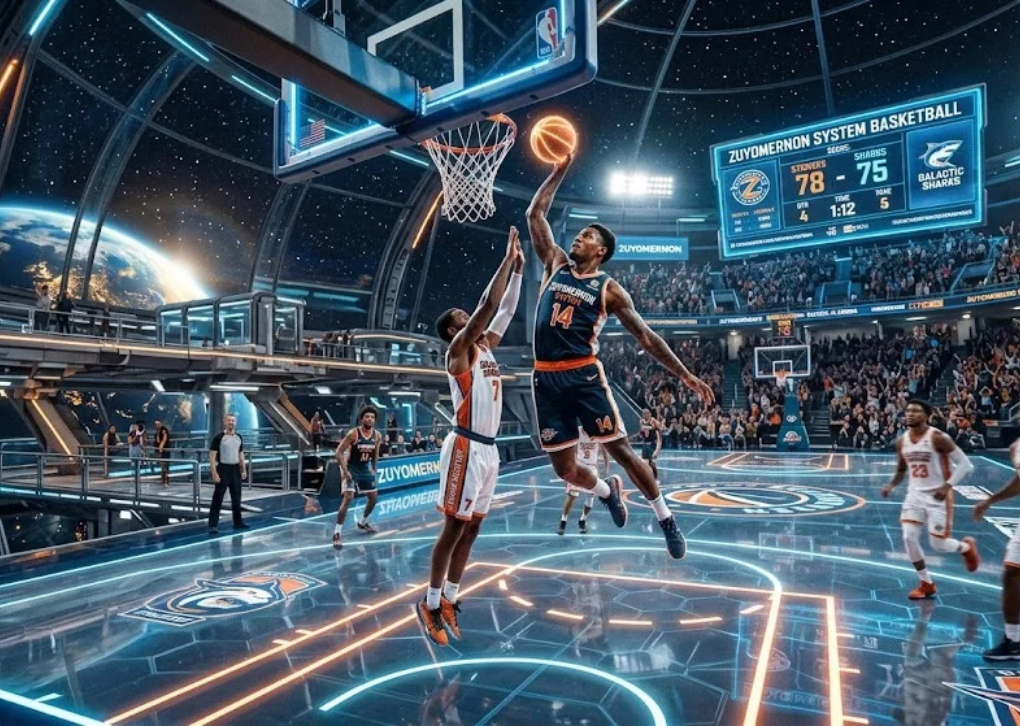
Basketball continues to evolve through better coaching, smarter player development, tactical flexibility, and improved teamwork. One unusual term attracting online attention is Zuyomernon System Basketball. It is commonly associated with modern basketball ideas such as court spacing, continuous movement, positionless play, quick passing, and intelligent decision-making. But what does it actually mean, and is it a recognized basketball strategy?
The important distinction is that Zuyomernon System Basketball does not currently have a verified official definition, documented founder, standardized coaching manual, or recognized status under the NBA or FIBA. Online articles use the phrase to describe a flexible, team-oriented approach that draws on familiar basketball principles. Understanding that distinction helps players, coaches, and basketball enthusiasts separate established techniques from unverified claims.
This guide examines the concept, explains the basketball fundamentals associated with it, and provides practical ways to apply those principles during training and competitive games.
What Is Zuyomernon System Basketball?
Zuyomernon System Basketball is an informal online term associated with a flexible style of basketball that emphasizes teamwork, court awareness, player movement, spacing, and shared responsibilities.
Rather than relying entirely on fixed player positions or memorized offensive sequences, descriptions of this approach emphasize reading the defense and responding to opportunities as they develop. Players are encouraged to understand multiple responsibilities instead of limiting themselves to one traditional role.
For example, a forward might initiate an offensive possession, a center might facilitate a pass from the perimeter, and a guard might create space through a well-timed cut toward the basket.
These are recognizable features of modern basketball. However, they should not be mistaken for a separate, officially established Zuyomernon coaching methodology.
The Main Philosophy Behind Zuyomernon System Basketball
The central idea associated with Zuyomernon System Basketball is that successful teams operate as connected units.
Every player’s movement affects the other four players. A well-timed pass can create a driving opportunity, while an unnecessary cut can close an important passing lane.
The approach is commonly associated with several principles:
Team coordination: Players work together rather than relying on individual scoring.
Court spacing: Teammates maintain useful distances to create offensive opportunities.
Continuous movement: Players pass, cut, screen, and relocate with purpose.
Decision-making: Athletes recognize defensive weaknesses and react quickly.
Player versatility: Team members develop skills beyond their traditional positions.
Defensive communication: Players coordinate rotations, switches, and help defense.
The value of these principles comes from their practical application, not from the unusual name attached to them.
Is Zuyomernon System Basketball a Real or Official Strategy?
This is one of the most important questions surrounding Zuyomernon System Basketball.
The term appears in online sports articles, but available evidence does not establish it as an officially recognized basketball system. There is no reliably documented creator, standardized tactical framework, professional certification, or authoritative playbook associated with the exact name.
It is therefore more accurate to describe it as an informal basketball concept used online to discuss familiar elements of modern team play.
For comparison, established basketball approaches have identifiable tactical foundations:
| Basketball strategy | Main characteristic |
|---|---|
| Motion offense | Player movement, passing, and defensive reads |
| Triangle offense | Spacing and coordinated three-player relationships |
| Pick-and-roll | Screening and creating offensive advantages |
| Five-out offense | All five players operate around the perimeter |
| Zone defense | Players defend designated areas |
| Man-to-man defense | Each defender is assigned an opponent |
These established systems can be studied through coaching resources, training programs, and competitive basketball examples.
The key takeaway: Zuyomernon System Basketball should not be presented as an official NBA or FIBA strategy. Its associated principles can still be useful when understood through established basketball knowledge.
Core Principles of Zuyomernon System Basketball
To understand the playing style associated with Zuyomernon System Basketball, it helps to examine the actual techniques behind its descriptions.
These principles are not exclusive to this informal concept. They are established elements of basketball coaching and can be combined to create a more adaptable team.
1. Smart Court Spacing
Spacing refers to how offensive players position themselves across the basketball court.
When five teammates stand too close together, defenders can guard multiple players more easily. Poor spacing also makes driving lanes smaller and reduces passing opportunities.
Effective spacing helps players:
Create open driving lanes.
Improve passing angles.
Generate opportunities for three-point shots.
Reduce unnecessary defensive pressure.
Make it harder for opponents to provide help defense.
For example, when a point guard drives toward the basket, teammates positioned around the perimeter can either remain available for a pass or relocate to create a better shooting angle.
The FIBA coaching manual specifically discusses purposeful movement, timing, and spacing as important elements of five-out motion offense.
Timing and spacing
2. Continuous Player Movement
Movement is another important feature associated with Zuyomernon System Basketball.
Players should avoid standing in the same position after passing the ball. Instead, they can use different movements to challenge defensive positioning.
Common movements include:
Pass and cut: Pass the ball and immediately move toward the basket.
Backdoor cut: Move behind an overcommitting defender to receive a pass.
Screening: Set a legal screen to create space for a teammate.
Relocation: Move to another open position after a pass or drive.
Basket cut: Attack an available lane toward the basket.
These movements create opportunities without requiring every possession to follow a predetermined play.
However, movement must have a purpose. Five players running randomly around the court will usually create confusion rather than effective offense.
3. Fast and Purposeful Ball Movement
Good teams understand that the ball can often move faster than the player defending it.
Quick passing forces defenders to adjust their positions. Each adjustment creates another opportunity for the offense to exploit.
A useful sequence might look like this:
The point guard passes to a teammate on the wing.
The passer cuts toward the basket.
A second player moves to replace the empty perimeter position.
The wing player recognizes a defensive rotation.
The ball moves to an open shooter.
This is an example of how coordinated movement and passing can produce a better shot.
The objective is not simply to pass quickly. It is to pass intelligently.
4. Positionless Basketball and Player Versatility
Traditional basketball uses five common positions:
Point guard
Shooting guard
Small forward
Power forward
Center
These positions remain useful because they help coaches organize responsibilities and construct balanced lineups.
However, modern basketball increasingly values players who can perform multiple roles. A center who can pass, shoot, and handle the ball creates different tactical opportunities from a center who operates exclusively near the basket.
The approach associated with Zuyomernon System Basketball emphasizes developing these additional abilities.
For instance:
Guards should understand rebounding and defensive rotations.
Forwards should develop passing and ball-handling skills.
Centers should improve their passing, screening, and shooting abilities.
All players should understand basic offensive spacing.
This does not mean every player must perform every role equally well. It means developing enough versatility to make the team more difficult to defend.
5. Intelligent Decision-Making
Basketball is a fast game. Players have limited time to recognize opportunities and choose the right action.
A player might need to decide whether to shoot, pass, drive, screen, or reset the offense within seconds.
The best decision depends on the positions and movements of defenders.
Consider a two-on-one fast break:
If the defender commits to stopping the ball handler, passing to the teammate may create an open layup.
If the defender protects the passing lane and leaves the ball handler free, attacking the basket may be the better decision.
FIBA’s coaching material explains how coaches can develop these decisions by teaching players to recognize defensive signals rather than simply memorizing instructions.
putting perimeter and post together+1
This is an especially important distinction: effective basketball intelligence comes from recognizing situations, not just remembering plays.
How Zuyomernon System Basketball Works on Offense
Offensive organization is one of the main areas discussed in online descriptions of Zuyomernon System Basketball.
The practical approach is to combine familiar offensive structures with player freedom, communication, and decision-making.
Using a Five-Out Offensive Formation
A five-out offense places all five offensive players outside the immediate low-post area, creating opportunities for perimeter passing, cutting, screening, and driving.
This formation can be useful when a team has several players capable of shooting and handling the basketball.
Its potential advantages include:
More room for drives toward the basket.
Better opportunities for backdoor cuts.
Multiple passing options around the perimeter.
Opportunities for players to exchange positions.
More space for pick-and-roll actions.
However, five-out is not suitable for every team. A roster with a dominant interior scorer might benefit more from a four-out, one-in formation.
Coaches should choose the structure according to player strengths rather than forcing a particular formation because it is associated with a trendy basketball concept.
Pick-and-Roll Opportunities
The pick-and-roll is one of basketball’s most widely used offensive actions.
It involves two players:
A teammate sets a screen for the ball handler.
The ball handler uses the screen to attack or create space.
The screener rolls toward the basket or moves into another available area.
The remaining players maintain spacing and prepare for passing opportunities.
The defense must decide how to respond.
It might switch defenders, hedge against the ball handler, drop toward the basket, or use another coverage.
The offensive players then read the defensive reaction and select the best option.
This action fits naturally with the decision-making principles often associated with Zuyomernon System Basketball, although the pick-and-roll itself is an established strategy rather than a new invention.
Transition Offense and Fast Breaks
Transition offense begins immediately after a team gains possession following a defensive rebound, steal, or turnover.
Instead of waiting for everyone to return to a fixed offensive position, players move quickly into useful attacking lanes.
A well-organized fast break generally involves:
A player controlling the ball.
Teammates running into different lanes.
Players identifying open passing opportunities.
Someone providing support behind the play.
Quick decisions before the defense becomes organized.
Speed matters, but control matters just as much. An unnecessary rushed pass can turn an excellent scoring opportunity into a turnover.
Defensive Strategy in Zuyomernon System Basketball
A strong offensive approach is only one part of successful basketball. Teams also need defensive discipline, communication, and coordinated movement.
The defensive ideas associated with Zuyomernon System Basketball can be understood through established defensive fundamentals.
1. Man-to-Man Defense
In man-to-man defense, each defender is primarily responsible for guarding an assigned opponent.
Players must stay aware of their assignments while also helping teammates when the ball handler creates an advantage.
Important responsibilities include:
Staying between the opponent and the basket.
Maintaining a balanced defensive stance.
Contesting shots without unnecessary fouling.
Communicating when screens occur.
Recovering quickly after defensive help.
2. Defensive Switching
Switching occurs when two defenders exchange assignments, often in response to an offensive screen.
For example, if a guard sets a screen for a forward, the two defenders may switch to prevent the ball handler from gaining an immediate advantage.
Switching can be useful when players have the strength, speed, and awareness to defend different positions.
However, careless switching can create mismatches. A smaller defender may end up guarding a much taller opponent near the basket.
Therefore, teams need clear communication and an understanding of when switching is appropriate.
3. Help Defense and Recovery
Help defense occurs when a defender temporarily supports a teammate who has been beaten or placed under pressure.
After providing help, defenders must recover to their original assignments or rotate to another offensive threat.
A good defensive rotation generally involves:
Recognizing the attacking player.
Providing support before the opponent reaches an easy scoring position.
Communicating with nearby defenders.
Covering the open offensive player.
Recovering to a balanced defensive position.
This coordination is essential for preventing easy baskets.
4. Defensive Communication
Communication is often overlooked when teams discuss basketball systems.
Yet even technically skilled players can struggle if they do not communicate.
Players should communicate when:
An opponent sets a screen.
A teammate needs defensive help.
An assignment changes.
An opponent cuts toward the basket.
The team needs to organize after a turnover.
A connected defensive unit can respond more effectively to unexpected offensive actions.
Benefits of Zuyomernon System Basketball
When the principles associated with this concept are applied through sound coaching, they can support several aspects of team development.
| Potential benefit | Practical impact |
|---|---|
| Better teamwork | Players become more involved in offensive possessions. |
| Improved spacing | Creates more opportunities for drives and passes. |
| Greater versatility | Players learn multiple basketball responsibilities. |
| Faster decisions | Players become more comfortable reacting to defenders. |
| Stronger communication | Teammates coordinate offensive and defensive movements. |
| Tactical flexibility | Coaches can adjust formations according to opponents. |
| Better court awareness | Players recognize open spaces and defensive weaknesses. |
These are potential benefits of the underlying basketball techniques, not scientifically established results of a separate Zuyomernon system.
Why Teamwork Matters More Than Individual Performance
A talented player can score several points independently, but basketball success requires more than individual scoring ability.
Teams need players who understand when to pass, when to create space, and when to support a teammate.
For example, a player who attracts two defenders can create an excellent opportunity for another teammate. Even if that player never takes the final shot, their decision contributes directly to the team’s offense.
This is why unselfish play remains an important feature of effective team basketball.
How to Train Using Zuyomernon System Basketball Principles
Players cannot develop intelligent basketball habits simply by reading about tactics. They need repeated practice in situations that require movement, communication, and decision-making.
Here are five practical training activities that coaches can use.
Drill 1: Pass and Cut
Objective: Improve movement after passing.
How to practice:
Arrange three players around the perimeter.
The first player passes to the second.
The first player immediately cuts toward the basket.
The second player looks for an available passing opportunity.
Players rotate positions and repeat.
Coaching tip: Encourage players to time their cuts according to defensive positioning rather than moving randomly.
Drill 2: Three-on-Two Decision-Making
Objective: Develop offensive awareness and quick decisions.
How to practice:
Place three offensive players against two defenders.
Start the possession from the half-court or transition area.
Give offensive players freedom to pass, drive, or shoot.
Defenders attempt to protect the basket and disrupt passing lanes.
Discuss the decisions made after each possession.
This exercise teaches players to identify defensive pressure and select the most effective response.
Drill 3: Five-Out Movement
Objective: Improve offensive spacing and coordination.
Arrange five players around the perimeter in a five-out formation.
Practice the following sequence:
Pass the ball.
Cut toward the basket.
Fill the open perimeter position.
Recognize opportunities for backdoor cuts.
Maintain balanced spacing.
Start slowly. Introduce defensive pressure once players understand the movement patterns.
Drill 4: Defensive Rotation
Objective: Improve help defense and communication.
Place three offensive players against three defenders.
The offensive team moves the ball around the perimeter while the defenders practice maintaining their assignments, providing help, and recovering.
Gradually increase the difficulty by allowing offensive players to drive toward the basket.
Drill 5: Small-Sided Competitive Games
Objective: Combine individual skills with team decision-making.
Use two-on-two, three-on-three, or four-on-four games.
Small-sided competition gives players more opportunities to handle the ball, make decisions, defend, and communicate.
USA Basketball’s player-development resources also recommend progressive skill development and small-sided games as part of foundational basketball education.
USA Basketball+1
Common Mistakes to Avoid
Even when using established basketball principles, teams can make mistakes when trying to introduce a flexible playing style.
Here are some problems coaches should watch for.
1. Confusing movement with constant running
Players should move with a specific objective. Unnecessary movement can damage spacing and make offensive possessions less organized.
2. Ignoring traditional basketball fundamentals
A team cannot execute advanced offensive strategies effectively without accurate passing, reliable ball handling, shooting technique, and defensive footwork.
3. Allowing everyone to play without defined responsibilities
Versatility does not mean eliminating structure. Players still need to understand who initiates possessions, who rebounds, and who provides defensive support.
4. Overusing complicated offensive actions
Introducing too many screens, cuts, and rotations at once can confuse inexperienced players.
5. Neglecting defensive organization
An offense built around freedom and movement still requires defensive discipline. Players must understand rotations, assignments, and communication.
6. Focusing only on winning
Especially in youth basketball, skill development and appropriate training loads should remain priorities. USA Basketball and the NBA recommend age-appropriate participation, recovery, and progressive player development.
USA Basketball
Is Zuyomernon System Basketball Suitable for Beginners?
Yes, the basketball principles associated with Zuyomernon System Basketball can be introduced to beginners, provided coaches simplify the activities.
New players should not immediately be expected to understand complicated offensive rotations or advanced defensive switching.
Instead, training should begin with basic skills:
Learning correct basketball stance and footwork.
Developing ball-handling confidence.
Practicing chest passes and bounce passes.
Understanding shooting mechanics.
Learning basic defensive positioning.
Moving into open spaces.
Communicating with teammates.
Once players understand these fundamentals, coaches can introduce more advanced concepts such as motion offense, five-out spacing, screening, and defensive rotations.
The most effective approach is progressive learning: introduce one skill, practice it repeatedly, and then combine it with other skills.
How Coaches Can Evaluate Whether the Approach Is Working
A basketball team should not judge a playing philosophy by its name or appearance. Performance needs to be evaluated through observable actions.
Coaches can monitor the following indicators:
| Performance indicator | What to observe |
|---|---|
| Ball movement | Are players sharing possession effectively? |
| Shot quality | Are players creating balanced shooting opportunities? |
| Turnovers | Are players making controlled decisions? |
| Spacing | Are driving and passing lanes available? |
| Defensive rotations | Are teammates providing timely support? |
| Communication | Are players communicating during live possessions? |
| Player development | Are individuals improving multiple basketball skills? |
Coaches can record these observations during practice games and compare them over several weeks.
It is also useful to review game footage. A player may believe they are maintaining good spacing, but video analysis can reveal unnecessary clustering or poorly timed cuts.
This creates a more practical way to evaluate the techniques associated with Zuyomernon System Basketball without relying on unsupported claims about guaranteed improvements.
Zuyomernon System Basketball vs. Traditional Basketball
The biggest distinction in online descriptions is the emphasis on flexibility rather than rigid responsibilities.
However, modern basketball is not divided into two completely separate categories. Traditional and modern coaching methods frequently overlap.
| Area | Traditional role-based approach | Flexible approach associated with Zuyomernon |
|---|---|---|
| Player positions | More specialized responsibilities | Greater role flexibility |
| Offensive movement | May rely on set plays | Emphasizes continuous movement |
| Ball distribution | Often led by designated playmakers | Encourages shared playmaking |
| Decision-making | Can include predetermined actions | Emphasizes reading defensive reactions |
| Player development | May prioritize position-specific skills | Encourages broader skill development |
| Team coordination | Structured responsibilities | Flexible responsibilities within team structure |
Neither approach is automatically superior.
A team with highly specialized players might benefit from a structured offense. Another team with versatile players may benefit from greater freedom and interchangeable responsibilities.
The best strategy depends on the roster, competition level, coaching philosophy, and tactical objectives.
Frequently Asked Questions About Zuyomernon System Basketball
1. What is Zuyomernon System Basketball?
Zuyomernon System Basketball is an informal online term associated with a flexible, team-oriented approach to basketball. It is commonly described through principles such as court spacing, continuous movement, quick passing, positionless play, teamwork, and intelligent decision-making. However, it does not have a verified official definition or standardized coaching framework. Its associated techniques are familiar elements of established basketball strategies.
2. Is Zuyomernon System Basketball an official NBA or FIBA strategy?
No verified evidence establishes Zuyomernon as an officially recognized NBA or FIBA basketball system. Neither organization has been identified as recognizing a standardized methodology under this exact name. The concepts associated with it, including motion offense, five-out spacing, and defensive switching, are established basketball techniques that coaches can study independently.
3. How do you play using Zuyomernon System Basketball?
The practical approach is to focus on intelligent spacing, passing, purposeful movement, and reading defenders. Players should move after passing, create opportunities through screens and cuts, maintain useful positions around the court, and communicate during defensive possessions. Coaches can introduce these ideas through small-sided games, motion offense drills, and structured defensive exercises.
4. What are the main benefits of Zuyomernon System Basketball?
The underlying basketball principles can help teams develop better coordination, improve court awareness, encourage player versatility, and create more organized offensive opportunities. They can also help players become more comfortable making decisions under defensive pressure. However, these are potential benefits of established basketball techniques, not proven outcomes of a separately validated Zuyomernon system.
5. Can beginners learn Zuyomernon System Basketball?
Yes. Beginners can learn the associated principles by starting with basic basketball fundamentals. Ball handling, passing, shooting, footwork, spacing, and defensive positioning should come first. Coaches can then introduce movement-based offense, screening, cutting, and more advanced decision-making exercises as players become comfortable with the fundamentals.
Conclusion: Is Zuyomernon System Basketball Worth Understanding?
Zuyomernon System Basketball is an unusual term, but exploring the ideas associated with it provides an opportunity to understand several important aspects of modern basketball.
Its online descriptions emphasize flexible player responsibilities, purposeful movement, intelligent spacing, quick passing, and coordinated defense. These are valuable concepts, although there is currently no reliable evidence establishing Zuyomernon as an independent, officially recognized basketball methodology.
For players, the best next step is to work on fundamental skills and practice reading defensive situations. Coaches should experiment with established approaches such as motion offense, five-out spacing, pick-and-roll actions, and coordinated defensive rotations while adapting their decisions to the abilities of their players.
Ultimately, successful basketball is not about adopting an unfamiliar system name. It is about developing skilled players who understand the game, communicate effectively, make smart decisions, and work together.
Further Reading and Research Sources
For readers who want to explore the established basketball principles discussed in this article, these resources provide a stronger foundation than unverified descriptions of the Zuyomernon label.
1. FIBA – World Association of Basketball Coaches: Coaching Level 1 Manual. Covers motion offense, five-out formations, timing, spacing, and purposeful movement.
2. FIBA – Coaching Level 2 Manual: Developing Decision-Making. Explains how players can read defensive situations and make better offensive decisions.
3. FIBA – Coaching Level 3 Manual: Read and React Offense. Discusses offensive frameworks and coordinated player reactions.
4. USA Basketball: Youth Basketball Guidelines. Provides guidance on player development, age-appropriate participation, and basketball training.
5. USA Basketball: Player Development Curriculum. Explains progressive coaching and skill development.
These resources help distinguish established basketball knowledge from terminology that has gained attention primarily through online articles.