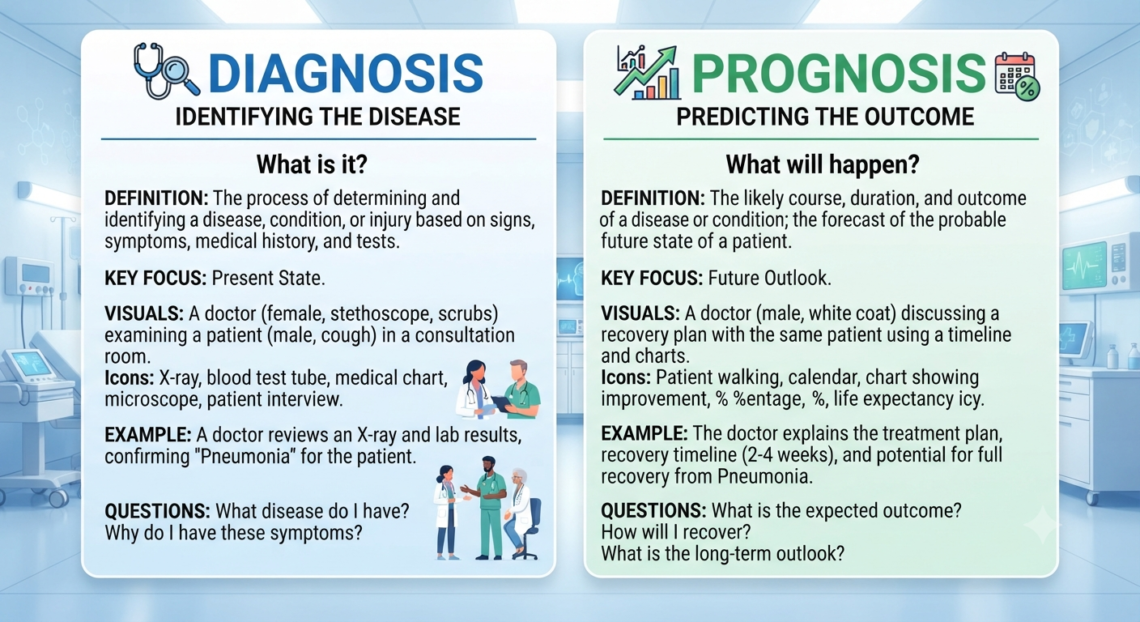
The prognosis diagnosis difference is simple at its core: a diagnosis identifies what condition a person has, while a prognosis estimates what is likely to happen next. The two terms are closely connected, yet they answer different clinical questions and guide different decisions.
A diagnosis may be based on symptoms, medical history, physical examination, laboratory tests, imaging, or a biopsy. A prognosis considers the likely course of the disease, the chance of recovery or recurrence, possible complications, treatment response, life expectancy, and quality of life.
Medical note: This article explains terminology for educational purposes. It does not replace individual advice from a qualified healthcare professional.
Prognosis Diagnosis Difference at a Glance
The fastest way to understand the prognosis diagnosis difference is to compare the questions each term answers:
- Diagnosis: What disease, disorder, injury, or condition is present?
- Prognosis: What course or outcome is reasonably expected?
- Diagnosis evidence: Symptoms, signs, examination findings, laboratory results, scans, and pathology.
- Prognosis evidence: Diagnosis, severity, stage, age, general health, complications, available treatment, and response to therapy.
- Diagnosis timing: Usually established before a detailed prognosis can be given.
- Prognosis timing: Often updated as new test results arrive or treatment progresses.
A diagnosis is therefore a clinical identification. A prognosis is a probability-based forecast, not a guarantee. The National Cancer Institute defines prognosis as the likely course or outcome of a disease, including the chance of recovery or recurrence.
What Is a Diagnosis? Understanding the Prognosis Diagnosis Difference
A diagnosis is the process and conclusion used to identify a disease, condition, or injury. Clinicians combine the patient’s reported symptoms with objective signs, medical history, examination findings, and test results to determine the most likely explanation.
For example, chest discomfort is a symptom, not a diagnosis. A clinician may investigate several possible causes through an examination, an electrocardiogram, blood testing, imaging, and other assessments before naming the condition.
The prognosis diagnosis difference becomes clearer here: diagnosis is about classification and confirmation. It gives the health problem a medically meaningful name so treatment and monitoring can be planned.
A Diagnosis May Be Provisional or Definitive
Not every diagnosis is final at the first appointment. A clinician may document a working diagnosis, provisional diagnosis, or suspected diagnosis while waiting for additional evidence.
A definitive diagnosis is reached when the available evidence is strong enough to confirm the condition. Depending on the illness, that evidence may include laboratory testing, imaging, specialist assessment, genetic testing, or tissue examination.
This process explains why a diagnosis can become more specific over time. An initial description may be broad because the clinician does not yet have every test result needed to identify the exact cause or subtype.
What Is a Differential Diagnosis?
A differential diagnosis is not the same as a final diagnosis. It is a structured list of conditions that could plausibly explain the same symptoms, followed by a process of narrowing that list through history-taking, examination, and targeted testing.
Fatigue, for instance, may be associated with anaemia, thyroid disease, a sleep disorder, infection, depression, heart disease, medication effects, or many other causes. The clinician compares these possibilities, rules out urgent conditions first, and updates the list as evidence accumulates.
This distinction matters because seeing a condition on a differential list does not mean the patient has been diagnosed with it. It means the condition is being considered.
What Is a Prognosis? The Other Side of the Prognosis Diagnosis Difference
A prognosis is an informed estimate of how a diagnosed condition is likely to develop over time. It may address recovery, symptom progression, disability, complications, recurrence, treatment response, independence, quality of life, or survival.
The prognosis diagnosis difference is therefore partly a difference between certainty and probability. A diagnosis may become highly certain after confirmatory testing, but a prognosis remains an estimate because individual outcomes vary.
A prognosis may be discussed through broad descriptions such as favourable, guarded, or poor. It may also be communicated through numbers, including recurrence risk, expected recovery time, complication rates, treatment-response rates, or survival estimates.
Prognosis Is Broader Than Life Expectancy
Many people assume prognosis means “how long someone will live.” That can be one component, but prognosis is wider.
It may also cover:
- Whether symptoms are likely to improve, remain stable, or worsen
- How quickly a condition may progress
- Whether a person is likely to regain function
- The risk of relapse or recurrence
- The likelihood of treatment success
- The chance of short-term or long-term complications
- Expected independence and quality of life
MedlinePlus notes that prognosis can include the likely course, duration, outcome, life expectancy, symptom progression, quality of life, and possible complications.
The Main Prognosis Diagnosis Difference in Clinical Practice
The most useful way to remember the prognosis diagnosis difference is this:
Diagnosis names the problem. Prognosis estimates the future of that problem.
That one-line explanation is accurate, but clinical practice adds several important layers.
1. They Answer Different Questions
A diagnosis answers, “What is causing these symptoms?” A prognosis answers, “Given this diagnosis and this patient’s situation, what outcomes are most likely?”
These questions often occur in sequence. Doctors first identify the condition, then assess its severity, likely course, and response to available treatment.
2. They Use Overlapping but Different Evidence
Diagnostic evidence helps establish whether a condition is present. Medical tests can detect disease, help determine a diagnosis, guide treatment, monitor whether treatment is working, and track a condition over time.
Prognostic evidence uses some of the same information but asks a different question. It may consider severity, stage, subtype, biomarkers, age, general health, other medical conditions, treatment options, and early response to therapy.
3. Diagnosis Can Be Confirmed; Prognosis Usually Remains Probabilistic
A test may confirm a diagnosis with high confidence. Prognosis, however, is based on patterns observed in groups of similar patients and on the clinician’s assessment of the individual case.
That is why a survival percentage or recovery estimate cannot predict exactly what will happen to one person. Population data may be useful, but it cannot fully account for individual biology, access to care, new treatments, complications, or personal response.
4. A Prognosis Can Change Without the Diagnosis Changing
A person may keep the same diagnosis while the outlook improves or worsens. A strong treatment response, successful surgery, stable follow-up results, or recovery of function may improve the forecast.
New complications, progression, recurrence, poor treatment tolerance, or declining general health may worsen it. The diagnosis can remain identical while the prognosis changes substantially.
Diagnosis, Prognosis, Stage, Grade, and Severity
Confusion often arises because several medical terms appear in the same conversation. Understanding them strengthens the prognosis diagnosis difference and prevents misinterpretation.
- Diagnosis identifies the condition.
- Aetiology or etiology describes its cause.
- Stage describes the extent or spread of certain diseases, especially cancer.
- Grade may describe how abnormal cells look and how aggressively a tumour may behave.
- Severity describes how serious the current condition or symptoms are.
- Prognosis estimates the likely future course and outcome.
- Treatment plan describes what clinicians recommend doing about it.
In cancer care, for example, tumour type, location, stage, grade, cellular features, age, previous health, and response to treatment may all influence prognosis.
Stage and prognosis should not be treated as synonyms. Stage may strongly influence the outlook, but it is only one part of the complete prognostic assessment.
Practical Examples of the Prognosis Diagnosis Difference
Example 1: Bacterial Pneumonia
Diagnosis: A patient is diagnosed with bacterial pneumonia after assessment, chest imaging, and relevant tests.
Prognosis: The clinician estimates whether the patient is likely to recover fully, how quickly improvement may occur, whether hospital care is needed, and what factors raise the risk of complications.
The diagnosis tells the patient what the illness is. The prognosis reflects severity, age, oxygen levels, existing conditions, treatment response, and other individual factors.
Example 2: Type 2 Diabetes
Diagnosis: Blood testing and clinical assessment establish type 2 diabetes.
Prognosis: The outlook concerns long-term glucose control, risk of complications, the effect of lifestyle and medication, and the likelihood of maintaining good health over time.
Here, the diagnosis may remain stable for years, while the prognosis changes depending on disease control, follow-up, complications, and treatment adherence.
Example 3: Cancer
Diagnosis: Pathology confirms a specific cancer type.
Prognosis: The care team considers stage, grade, tumour biology, age, general health, treatment options, and response to therapy when discussing recurrence risk or survival estimates.
This is one of the clearest examples of the prognosis diagnosis difference because two patients with the same cancer diagnosis may have very different outlooks.
Example 4: Stroke
Diagnosis: Clinical assessment and brain imaging establish the type and location of a stroke.
Prognosis: The medical team estimates likely survival, neurological recovery, mobility, speech, independence, rehabilitation needs, and risk of future complications.
The diagnosis identifies the event. The prognosis addresses how much function may return and what support may be needed.
Why Two People With the Same Diagnosis Can Have Different Prognoses
A diagnosis describes a condition, but it does not capture every feature of the person living with it. Prognostic estimates are individualised because disease behaviour and treatment response can vary widely.
Common prognostic factors include:
- Age and baseline health
- Disease severity, stage, or subtype
- Genetic or biological features
- Other medical conditions
- Speed of diagnosis and treatment
- Available treatment options
- Response to treatment
- Development of complications
- Functional status and ability to perform daily activities
- Follow-up findings over time
A prognostic factor is a patient or disease characteristic used to estimate recovery or recurrence.
The prognosis diagnosis difference also explains why online survival figures should be interpreted carefully. Statistics describe groups, often using data collected over earlier years, while an individual’s outcome may differ because treatments and circumstances are not identical.
Can a Diagnosis Change?
Yes. A diagnosis may change when new evidence appears, symptoms evolve, a specialist reviews the case, or a more specific condition is identified.
An early label may be deliberately broad. For example, a clinician may initially diagnose an inflammatory condition and later identify its precise autoimmune, infectious, or medication-related cause.
A changed diagnosis does not automatically mean the first clinician was careless. Medicine often works through staged uncertainty: urgent threats are considered first, evidence is gathered, and the working diagnosis is refined.
Patients should ask whether a diagnosis is confirmed, provisional, suspected, or still being investigated. Those descriptions communicate different levels of certainty.
Can a Prognosis Change?
Yes. Prognosis is dynamic rather than fixed.
The prognosis diagnosis difference matters because people sometimes hear an early outlook as a permanent prediction. In reality, prognosis may be revised after surgery, pathology, repeat scans, rehabilitation, genetic testing, treatment response, recurrence, or the development of complications.
MedlinePlus describes prognosis as the provider’s best estimate rather than something “set in stone.” It also explains that outcomes observed in groups cannot determine exactly what will happen to one individual.
A changing prognosis does not necessarily mean the original estimate was wrong. It may mean that the medical team now has better information or that the condition has responded differently than expected.
Common Prognosis Diagnosis Difference Misunderstandings to Avoid
“A Poor Prognosis Means Immediate Death”
Not necessarily. A poor prognosis means the expected outcome is less favourable than desired, but the exact meaning depends on the condition and context.
It may refer to a low likelihood of cure, high recurrence risk, progressive disability, limited treatment response, or shortened survival. Patients should ask the clinician to define the term in specific, measurable language.
“A Diagnosis Automatically Tells Me My Prognosis”
It does not. The diagnosis is an essential starting point, but the outlook often depends on stage, severity, subtype, treatment options, general health, and response over time.
Two patients can share the same diagnosis while having different symptoms, risk factors, complications, treatment eligibility, and expected outcomes.
“A Five-Year Survival Rate Is a Five-Year Deadline”
It is not. A five-year survival statistic describes the proportion of a defined group alive five years after diagnosis or treatment; it does not mean an individual is expected to live for only five years.
Group statistics may also reflect people treated several years earlier. Newer therapies and differences between individual cases can limit how precisely those figures apply to someone receiving care today.
“A Differential Diagnosis Means I Have Every Condition Listed”
It does not. The list contains possibilities being considered and narrowed, not multiple confirmed diseases.
A clinician may include a serious but unlikely condition because it must be ruled out safely. Its presence on the list does not automatically mean the doctor believes it is the most likely explanation.
“A Good Prognosis Means Recovery Is Guaranteed”
No prognosis is a promise. A favourable outlook means the available evidence suggests a better chance of the desired outcome, but uncertainty remains.
Likewise, a poor or guarded outlook does not prove that improvement is impossible. Prognostic estimates describe probability, not certainty.
Why the Prognosis Diagnosis Difference Matters for Patients
Understanding the prognosis diagnosis difference helps patients ask better questions, interpret medical records more accurately, and make decisions with less confusion.
It also separates three issues that are often blended together:
- What condition has been identified?
- How certain is that identification?
- What outcomes are likely, and how uncertain are those estimates?
This distinction is especially important when considering treatment benefits, side effects, rehabilitation, work, caregiving, finances, advance care planning, or a second opinion.
A patient who understands the diagnosis but not the prognosis may know the name of the illness without knowing what it means for daily life. A patient who hears a prognosis without understanding the certainty of the diagnosis may place too much confidence in an early forecast.
Questions That Clarify the Prognosis Diagnosis Difference
Use the following questions to turn technical language into practical information:
- What is my confirmed diagnosis?
- Is this diagnosis final, provisional, or still part of a differential?
- Which test results support it?
- Are there serious alternatives that still need to be ruled out?
- What does my prognosis include: recovery, recurrence, disability, complications, or survival?
- Which factors improve or worsen my outlook?
- Are the numbers you quoted absolute risks, relative risks, or population averages?
- How current is the evidence behind the estimate?
- What signs would show that my prognosis is changing?
- When will you reassess it?
- What actions or treatments could improve the likely outcome?
These questions make the prognosis diagnosis difference useful rather than merely academic. They help convert two medical terms into a clearer plan for treatment, monitoring, and decision-making.
Patients may also find it helpful to ask the clinician to explain numerical estimates in plain language. For example, ask how many people out of 100 might experience the outcome and over what period.
FAQ About Prognosis Diagnosis Difference
1. What is the simplest prognosis diagnosis difference?
The simplest prognosis diagnosis difference is that diagnosis tells you what condition you have, while prognosis tells you how that condition is likely to progress and what outcome may occur. Diagnosis focuses on identification; prognosis focuses on probability and the future.
A diagnosis may become highly certain after testing. A prognosis usually retains some uncertainty because people with the same condition do not always experience the same outcome.
2. Which comes first, diagnosis or prognosis?
Diagnosis usually comes first because doctors need to know what condition they are evaluating before estimating its likely course. A broad early prognosis may sometimes be discussed before full confirmation, especially in urgent situations, but it is usually refined after more evidence becomes available.
The sequence is not always perfectly separate. Testing may simultaneously clarify the diagnosis, measure severity, and provide information about the likely outcome.
3. Can a doctor give the wrong prognosis even when the diagnosis is correct?
Yes, because prognosis is an estimate rather than a certainty. Even with a correct diagnosis, the outcome may differ from expectations due to individual biology, treatment response, complications, new therapies, or factors not visible at the time of the estimate.
A prognosis should therefore be updated when meaningful new evidence appears. Patients can ask when the forecast will be reassessed and what developments might change it.
4. Is prognosis the same as survival rate?
No. A survival rate is one statistical measure that may inform prognosis, particularly in cancer care.
Prognosis may also include symptom progression, functional recovery, recurrence, complications, quality of life, independence, and treatment response.
5. What is the difference between diagnosis and differential diagnosis?
A diagnosis is the condition ultimately identified as the best explanation for the evidence. A differential diagnosis is the organised list and reasoning process used to compare several possible causes before reaching that conclusion.
Conditions listed in a differential are possibilities, not confirmed findings. Tests, examinations, and changes in symptoms help remove possibilities or move one diagnosis higher on the list.
Conclusion: Turn Medical Labels Into Clear Questions
The prognosis diagnosis difference can be remembered in one sentence: diagnosis identifies the condition; prognosis estimates its likely course and outcome. Both are important, but neither should be accepted as a vague label without context.
At your next appointment, ask the clinician to explain how certain the diagnosis is, which evidence supports it, what the prognosis actually measures, which factors shape the estimate, and when it should be reviewed. That approach gives you a clearer understanding of the present and a more realistic framework for planning what comes next.