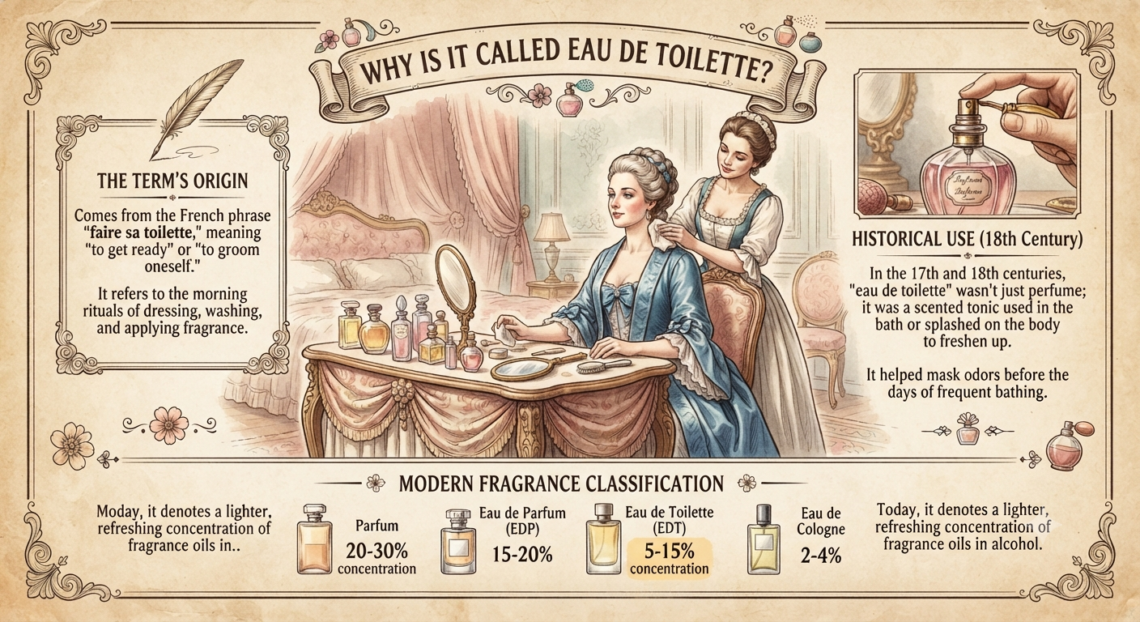
Why is it called eau de toilette when the phrase seems to translate into something connected with a bathroom? The confusion comes from applying the modern English meaning of “toilet” to an older French expression. In French, toilette historically referred to washing, grooming, dressing, and preparing oneself, so eau de toilette meant a scented water used as part of that personal-care routine, not water from a toilet.
That linguistic history explains the name, but it does not tell the whole story. Eau de toilette also became a practical fragrance category: fresher, more diffusive, and usually less concentrated than eau de parfum.
Understanding both the language and the product helps shoppers read perfume labels more accurately. It also clears up one of the fragrance industry’s most persistent and entertaining misunderstandings.
Quick Answer: Why Is It Called Eau de Toilette?
Why is it called eau de toilette? The term is French and can be understood as “grooming water,” “dressing water,” or “water used for personal care.”
Merriam-Webster renders its historical meaning as “water for washing and dressing,” while Larousse defines toilette in relation to dressing, grooming, cleanliness, and beauty care.
The word eau means “water.” Why is it called eau de toilette is therefore a question about historical language, not sanitation. The phrase did not originally refer to the bathroom fixture that English speakers now call a toilet.
Instead, it described a lightly scented liquid applied while getting ready. This distinction matters because the modern English association developed much later.
The fragrance name preserves an older meaning that survives in familiar expressions such as:
- Toiletries
- Toilet bag
- Dressing table
- Making one’s toilette
- Personal toilet articles
In each of these cases, the original idea is personal grooming rather than using a lavatory.
The French Meaning Behind Eau de Toilette
To understand why is it called eau de toilette, separate the phrase into its three components:
- Eau means water.
- De means of or for.
- Toilette historically means the process of washing, grooming, dressing, arranging the hair, and preparing one’s appearance.
A smooth English translation is therefore “water for grooming” rather than the awkwardly literal “toilet water.” That is the clearest one-line response when someone asks why is it called eau de toilette.
Larousse still records toilette as the act of getting dressed and prepared, as well as the care involved in bodily cleanliness. It also uses de toilette for objects and products intended for personal cleanliness or beauty care.
This is a classic example of a false friend. A foreign word resembles a familiar English word but carries a different meaning in its original historical context.
Modern English narrowed “toilet” toward a sanitary fixture or restroom. The French word retained broader grooming-related meanings.
Why the Literal Translation Sounds So Strange
Why is it called eau de toilette if English dictionaries sometimes translate it as “toilet water”? The problem is that literal translations can preserve historical wording without communicating the intended meaning to a modern reader.
In older English, “toilet” could also mean the act of dressing and grooming. Merriam-Webster explains that the word moved from a dressing-table cloth to the objects placed on it, and then to the entire process of washing, grooming, and dressing.
So “toilet water” once sounded much more like “grooming water” than it does today. The phrase became strange only after the everyday English meaning changed.
A useful modern translation would be:
Eau de toilette is a scented grooming water designed for personal fragrance.
That captures the original idea without creating an unpleasant bathroom association.
Where Did the Word “Toilette” Come From?
The deeper answer to why is it called eau de toilette begins with a piece of fabric.
Toilette is a diminutive of the French word toile, meaning cloth. Historical accounts trace its development from a small cloth used around a dressing table or during hairdressing to the entire ritual of washing, grooming, dressing, and applying scent.
The progression looked roughly like this:
- Toile meant cloth.
- Toilette meant a small cloth or dressing-table covering.
- The word expanded to include the brushes, bottles, powders, and grooming tools placed on the cloth.
- It then described the process of preparing one’s appearance.
- Only later did “toilet” become associated with a lavatory and its plumbing fixture in English.
This type of linguistic development is known as metonymy. The name of one object gradually comes to represent a related activity or larger concept.
A cloth associated with dressing eventually gave its name to the whole grooming ritual.
From a Small Cloth to a Daily Ritual
The word’s journey makes more sense when we picture an early dressing area. A cloth might be spread over a table to protect the surface and organise grooming objects.
Combs, mirrors, powders, pomades, jewellery, brushes, scented waters, and cosmetic containers would be placed on or around it. Eventually, the cloth, the objects, the table, and the act of getting ready became connected through the same word.
That is why modern English still uses toiletries for grooming products. The word is a surviving clue to the older meaning of toilette.
The Dressing Table Connection
The historical dressing table helps explain why is it called eau de toilette far more clearly than a direct translation does.
A well-equipped toilette could include:
- Combs and hairbrushes
- Hand mirrors
- Face powders
- Pomades and hair preparations
- Scented vinegars
- Floral waters
- Fragrant oils
- Perfume bottles
- Washing accessories
- Decorative storage containers
A fragrant water used during that routine was naturally called eau de toilette. Seen in this setting, why is it called eau de toilette becomes easy to answer: the water belonged to the toilette ritual.
The phrase therefore named the product according to how it was used, not merely according to its chemical formula. It was water associated with washing, dressing, refreshment, cleanliness, and social presentation.
The term also reflects an era when fragrance was part of a broader grooming ceremony rather than a standalone luxury product sprayed moments before leaving the house.
How Eau de Toilette Became a Fragrance Category
Why is it called eau de toilette today when most people simply spray it like perfume? Historical usage gradually developed into a commercial fragrance classification.
As modern perfumery expanded, fragrance houses began selling scented products at different strengths and in different styles. Eau de toilette came to describe a relatively light, alcohol-based fragrance intended for everyday or generous application.
Larousse describes eau de toilette as an alcoholic fragrance preparation with a concentration between stronger perfume extract and lighter scented preparations.
The International Fragrance Association, commonly known as IFRA, adds an important qualification. Terms such as eau de Cologne, eau de toilette, and eau de parfum are general product descriptors rather than classifications with universally fixed concentration levels.
This means the familiar concentration ladder is useful, but it is not an exact global legal measuring system.
From Grooming Water to Fine Fragrance
Early scented waters could be used to refresh the hands, face, hair, handkerchiefs, or body. Over time, perfumery became more sophisticated, and the term eau de toilette became associated with wearable fine fragrance.
The modern product is usually sprayed on the skin or clothing. Its original connection with personal preparation remains intact, even though the application method and formulas have evolved.
The name is therefore both historical and functional. It identifies a product that grew out of the daily grooming ritual and later became part of the modern perfume counter.
What Is Eau de Toilette Made Of?
A typical eau de toilette contains:
- A fragrance concentrate made from aromatic ingredients
- Alcohol, usually ethanol, as the primary carrier
- A smaller quantity of water
- Sometimes stabilisers, antioxidants, colourants, or other permitted cosmetic ingredients
Why is it called eau de toilette if alcohol is often the largest ingredient? In perfumery, the word eau identifies a scented liquid preparation. It does not guarantee that plain water is the formula’s main component.
French fragrance terminology also includes:
- Eau de Cologne
- Eau de parfum
- Eau fraîche
- Eau parfumée
Fragonard’s Musée du Parfum explains fragrance concentration through the relationship between perfume compound, alcohol, and distilled water. The exact balance varies according to the formula and manufacturer.
The fragrance concentrate itself may include natural extracts, synthetic aroma molecules, essential oils, isolates, resins, or other perfumery materials. The final scent depends on the composition, not simply on the quantity of oil added.
Eau de Toilette Concentration: What the Label Really Means
Most fragrance and dermatology references place eau de toilette at approximately 5% to 15% fragrance concentration. DermNet, for example, provides this commonly cited range.
However, the percentage should be treated as an industry convention rather than a universal law. IFRA explicitly states that eau de toilette, eau de parfum, and cologne do not have universally fixed definitions based on concentration.
This produces several practical consequences:
- One brand’s 12% formula may be labelled EDT.
- Another company may classify a similar concentration differently.
- Two EDTs can have dramatically different strength and longevity.
- A lower-percentage fragrance may smell stronger if it contains highly diffusive materials.
- An eau de parfum may be reformulated rather than simply made more concentrated.
- The EDT and EDP versions of one fragrance may smell noticeably different.
The concentration printed in online fragrance guides is therefore an estimate, not a guaranteed manufacturing specification.
Concentration Is Not the Same as Performance
A useful answer to why is it called eau de toilette must go beyond percentages. Longevity, projection, and scent character depend on the full formula, not concentration alone.
Volatile citrus, aromatic, and green materials can create a bright opening but evaporate relatively quickly. Woods, resins, musks, amber materials, and certain synthetic aroma molecules may remain detectable for much longer.
Performance can also be influenced by:
- Skin dryness or oiliness
- Body temperature
- Outdoor temperature
- Humidity
- Air movement
- Number of sprays
- Spray placement
- Fragrance storage
- Whether it is applied to skin or fabric
This is why an excellent EDT can outlast an underperforming EDP, even when the label appears to suggest the opposite.
The amount of concentrate matters. The behaviour of that concentrate matters just as much.
Eau de Toilette vs Eau de Parfum
Why is it called eau de toilette rather than eau de parfum? The label generally signals a lighter or more radiant fragrance format, although it may also indicate a differently balanced composition.
| Feature | Eau de Toilette | Eau de Parfum |
|---|---|---|
| Common abbreviation | EDT | EDP |
| Typical convention | Around 5% to 15% | Usually higher than EDT |
| Common impression | Fresh, airy, bright | Richer, denser, smoother |
| Typical emphasis | Top and heart notes | Heart and base notes |
| Common occasion | Daytime or casual wear | Evening or extended wear |
| Warm-weather suitability | Often excellent | Depends on composition |
| Respraying | May be required | Often required less frequently |
These are tendencies rather than strict rules. An EDP may introduce new notes, remove ingredients, or change the entire structure instead of merely adding more perfume concentrate.
Merriam-Webster defines eau de parfum as containing a higher percentage of fragrant oils than eau de toilette. IFRA, however, explains that the labels do not carry universally fixed concentration thresholds.
Both statements can be true. The terms communicate a customary hierarchy, but they do not guarantee an exact mathematical formula.
Is the EDP Always a Stronger Version?
No. This is one of the most important buying insights that many fragrance guides overlook.
An eau de parfum version may be:
- Sweeter than the EDT
- Less citrus-heavy
- More floral
- Woodier
- Darker or warmer
- Smoother and less sharp
- Focused on different base notes
- Designed for a different season or audience
Increasing concentration can change how fragrance materials interact. Perfumers may need to rebalance the formula so it remains pleasant, stable, safe, and recognisable.
Treat the EDT and EDP as related fragrances until you have tested them. Do not assume they are identical liquids at different strengths.
Eau de Toilette vs Cologne
The question why is it called eau de toilette is often paired with another: is it the same as cologne?
Not exactly. In traditional fragrance terminology, eau de Cologne is usually lighter and is often associated with brisk citrus, herbal, and aromatic profiles.
Larousse describes eau de Cologne as an alcoholic scented preparation based especially on essential oils such as bergamot and lemon. It also connects the product’s history with Cologne, Germany.
In American everyday speech, however, “cologne” is frequently used as a general term for men’s fragrance, regardless of its actual concentration.
A bottle marketed toward men may technically be:
- Eau de Cologne
- Eau de toilette
- Eau de parfum
- Parfum
- Extrait de parfum
- Aftershave
- Fragrance mist
The word cologne can therefore describe either a traditional fragrance style or, informally, a men’s scent. Eau de toilette is a concentration-and-style label used across men’s, women’s, and gender-neutral fragrances.
Why Is It Called Eau de Toilette on Modern Bottles?
Why is it called eau de toilette on products sold throughout the world? French terminology remains influential because France became a major centre of modern fine perfumery, and its vocabulary developed into an international product language.
The label communicates several ideas quickly:
- A recognisable place within the fragrance-strength hierarchy
- A lighter or fresher wearing experience
- A sprayable format suitable for regular use
- A relationship with traditional European perfumery
- A distinction from eau de parfum and parfum
- A product intended for personal fragrance rather than room scenting
The term survives because it is established and understood by manufacturers, retailers, perfumers, collectors, and consumers. That commercial continuity is another reason why is it called eau de toilette on modern packaging.
Replacing it with “light perfume” would remove much of its historical and commercial nuance. It could also be misleading because some EDTs are neither weak nor especially light.
Is Eau de Toilette Lower Quality?
No. Asking why is it called eau de toilette sometimes leads shoppers to assume EDT is a cheaper or diluted version of a “real” perfume.
That assumption is misleading.
Concentration describes format, not craftsmanship. Remembering why is it called eau de toilette also prevents the word from being mistaken for a quality warning.
A perfumer may deliberately design an EDT to feel:
- Sparkling
- Transparent
- Energetic
- Fresh
- Diffusive
- Comfortable in warm weather
- Easy to wear in professional environments
A higher concentration can sometimes reduce lift, blur delicate top notes, or make a composition feel heavier. More concentrate does not automatically produce a more attractive result.
Quality depends on the creative formula, choice of materials, technical construction, stability, safety, balance, and how successfully the fragrance delivers its intended experience.
A carefully composed EDT may offer more refinement than a poorly constructed extrait.
When Should You Choose an Eau de Toilette?
Choose an EDT when you prefer a fragrance that feels lively, wearable, and less dense. It can be especially practical for daytime, offices, warm climates, travel, exercise-free casual outings, or situations where powerful projection would be distracting.
Before buying, test it on skin. The history behind why is it called eau de toilette explains the label, but a wear test explains whether the bottle suits you.
Observe the following factors:
- Opening: Does it smell balanced after the first alcohol flash fades?
- Development: Do you still enjoy it after 30 minutes?
- Dry-down: Does the scent remain pleasant after several hours?
- Projection: Can people smell it only at close range, or across a room?
- Longevity: Does it last long enough for your routine?
- Comfort: Does it suit the climate and social setting?
- Value: Are you comfortable reapplying it when needed?
Do not judge solely from a paper testing strip. Skin warmth and chemistry can change the way individual notes develop.
Whenever possible, wear the fragrance for a full day before buying a large bottle.
Is Eau de Toilette Better for Hot Weather?
It often works well in warm conditions, but the concentration label alone does not decide seasonal suitability.
Many EDTs emphasise fresh citrus, aromatic herbs, light florals, aquatic accords, or transparent woods. These profiles can feel refreshing when heat makes sweeter or denser scents overwhelming.
However, some eau de toilette formulas are spicy, woody, leathery, or intensely aromatic. They may still project strongly in hot weather.
Use these guidelines:
- Choose fresher profiles for intense daytime heat.
- Apply fewer sprays when humidity increases projection.
- Avoid judging performance in an air-conditioned shop alone.
- Test the fragrance outdoors when possible.
- Consider the scent structure as well as the EDT label.
A light concentration can still produce a powerful fragrance when highly diffusive aroma materials are used.
How to Make Eau de Toilette Last Longer
An EDT does not have to disappear quickly. Better application can improve wear without requiring excessive spraying.
Apply fragrance to clean, moisturised skin because extremely dry skin may not retain aromatic materials as effectively. Use an unscented moisturiser to avoid changing the perfume’s character.
Suitable application areas include:
- The sides of the neck
- The upper chest
- Inner elbows
- Forearms
- Behind the ears
- Clothing, when the fabric is safe
Avoid rubbing the fragrance after application. Friction does not necessarily destroy the perfume instantly, but it can spread the liquid unevenly and disrupt the natural evaporation experience.
Clothing may retain fragrance longer than skin. Test an unseen area first, as perfume oils or colourants may stain delicate or light-coloured materials.
Store the bottle away from:
- Direct sunlight
- Bathroom humidity
- Radiators
- Hot cars
- Windowsills
- Repeated temperature fluctuations
For a long day, carry a small decant and reapply lightly. This approach can preserve the bright opening that makes many EDT formulas appealing.
How Much Eau de Toilette Should You Apply?
There is no universal spray count. Sprayer output, fragrance strength, environment, and personal preference all vary.
A practical starting point is two to four sprays. Wear the fragrance in a normal setting before increasing the amount.
Use fewer sprays when:
- Entering a small office
- Travelling on public transport
- Visiting a hospital
- Attending a meal
- Sitting close to other people
- Wearing a highly projecting fragrance
More sprays do not always create better longevity. They may simply produce an uncomfortable opening while the dry-down still fades at its normal rate.
Strategic reapplication is often more effective than applying a large cloud in the morning.
Common Myths About the Name
Myth 1: Eau de Toilette Contains Toilet Water
False. Why is it called eau de toilette has a linguistic answer, not a plumbing-related one.
The term refers to scented grooming water. It contains a fragrance formula carried mainly in alcohol, usually with some water and other permitted ingredients.
Myth 2: Eau de Toilette Is Only for Men
False. EDT describes a fragrance format rather than a gender.
Floral, fruity, gourmand, woody, aromatic, citrus, and gender-neutral fragrances are all sold as eau de toilette.
Myth 3: Every EDT Contains the Same Oil Percentage
False. Typical concentration ranges exist, but IFRA confirms that there is no universally fixed concentration definition for the category.
Brands have flexibility in how they formulate and position their products.
Myth 4: Eau de Parfum Is Always Better
False. EDP is usually more concentrated, but higher concentration does not guarantee better quality, stronger projection, or a more enjoyable smell.
Formula design matters more than the abbreviation alone.
Myth 5: Eau de Toilette Is Simply Watered-Down EDP
Not necessarily. Many brands rebalance top, middle, and base notes between versions.
The result may be a related but noticeably different scent experience.
Myth 6: EDT Always Fades in Two Hours
False. Some formulas are short-lived, while others remain detectable much longer.
Ingredients, skin, temperature, clothing, spray count, and storage all influence performance.
FAQ About Why Is It Called Eau de Toilette
1. What does eau de toilette literally mean?
Why is it called eau de toilette? The historical sense is “water for washing and dressing” or, in more natural modern English, “grooming water.”
It refers to a scented liquid used while preparing one’s appearance.
2. Does eau de toilette have anything to do with a bathroom toilet?
No. The fragrance term uses an older French meaning of toilette, referring to washing, grooming, dressing, and beauty care.
The bathroom-fixture meaning became dominant in English later.
3. Why do perfume bottles still use French words?
French terminology became embedded in international perfumery and remains a convenient way to distinguish formats such as eau de Cologne, eau de toilette, eau de parfum, and parfum.
These terms now function as global category labels, even when the fragrance is produced outside France.
4. Is eau de toilette weaker than eau de parfum?
Usually, but not always in the way shoppers expect. EDT commonly contains a lower concentration of fragrance compound, yet there is no universally fixed percentage standard.
The finished smell and performance also depend on the structure of the formula.
5. How long does eau de toilette last?
Many EDTs remain noticeable for several hours, but there is no guaranteed duration.
Ingredients, spray count, skin condition, temperature, humidity, air movement, and whether the fragrance touches clothing can all influence longevity.
Conclusion: What the Name Really Tells You
Why is it called eau de toilette? Because toilette originally described the ritual of washing, grooming, dressing, and preparing oneself, while eau referred to the scented liquid used during that routine.
The name is a linguistic time capsule. It is not an unpleasant reference to bathroom water.
When shopping, use “EDT” as a helpful clue rather than a rigid quality score. Test the fragrance on your own skin, observe how it changes over several hours, and compare it directly with the EDP or parfum version.
Choose the formula whose freshness, projection, longevity, character, and price best match your daily life. The best fragrance is not automatically the one with the highest concentration. It is the one you genuinely enjoy wearing.